Why Did Switzerland’s Population Growth Slow Down in 2025?
Svájc népességnövekedése 2025-ben azért lassult, mert a nettó migrációs egyenleg 82 800-ról 70 400 főre csökkent. A lakosság ennek ellenére tovább nőtt: a növekedés 92%-át a migráció, 8%-át a természetes szaporulat adta. A belföldi költözések száma 511 200 volt, és 26 kantonból 17-ben már több idős ember élt, mint fiatal.
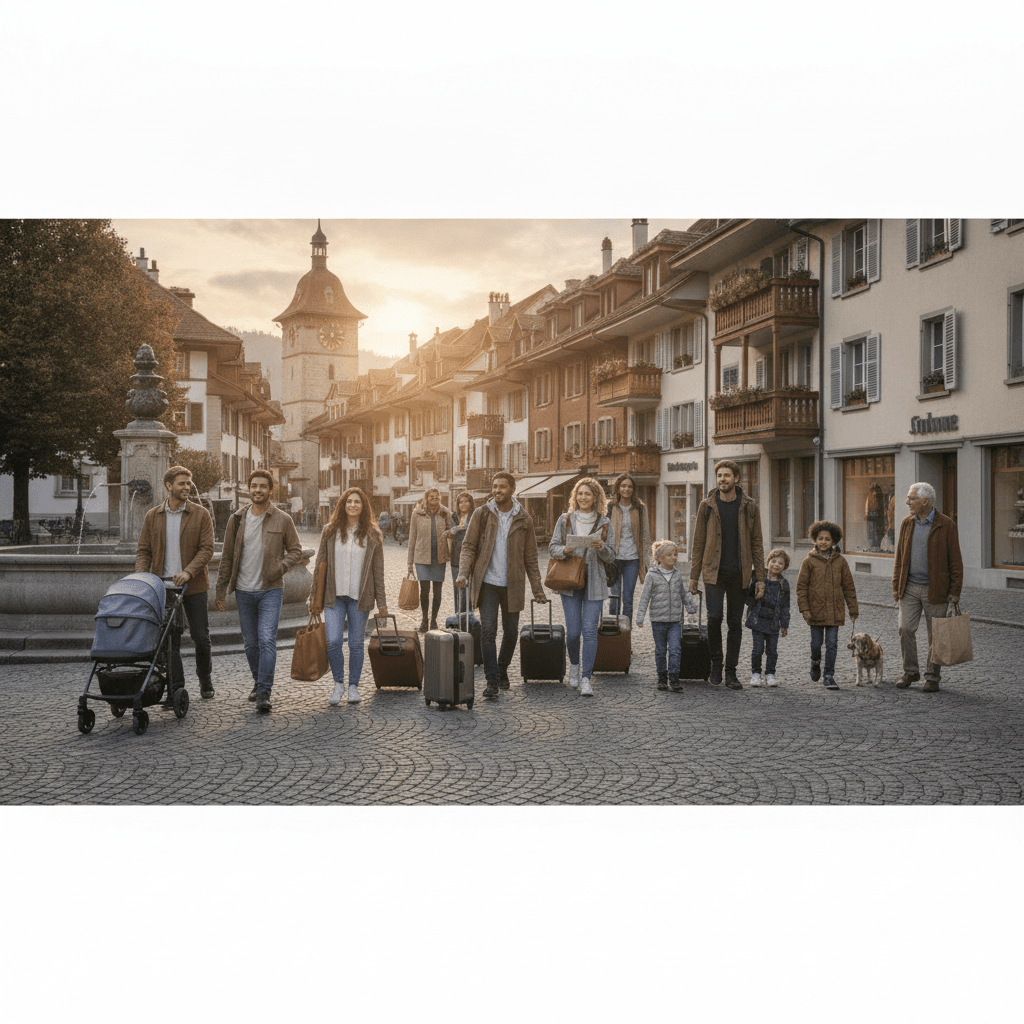
What do the 2025 population figures show at a glance?
According to the 2025 figures, population growth (population growth) in Switzerland continued to be driven primarily by migration, although its scale decreased. Net migration was 70 400 people, compared with 82 800 in the previous period.
According to the population statistics published by the Swiss Federal Statistical Office (BFS) and media reports covering the topic, this represents a 14.9% decrease. The slowdown does not mean that the population is shrinking: the population continued to grow, just to a lesser extent than before.
The composition of this growth is particularly important. In 2025, population growth was as follows:
Source of growth | Share in 2025 |
|---|---|
Migration | 92% |
Natural increase | 8% |
Natural increase means the difference between births and deaths. The 92% migration share shows that Switzerland’s population trends are closely linked to immigration (immigration) and emigration (emigration).
This is important from a Hungarian perspective because Hungarians working or planning to settle in Switzerland are also part of this broader labour-market and housing environment. However, headline population figures alone do not indicate what employment and housing-search conditions can be expected in a particular profession, municipality or canton.
What does a net migration balance of 70 400 people mean?
A net migration balance of 70 400 people means that in 2025, 70 400 more people arrived in Switzerland than left the country. This is a net figure: the immigration and emigration combined result, rather than the volume of the two movements separately.
The Wanderungssaldo fell from 82 800 to 70 400 people. This represents a decrease of 12 400 people, or 14.9%.
The migration balance cannot automatically be interpreted as meaning that only immigration declined or only emigration increased. The indicator reflects the net result of population movements in both directions. Hungarian readers should therefore distinguish between concepts that are often conflated in public discourse.
*Immigration (Einwanderung):* Movement of persons arriving in Switzerland.
*Emigration (Auswanderung):* Movement of persons leaving Switzerland.
*Migration balance (Wanderungssaldo):* the difference between immigration and emigration.
*Population growth (Bevölkerungswachstum):* the combined effect of migration and natural population growth.
Hungarian citizens in Switzerland as EU/EFTA citizens fall under the rules governing the free movement of persons. When making an individual decision to move, however, the decisive factors are not Switzerland’s overall net migration figures, but the specific employment contract, place of residence, household size and available housing options.
How has the role of immigration in population growth evolved?
In 2025, migration accounted for 92% of Switzerland’s population growth, while natural population growth accounted for 8%. This means that, at national level, population trends were shaped primarily by cross-border movements.
The role of migration does not mean that every person arriving in Switzerland settles there permanently. Population statistics may reflect a range of circumstances: employment, living with family, studies, temporary residence abroad or moving on to another destination later.
For Hungarian families, the practical takeaway from these statistics is that Switzerland’s population continues to change significantly as a result of international mobility. This context does not replace an individual relocation plan.
When making a family decision, it is particularly advisable to consider:
The distance between the workplace and place of residence, as in Switzerland, the choice of canton and municipality also determines the costs and organisation of everyday life.
The household’s legal and administrative situation, particularly if one family member is not an EU/EFTA citizen.
The handling of matters in Hungary, such as healthcare coverage, family assets or the administrative aspects of returning home later .
The long-term housing plan, because population and relocation data provide national averages and do not describe the specific supply available in a particular municipality.
What do 511,200 domestic moves indicate?
In Switzerland, 511,200 domestic moves (Binnenwanderung) were recorded in 2025. This corresponds to 56 moves per 1,000 inhabitants and indicates declining domestic mobility compared with the past decade.
Domestic migration is not international immigration: it shows changes of residence within the country. This may include moves between cantons, but also a change of address within the same municipality, depending on how the move is recorded in the register.
The 511,200 recorded moves do not necessarily represent 511,200 different people. The indicator records moving events.
Declining mobility is also relevant background information for Hungarians already living in Switzerland. Anyone moving to another canton, for example because of a job change, must consider not only the conditions of the new job but also finding accommodation, local administration and family logistics together.
However, the domestic-move indicator cannot be used to draw reliable conclusions about the housing market in a single city, area or canton. National data does not replace an examination of the current housing supply and rental conditions in the municipality concerned.
What does demographic ageing mean for Hungarians living in Switzerland?
Demographic ageing (demografische Alterung) manifests itself differently from canton to canton in Switzerland. In 2025, 17 of the 26 cantons already had more older people than young people.
This figure indicates that the age structure is shifting towards older age groups in many cantons. The situation is not the same in every canton, so it is not advisable to draw conclusions about a particular place of residence based on the national average.
For Hungarians living in Switzerland, the issue of ageing may be relevant in several life situations:
As an employee: when planning your career over the long term, it is worth monitoring changes in the labour market.
As a family: raising children, supporting elderly relatives and travelling between the two countries can together require significant organisational effort.
As an older person moving abroad:when choosing where to live, personal connections, the linguistic environment and access to local services may carry particular weight.
As someone considering returning to Hungary:putting your life situation in Hungary and Switzerland, as well as family ties, on a sound long-term footing is not merely a financial matter.
An ageing population does not describe individual destinies; it reflects the structure of society. When a Hungarian family makes its own decision, the specific circumstances relating to work, housing, language and family therefore remain decisive.
What cantonal differences should be taken into account?
Differences between cantons also matter when interpreting Swiss population trends. The ageing indicator, for example, is not uniform nationwide: in 17 of the 26 cantons, there are more older people than young people.
For this reason, a relocation plan connected to the canton of Schaffhausen, Uri, Glarus, Ticino, Bern, Jura or Neuchâtel cannot be assessed solely on the basis of national population data. When choosing a place to live, the local language, commuting options, employment contract and the household’s needs all matter.
The BFS population data and the STATPOP statistical system can provide a useful starting point for understanding nationwide trends. However, for an individual housing or employment decision, the specific circumstances of the chosen canton and municipality should always be reviewed separately.
Sources
Related Articles
In Brief
Switzerland’s population continued to grow in 2025, but net migration fell from 82,800 to 70,400, a decline of 14.9%. Migration accounted for 92% of the growth and natural increase for 8%, while the number of domestic relocations decreased to 511,200.
Key Takeaways
- Interpret the slowdown in Swiss population growth primarily as a 14.9% decline in the net migration balance, not as a population decrease.
- The net migration balance of 70,400 is a net figure: it does not, by itself, show whether immigration declined or emigration increased.
- When deciding to relocate, check the circumstances of the specific canton, municipality, employment contract and housing options in addition to national population data.
- In the case of domestic relocation, interpret the figure of 511,200 as relocation events, not as the same number of different people.
- For long-term planning, consider that in 17 of the 26 cantons, more older people lived there than young people.
- Before relocating as a family, organise the household’s legal and administrative situation, matters in Hungary and long-term housing plans.
Frequently Asked Questions
Why did Switzerland’s population growth slow down in 2025?
The main reason is that the net migration balance fell from 82,800 to 70,400. This represents a decline of 12,400 people, or 14.9%, while Switzerland’s population continued to grow.
Did Switzerland’s population decrease in 2025?
No. The rate of population growth slowed, but the population continued to increase. Migration accounted for 92% of the growth and natural increase for 8%.
What does a net migration balance of 70,400 mean?
It means that in 2025, 70,400 more people arrived in Switzerland than left the country. This is a net indicator, so it does not, by itself, show how immigration and emigration developed separately.
How significant was migration in Switzerland’s population growth?
In 2025, migration accounted for 92% of population growth, while natural increase represented 8%. This shows that, nationally, population trends were primarily influenced by cross-border relocations.
What does 511,200 domestic relocations mean?
In 2025, 511,200 domestic relocations were recorded in Switzerland, equivalent to 56 relocations per 1,000 residents. This refers to relocation events, not necessarily 511,200 different people, and is not the same as international immigration.
What does it mean that 17 of Switzerland’s 26 cantons had more older people than young people?
This refers to cantonal differences in demographic ageing: in many cantons, the age structure has shifted towards older age groups. The situation in a particular canton or municipality cannot automatically be inferred from this figure, so relocation plans should also take local data into account.
What should a Hungarian family consider before moving to Switzerland?
Instead of focusing on Switzerland’s overall migration balance, examine the specific employment contract, place of residence, household size and housing options. The household’s legal and administrative situation should also be organised, along with healthcare, financial and potential future return-related matters in Hungary.
Related articles
Importing and exporting pets in Switzerland: different requirements for travel and sale
The requirements for private travel with a dog, cat or ferret differ from those for transporting an animal when ownership changes.
How does Switzerland protect drinking water sources and groundwater resources?
Swiss groundwater protection applies increasingly strict rules as one approaches water extraction sites. Below, we review how the system is structured and what this means for the population.

Switzerland May Decide to Tighten Its Neutrality: What Should You Know?
The neutrality initiative would prohibit economic sanctions against states engaged in armed conflict. We summarize what is at stake and what it could mean for Hungarians living in Switzerland.