Working and Naturalisation in Switzerland: What Should You Check?
Svájcban a rendes honosítás feltételeit szövetségi, kantonális és önkormányzati szabályok együtt határozzák meg. A magyar állampolgárok általában B, majd C engedéllyel élnek, amelyek teljes időtartama rendszerint beszámítható, míg az L engedélyes idő nem. A helyi lakóhelyi idő, a nyelvtudás, az integráció és az eljárási díj kantononként, illetve községenként eltérhet, ezért a kérelmezés előtt az illetékes hatóság aktuális követelményeit kell ellenőrizni.

Which official sources does this summary rely on?
This summary is based on official information from the Swiss State Secretariat for Migration (SEM), SEM guidelines relating to the Federal Act on Foreign Nationals and Integration (Ausländer- und Integrationsgesetz, AIG), and a federal naturalisation study (BASS study).
This article provides general information. In each case, the specific procedure depends on the current rules of the canton and municipality concerned.
An important starting point is that, under Swiss law, a Hungarian citizen is regarded as an EU citizen on the basis of the Agreement on the Free Movement of Persons. This affects the rights associated with permits and changing cantons.
Under what conditions can ordinary naturalisation be applied for in Switzerland?
Ordinary naturalisation (Ordentliche Einbürgerung) is subject not only to federal requirements but also to cantonal and municipal requirements. Applicants must demonstrate an appropriate residence history, integration, and language skills.
The levels of naturalisation build on one another: the Confederation sets the framework, while the canton and the municipality of residence add their own requirements. As a result, the same person may face different prospects and conditions in different cantons.
Which periods of residence count towards the naturalisation period?
Not every period spent in Switzerland counts equally towards the naturalisation period. The type of permit determines whether and to what extent a given period can be counted.
Permit / status | Counted towards the naturalisation period |
|---|---|
B permit (Aufenthaltsbewilligung, Ausweis B) | Entire period |
C permit (Niederlassungsbewilligung, Ausweis C) | Entire period |
EDA legitimation card | Entire period |
Entire period | |
F permit (temporarily admitted persons) | Half counts |
N permit (asylum seekers) | Does not count |
L permit (short-term residence) | Does not count |
Hungarian citizens typically live in Switzerland first with a B permit and later with a C permit, so the time they spend here can generally be counted in full. Time spent with an L permit (short-term residence), however, does not count, so it is advisable to track the permit types carefully when planning naturalisation.
Who is eligible for facilitated naturalisation?
Facilitated naturalisation (Erleichterte Einbürgerung) applies to specific life situations, such as certain family relationships. Not everyone who has lived in the country for a long time is eligible for it.
Second-generation foreigners are not eligible for facilitated naturalisation. In other words, being born or raised in Switzerland as the child of foreign parents does not, in itself, open up the possibility of the facilitated procedure.
This is also important for Hungarian families: the naturalisation of a child raised in Switzerland generally takes place under the ordinary procedure, in accordance with cantonal requirements.
How can cantonal and municipal naturalisation rules differ?
Cantons and municipalities may impose additional requirements beyond the federal requirements. The differences can be significant, so the same application may proceed differently from one canton to another.
Cantons and municipalities can typically regulate the following matters within their own remit:
Local residence period: 2–5 years of residence locally, depending on the canton and municipality.
Language requirements: a specified level of proficiency in the local language (German, French or Italian).
Procedural fees: the amount of the fee payable for the naturalisation procedure.
This is why planning naturalisation requires more than knowing the federal requirements. The current rules of the canton and municipality of residence must also be checked separately, potentially even before choosing where to live.
How has the procedure for social assistance and extending a B permit changed?
As of 1 April 2025, decision-making authority has been fully returned to the cantonal migration authorities. The extension of the B permit is therefore decided by the competent cantonal migration authority.
Receiving social assistance (Sozialhilfebezug) may also affect the status of the permit. Under the rules in force since 1 September 2023, the threshold differs for B and C permits.
For a B permit it is sufficient for the person to be dependent on social assistance (auf Sozialhilfe angewiesen) for the extension of the permit to become uncertain.
For a C permit withdrawal requires the person to have received substantial social assistance on a sustained basis (dauerhaft und in erheblichem Mass auf Sozialhilfe angewiesen).
There is an important exception for pensioners. If someone no longer receives social assistance because they receive an AHV pension and supplementary benefits (Ergänzungsleistungen) due to early retirement, their residence permit cannot be withdrawn for this reason.
When does non-extension of a B permit differ from withdrawal of a C permit?
The thresholds for the two situations are not the same. The threshold for non-extension of a B permit (Nichtverlängerung der Bewilligung) is lower than that for withdrawal of a C permit (Widerruf der Bewilligung).
In practice, this means that people with a B permit are in a more vulnerable position: a less serious problem may be sufficient to refuse an extension than would be required to withdraw the more stable C permit. This is why it is particularly important to continuously maintain the residence requirements while holding a B permit.
What cantonal differences apply to work permits?
There is no uniform “Swiss” work permit. SEM sets the framework rules, but the cantons are responsible for assessing and issuing permits.
When changing cantons, the rule depends on citizenship:
EU/EFTA citizens – including Hungarian citizens – may move freely and take up work in another canton.
Third-country nationals require a separate cantonal permit to change cantons.
This distinction may be important for a mixed Hungarian–third-country family: the Hungarian citizen may move freely between cantons, whereas the mobility of the spouse from a third country may be subject to cantonal authorisation.
How does the downgrading and suspension of a C permit work?
A C settlement permit is not necessarily permanent. In certain cases, it may be downgraded to a lower-level B residence permit.
Downgrading may occur, among other cases, in the following circumstances:
committing a serious criminal offence – including abroad;
endangering public security;
making a false statement during the application process;
the family’s long-term dependence on social assistance.
The possibility of temporarily suspending a C permit applies exclusively to C permit holders – it cannot be applied to holders of a B permit. This also shows that the legal status of the two permit types differs.
Why is it important to check the relevant canton and individual circumstances?
In Switzerland, the federal framework is only the starting point. The actual requirements are determined by the canton and municipality concerned, as well as by the individual circumstances (permit type, length of residence, family situation and income).
Therefore, the same rule may produce different outcomes in two different cantons or in two different personal circumstances. The only reliable way to obtain accurate information is to check the current requirements of the cantonal migration authority and municipality responsible for your place of residence.
This article provides general information and does not replace official or personalised legal advice. In individual cases, the position of the competent Swiss authority is always decisive.
Sources
Related Articles
In Brief
The requirements for Swiss naturalisation are determined not only by federal rules but also by the regulations of the canton and municipality of residence. As a Hungarian citizen, it is particularly important to check the type of permit, which periods of residence count, language skills, integration and the required period of local residence; a B permit is more sensitive to reliance on social assistance than a C permit.
Key Takeaways
- Based on your citizenship and permit type, check which periods of residence in Switzerland count towards naturalisation.
- Before planning naturalisation, examine the local residence, language and fee requirements of the canton and municipality you have selected.
- If you hold a B permit, pay particular attention to maintaining the residence requirements, as reliance on social assistance may also jeopardise its renewal.
- Before moving to another canton, check the rules applicable to your citizenship: EU/EFTA citizens, including Hungarians, may move freely and take up employment in another canton.
- If you hold a C permit, be aware that serious offences, false statements or long-term, substantial reliance on social assistance may lead to downgrading.
- For specific cases, request information from the cantonal migration authority and municipality of your place of residence, as general rules do not replace an individual assessment.
Frequently Asked Questions
What are the requirements for ordinary naturalisation in Switzerland?
For ordinary naturalisation, you must demonstrate an appropriate residence history, integration and language skills. In addition to the federal requirements, the canton and municipality of residence may impose further conditions, such as a required period of local residence and procedural fees.
Does all time spent in Switzerland count towards naturalisation?
Not all permit types count in the same way. Time spent with a B or C permit, as well as certain other statuses, may count in full; half of the time spent with an F permit counts, whereas time spent with an N or L permit does not count.
May a Hungarian citizen move freely to another Swiss canton?
Yes. A Hungarian citizen is an EU citizen and may therefore move freely and take up employment in another canton under the rules applicable to EU/EFTA citizens. By contrast, a third-country national family member may need a separate cantonal permit to change cantons.
Is a foreign child born or raised in Switzerland entitled to facilitated naturalisation?
Being born or raised in Switzerland does not in itself establish eligibility for facilitated naturalisation. According to the article, second-generation foreign nationals are not automatically entitled to this procedure; their naturalisation generally takes place through the ordinary procedure.
How does social assistance affect the renewal of a B permit?
For a B permit, reliance on social assistance may already call its renewal into question. From 1 April 2025, the decision is made by the competent cantonal migration authority.
How does the legal protection of a B permit differ from that of a C permit?
The threshold for non-renewal of a B permit is lower than the threshold for revoking a C permit. For a C permit, revocation requires long-term and substantial reliance on social assistance; in certain cases, the C permit may instead be downgraded to a B permit.
Where can the current naturalisation requirements be checked?
The current requirements should be checked with the cantonal migration authority and municipality of your place of residence. In a specific case, the position of the competent Swiss authority is decisive, as local and individual circumstances may affect the conditions of the procedure.
Related articles

Council of States Rejects Initiative to Reduce the Naturalisation Period
The Council of States rejected the Democracy Initiative, which would have allowed ordinary naturalisation after a shorter period of residence in Switzerland.
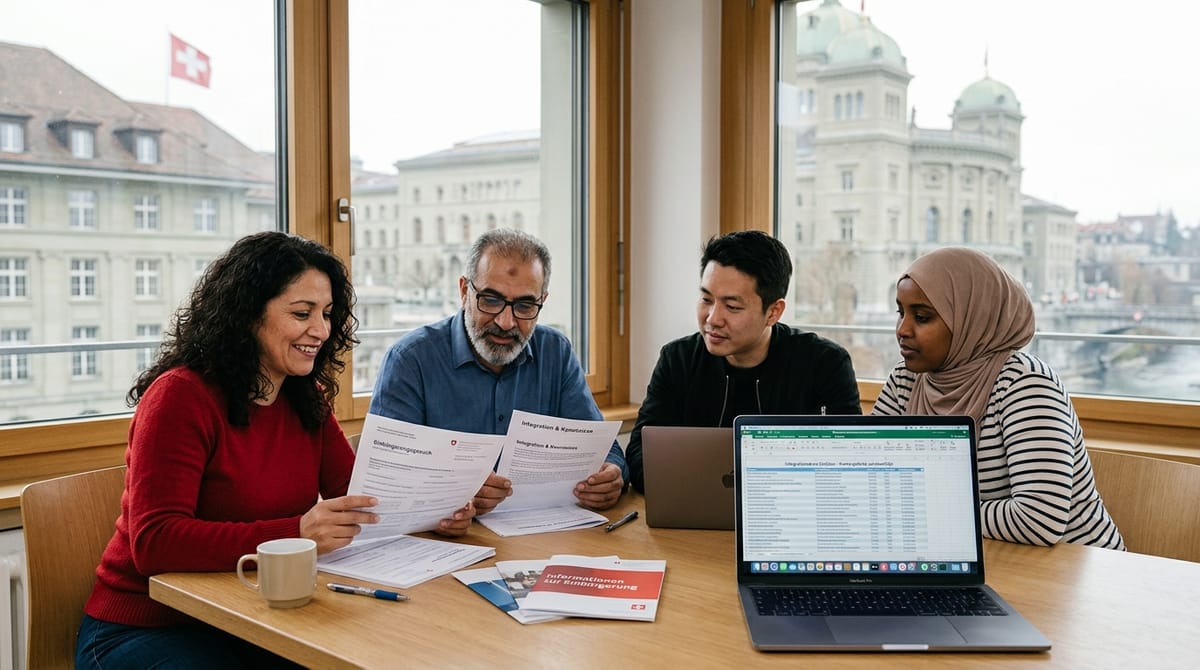
Citizenship in Switzerland: Is an Integration Course Required?
At federal level, completing an integration course is not mandatory for naturalisation in Switzerland. However, integration requirements must be met, and local differences may apply.

What does Switzerland’s 2025 migration foreign policy report show?
The 2025 Swiss migration foreign policy report indicates a sharp decline in irregular migration, but several important details remain unknown.