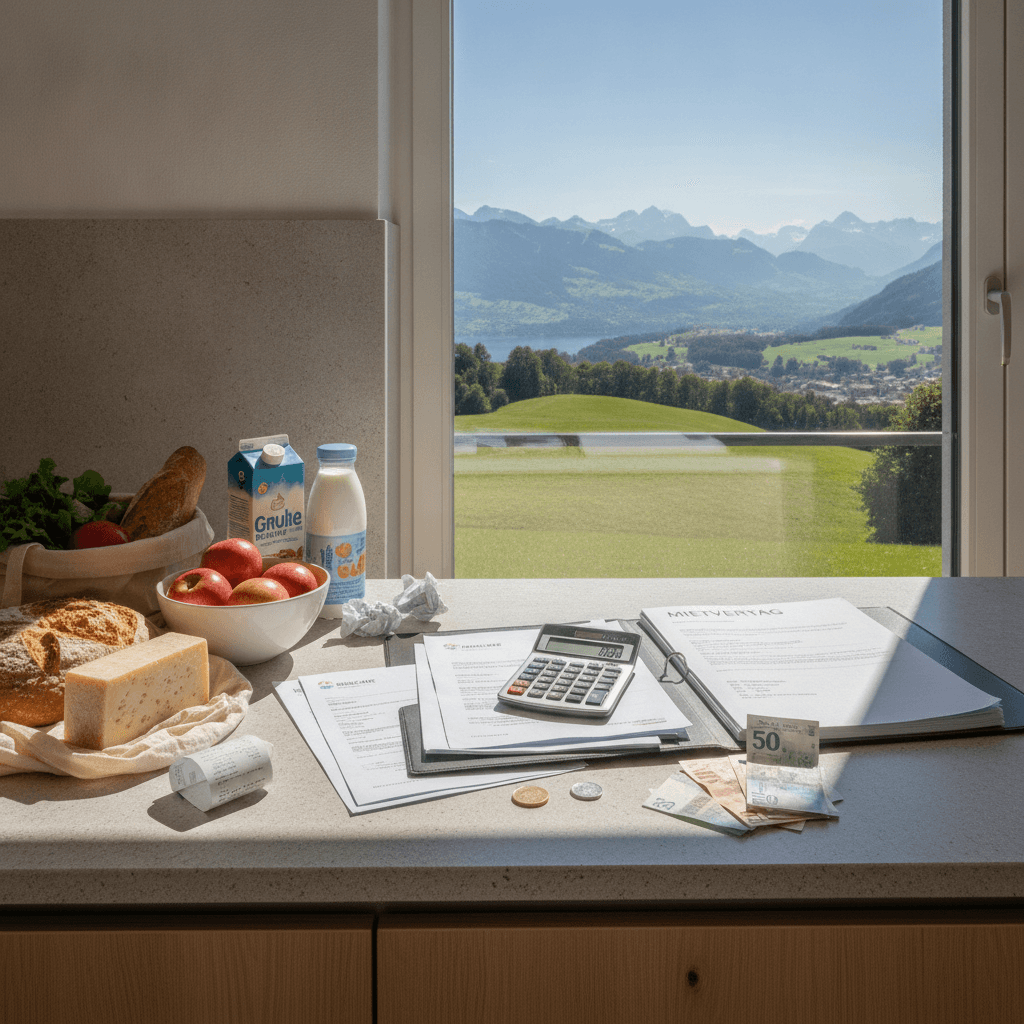
How does Switzerland compare to the world's most expensive cities?
Switzerland consistently ranks first in global cost of living surveys. According to Mercer's 2025 Cost of Living Survey, both Zürich and Genève rank among the five most expensive cities in the world. The Economist Intelligence Unit (EIU) Worldwide Cost of Living index also places both cities in the top tier.
For comparison: based on Numbeo's 2025 data, the combined monthly cost of food, transport, and housing in Zürich is approximately 2.5–3 times that of Budapest, while the average Swiss net salary is 5–7 times higher than the Hungarian average.
An important nuance: Swiss prices are high in CHF terms, but the gap is smaller when measured by purchasing power parity (PPP). Someone living on a Swiss salary and paying Swiss prices is not necessarily worse off than someone living on a Hungarian salary paying Hungarian prices — however, during the transition period, when your income may not yet be at full level but expenses arise immediately, serious liquidity pressure can build up.
How much does it cost to rent an apartment in Switzerland in 2026?
Housing represents the single largest expense for Swiss households. According to the Federal Statistical Office (Bundesamt für Statistik / BFS), Swiss households spend an average of 25–30% of their income on housing.
Rental prices by city (2025–2026 market data)
City / region | 1-bedroom apartment (approx. 40–50 m²) | 3-bedroom apartment (approx. 80–90 m²) |
|---|
Zürich (city) | CHF 2,000–2,800/month | CHF 3,500–5,000/month |
Genève | CHF 1,800–2,600/month | CHF 3,200–4,800/month |
Basel | CHF 1,400–2,000/month | CHF 2,500–3,800/month |
Bern | CHF 1,300–1,900/month | CHF 2,400–3,500/month |
Luzern | CHF 1,400–2,000/month | CHF 2,500–3,600/month |
Small town / agglomeration | CHF 1,000–1,500/month | CHF 1,800–2,800/month |
Rent is typically accompanied by a security deposit (Mietkaution) as well, which usually amounts to 2–3 months' rent and must be held in a dedicated blocked bank account opened for this purpose.
Buying property: is it a realistic option?
Property prices in Switzerland are extremely high. In Zürich, the purchase price of an average 4-room apartment ranges around CHF 1.5–3 million. As a Hungarian citizen — who is also an EU citizen and falls under the Agreement on the Free Movement of Persons (Freizügigkeitsabkommen / FZA, 1999) — you are generally entitled to purchase residential property in Switzerland, provided you live there. The Lex Koller law (Bundesgesetz über den Erwerb von Grundstücken durch Personen im Ausland) does not pose a general obstacle for EU citizens when the residency requirement is met, though restrictions may apply to certain holiday zone properties and investment-purpose purchases.
What is the net salary in Switzerland, and what deductions are made?
Gross-to-net ratio
The Swiss employee contributions (social deductions) as a percentage of gross salary are approximately:
Type of deduction | Rate (employee's share) |
|---|
AHV/AVS (old-age and survivors' insurance) | ~5.3% |
IV/AI (disability insurance) | ~0.7% |
ALV/AC (unemployment insurance) | ~1.1% (up to CHF 110,000/year) |
Second pillar (berufliche Vorsorge / BVG) | 6–9% (depending on age and salary base) |
Income tax (withholding tax / Quellensteuer, if no C permit) | 10–25% (varies by canton) |
From a gross monthly salary of CHF 7,000, the actual net — depending on canton, tax status, and the specific second-pillar plan — typically falls between CHF 4,800 and CHF 5,600.
Withholding tax (Quellensteuer) vs. ordinary tax return
Those who do not hold a C permit (Niederlassungsbewilligung), and are not Swiss citizens, have income tax deducted directly from their salary by their employer. This is simpler, but not always optimal: if annual income exceeds CHF 120,000, filing an ordinary tax return is mandatory. Even at lower income levels, a supplementary ordinary assessment (nachträgliche ordentliche Veranlagung / NOV) can be requested if it results in a tax refund (e.g. child deductions, commuting costs, professional expenses).
Hungarian–Swiss double taxation agreement
A double taxation agreement is in force between Hungary and Switzerland (1981, with amendments). This means that, as a general rule, the same income cannot be taxed in both countries. Someone who works in Switzerland and pays taxes there is, as a general rule, exempt from paying Hungarian tax on their Swiss income in Hungary — though the precise application depends on the type of income and individual circumstances.
How much does food and everyday life cost in Switzerland?
Food
Swiss food prices are 60–80% higher than the EU average. Some indicative prices (2025 market data, Migros / Coop supermarket):
Product | Swiss price (CHF) | Hungarian equivalent (HUF, at ~400 HUF/CHF exchange rate) |
|---|
1 kg bread | 2.50–4.00 | 1,000–1,600 HUF |
1 litre of milk | 1.50–2.00 | 600–800 HUF |
1 kg chicken breast | 14–20 | 5,600–8,000 HUF |
1 kg apples | 2.50–4.00 | 1,000–1,600 HUF |
Restaurant lunch (simple) | 20–30 | 8,000–12,000 HUF |
Coffee (espresso, in a café) | 4.50–6.00 | 1,800–2,400 HUF |
In cantons close to the border (e.g. Schaffhausen, Basel-Stadt, Genève) many people cross into Germany, France, or Italy to shop — this is legal, but quantity limits apply for personal imports (Zollfreigrenze).
Transport
Swiss public transport (SBB/CFF/FFS, PostAuto, local urban networks) is one of the densest and most reliable systems in Europe — but it doesn't come cheap.
Local pass (e.g. Zürich zone 110): ~CHF 85–90/month
Nationwide GA pass (Generalabonnement): CHF 3,860/year (2nd class, 2025 price), discounted versions available
Half-fare card (Halbtax-Abonnement): ~CHF 185/year — one of the best value-for-money purchases in Switzerland if you travel regularly
By car: petrol prices are around CHF 1.80–2.00/litre; the annual motorway sticker (Autobahnvignette) costs CHF 40
Basic health insurance in Switzerland (Krankenversicherung / KVG, in French LAMal) is mandatory for everyone living in Switzerland and must be taken out within 3 months of registering. The premium is paid by each individual — employers do not deduct it automatically from your salary.
Monthly premiums (indicative figures for 2026)
The premium varies significantly by canton, insurer, age, and the chosen deductible level (Franchise).
Canton | Adult monthly base premium (mid-range Franchise, indicative) |
|---|
Zürich | CHF 380–520 |
Genève | CHF 480–620 |
Basel-Stadt | CHF 420–560 |
Bern | CHF 360–490 |
Uri, Appenzell Innerrhoden | CHF 280–380 |
The Franchise (annual deductible) can be chosen between CHF 300 and CHF 2,500. A higher deductible means a lower monthly premium, but higher out-of-pocket costs when you fall ill. On top of the deductible, you also pay 10% of bills yourself (Selbstbehalt), up to a maximum of CHF 700 per year for adults.
Important: KVG premiums in Switzerland are not income-based — everyone pays the same amount, regardless of their earnings. This places a proportionally heavier burden on lower-income households. If your income is low, you may be eligible for a cantonal subsidy (Prämienverbilligung / IPCs).
How much does it cost to raise a child in Switzerland?
Raising a child in Switzerland is one of the most significant financial items Hungarian parents need to plan for.
Childcare and nursery (Kita / crèche)
The monthly fee for a nursery (Kindertagesstätte / Kita) is one of the biggest surprises for newcomers. Depending on income and canton:
Zürich: 100–160 CHF/day (full day, unsubsidised market rate)
Bern, Basel: 80–140 CHF/day
Subsidised places: reduced fees based on income – but waiting lists are long and a spot is not guaranteed
For a two-parent household both working full-time, Kita fees for two children can exceed CHF 3,000–4,000/month, which is a very real item to plan for.
School and Education
State primary and secondary schools (Volksschule, Gymnasium) are free of charge. The tuition-free education is of a high standard, but the language of instruction is the local cantonal language (German, French, or Italian) — not English. Hungarian Saturday schools operate in Zürich, Bern, and Genève, playing an important role in maintaining children's mother tongue.
Private schools (international schools in particular) can cost CHF 25,000–45,000 per year — generally not a realistic option unless covered by an employer.
Child Allowance (Kinderzulage / allocations familiales)
In Switzerland, every parent in employment is entitled to child allowances. The amount varies by canton, but the federal minimum is set at the national level: in 2025, at least CHF 200/month per child (up to age 16), and CHF 250/month as an education allowance (up to age 25). Some cantons pay higher amounts.
What can you expect to spend in total each month? Indicative budgets
Single adult, Zürich (2026 indicative figures)
Expense item | Monthly amount (CHF) |
|---|
Rent (1-bedroom, city) | 2,200 |
Health insurance (KVG) | 450 |
Food | 500 |
Transportation (local pass) | 90 |
Communication (phone, internet) | 80 |
Other (clothing, leisure, personal) | 400 |
Total (indicative) | ~3,720 CHF |
Family of four, medium-sized Swiss city
Expense item | Monthly amount (CHF) |
|---|
Rent (3–4 rooms) | 2,800 |
Health insurance (2 adults + 2 children) | 1,100 |
Food | 1,200 |
Childcare / school expenses | 800–2,000 |
Transportation | 250 |
Other | 600 |
Total (indicative) | ~6,750–8,000 CHF |
How to save and plan financially in Switzerland?
The three-pillar system
The Swiss pension system is built on three pillars:
First pillar (AHV/AVS): state basic pension, mandatory, contributions proportional to income.
Second pillar (berufliche Vorsorge / BVG): occupational pension fund, mandatory when employed. Contributions come with tax benefits. Upon permanently leaving Switzerland — if moving back to the EU — the accumulated capital can be withdrawn under certain conditions, though the payment of the retirement portion is restricted.
Third pillar (Säule 3a): voluntary, tax-advantaged private savings. In 2025, the annual contribution limit for employed individuals is CHF 7,258. This amount is deductible from taxable income — one of the best legal tax optimisation tools in Switzerland.
Savings rate and realistic expectations
According to OECD data, Swiss households have one of the highest savings rates in Europe, typically around 15–20%. However, this varies greatly depending on income level and place of residence: for a single person on an average wage living in Zürich, saving CHF 500–800 per month is realistic, but by no means automatic.
Sources
Related Articles