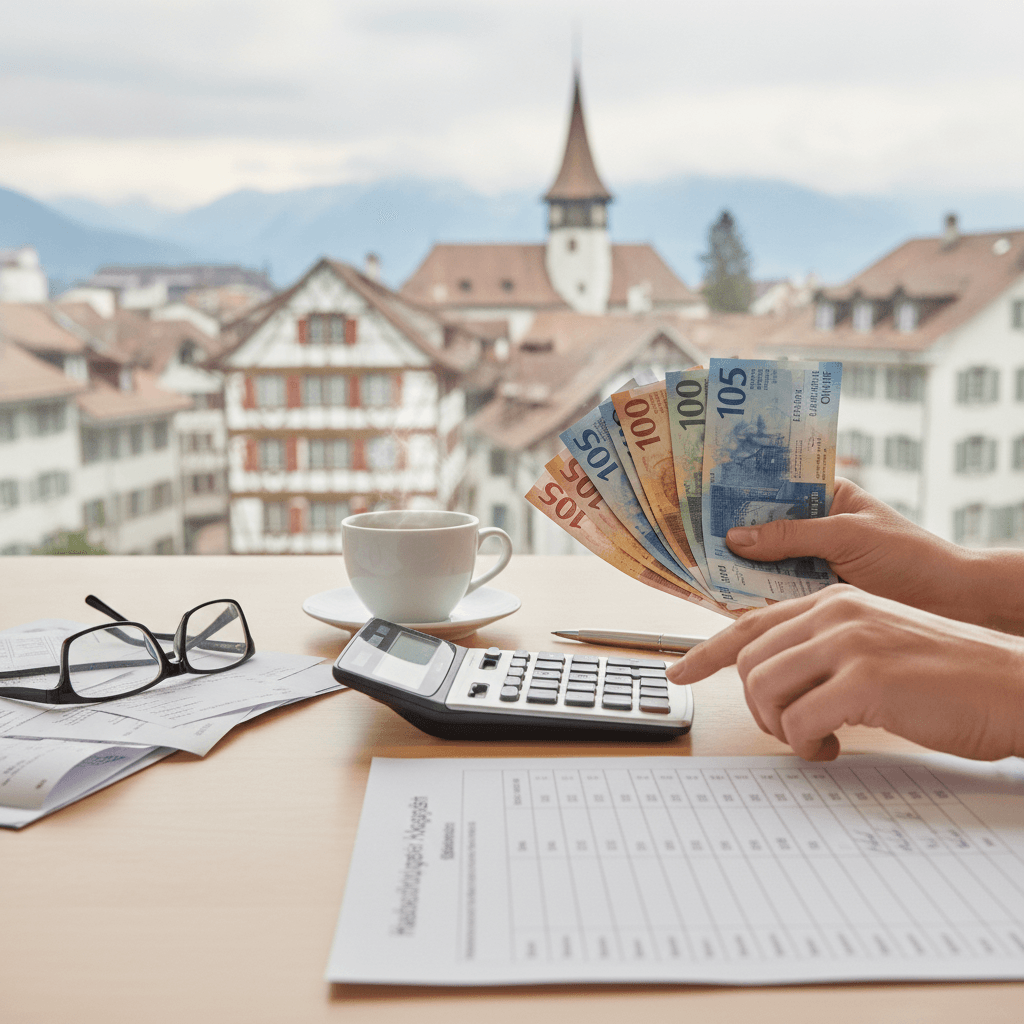
How are the costs of living in Switzerland structured?
It is worth breaking down Swiss household expenses into three layers:
Most budgeting mistakes stem from underestimating the first two layers — people start from their net salary without calculating the mandatory deductions in advance.
In Switzerland, the employer deducts social security contributions from the gross salary, but health insurance and taxes must in many cases be paid by the employee directly — this is fundamentally different from the Hungarian system, where these are typically deducted automatically.
How much does housing cost in Switzerland?
Housing is the largest expense for Swiss households. Rental prices vary significantly by city and canton.
What should you expect in terms of rent?
The table below is indicative and based on 2025–2026 market data. Actual prices depend heavily on the condition and location of the apartment and local market conditions.
Region / City | 1-bedroom apartment (approx.) | 2-bedroom apartment (approx.) |
|---|
Zürich (city) | CHF 2,000–2,800/month | CHF 2,800–4,000/month |
Geneva (Genève) | CHF 1,800–2,600/month | CHF 2,600–3,800/month |
Basel | CHF 1,400–2,000/month | CHF 2,000–2,800/month |
Bern | CHF 1,300–1,900/month | CHF 1,900–2,700/month |
Lucerne (Luzern) | CHF 1,400–2,000/month | CHF 2,000–2,800/month |
Small town / rural area | CHF 900–1,400/month | CHF 1,400–2,000/month |
Important: the price listed in advertisements is usually the net rent (Nettomiete). On top of this come the ancillary costs (Nebenkosten), which typically amount to CHF 150–300 per month and cover heating, hot water, and stairwell cleaning. The gross rent (Bruttomiete) already includes these — always ask which one is being quoted.
What hidden housing costs should you budget for?
Security deposit (Mietkaution): typically 2–3 months' net rent, which must be held in a blocked bank account. This money isn't lost, but it represents a significant one-off expense at the time of moving in.
Home contents insurance (Hausratversicherung): mandatory in some cantons (e.g. Vaud, Fribourg), and strongly recommended elsewhere. Expect to pay around CHF 100–250 per year.
Personal liability insurance (Haftpflichtversicherung): also recommended, at around CHF 50–150 per year.
Move-in renovation: many Swiss rental properties are handed over in a 'blank canvas' state (beige-white walls, neutral condition) and must be returned in the same condition — painting and minor repairs are the tenant's responsibility.
How much does daily living cost in Switzerland?
Food and groceries
Grocery prices in Switzerland are roughly 2.5–4 times higher than in Hungary, depending on the product category and type of store.
The two major discount chains — Aldi Suisse and Lidl Schweiz — have prices closer to the Western European average. Migros and Coop represent the mid-range, while Manor Food and Globus sit at the premium end.
Indicative monthly grocery budget per person:
Budget shopping (mainly discount chains): CHF 300–400
Average shopping (mixed stores): CHF 450–600
With restaurant dining included: 700–1,000 CHF and above
A lunch menu at an average Swiss restaurant costs 20–30 CHF, a coffee 4–6 CHF. These are not luxury expenses — this is standard Swiss pricing.
Transportation
Public transport in Switzerland (SBB/CFF/FFS rail, local buses, trams) is excellent quality, but not cheap.
Local season pass (Generalabonnement / GA): valid across the entire Swiss network, 2nd class costs approximately 3,860 CHF per year (around 322 CHF/month). This price applies to adults over 26.
Local zone pass: a more affordable option within a single city or region, typically around 70–120 CHF per month.
Car: beyond the purchase price, factor in mandatory liability insurance (Haftpflichtversicherung, 500–1,200 CHF per year), cantonal vehicle tax (Motorfahrzeugsteuer, 200–600 CHF per year), the motorway vignette (Vignette, 40 CHF per year), and fuel costs.
⚠️ The GA pass price may change annually — check the official SBB website for the exact, up-to-date rates.
Communications
A mobile phone subscription (with data and calls) ranges from 20–60 CHF per month, depending on the plan and provider. Home broadband internet costs 40–80 CHF per month.
What is deducted from a Swiss salary?
This is the point where most newcomers are caught off guard. The gross-to-net difference in Switzerland is complex.
Employer deductions (automatic)
Your employer deducts the following from your gross salary:
Contribution | Approximate rate (employee share) |
|---|
AHV/AVS (old-age and survivors' insurance) | ~5.3% |
IV/AI (disability insurance) | ~0.7% |
EO/APG (income compensation scheme) | ~0.25% |
ALV/AC (unemployment insurance) | ~1.1% (reduced rate on annual salary above CHF 110,000) |
Second pillar (berufliche Vorsorge / BVG) | 6–9% (depending on age and salary) |
Overall, social security contributions amount to approximately 13–17% of gross salary on the employee side.
If you hold a B permit (Ausländerausweis B) your employer will deduct withholding tax directly from your salary. This tax varies by canton and income level, and typically ranges between 15–25% of gross salary.
If you are tax-resident in Switzerland (C permit or Swiss citizenship), tax is settled through an annual tax return.
From a Hungarian perspective: A double taxation agreement is in force between Hungary and Switzerland (1981, with amendments), which prevents the same income from being taxed in both countries. If you work and pay taxes in Switzerland, you are not required to pay tax on that same income in Hungary — though the exact procedure depends on your individual circumstances.
Cantonal Tax Differences
The tax burden in Switzerland varies significantly by canton. Zug and Schwyz are known for their low tax rates, while Geneva and Vaud apply higher rates. The same gross salary results in a different net amount depending on which canton you live in.
How much does health insurance cost (KVG / LAMal)?
Health insurance in Switzerland is mandatory for everyone residing there, and it is not paid by the employer — you must transfer it monthly directly to your insurer (Krankenkasse).
How is the premium structured?
The monthly premium (Prämie) is influenced by several factors:
Canton: premiums differ by canton because the costs of local healthcare infrastructure vary.
Deductible (Franchise): the annual deductible can be chosen between CHF 300 (basic) and CHF 2,500. A higher deductible means a lower monthly premium. You also pay 10% of costs above the deductible (Selbstbehalt), up to a maximum of CHF 700 per year.
Insurance model: the standard model (Standardmodell) is more expensive; the family doctor model (Hausarztmodell / HMO) can be 10–20% cheaper.
Indicative premium ranges for 2025 (adults over 26, CHF 300 deductible):
Canton | Monthly premium (approximate) |
|---|
Zürich | CHF 430–530 |
Genève | CHF 500–620 |
Basel-Stadt | CHF 480–580 |
Bern | CHF 420–510 |
Zug | CHF 330–420 |
Appenzell Innerrhoden | CHF 280–360 |
⚠️ KVG premiums change every year. The Federal Office of Public Health (BAG/OFSP) announces the following year's rates at the end of October each year. The figures above are indicative — check the current, exact premiums on the Priminfo.ch comparison portal.
What should you look out for when choosing an insurer?
Every insurer is required to provide the same basic healthcare package (Grundversicherung) — the difference lies in the premium and in supplementary insurance (Zusatzversicherung). It is worth comparing premiums every year, as you can switch insurer once a year by giving notice by 31 October (the new cover takes effect on 1 January).
What are the most common budgeting mistakes made by newly arrived expats?
1. Not budgeting for health insurance in advance Many people start from their net salary and fail to account for the fact that the Krankenkasse premium must be paid separately each month. For a single adult, this can amount to CHF 4,000–7,000 per year.
2. Not setting aside the deposit in time The deposit required when moving in (2–3 months' rent) falls due all at once. Anyone who has not set this aside may face serious cash-flow problems in the first few months.
3. Underestimating taxes The level of withholding tax (Quellensteuer) in particular tends to be underestimated. The gap between gross and net salary in Switzerland — taking all deductions into account — can reach 30–40% at higher income levels.
4. Comparing prices to those in Hungary The cost of food, dining out, and services in Switzerland is on an entirely different scale. Anyone who carries over their habits from Hungary unchanged will regularly overspend in the first few months.
5. They don't account for one-time moving costs In the first 1–3 months, one-time expenses arise: a security deposit, furniture, household items, possibly a car purchase, and setting up insurance policies. Depending on the situation, these can add up to CHF 5,000–15,000.
Sources
Related Articles