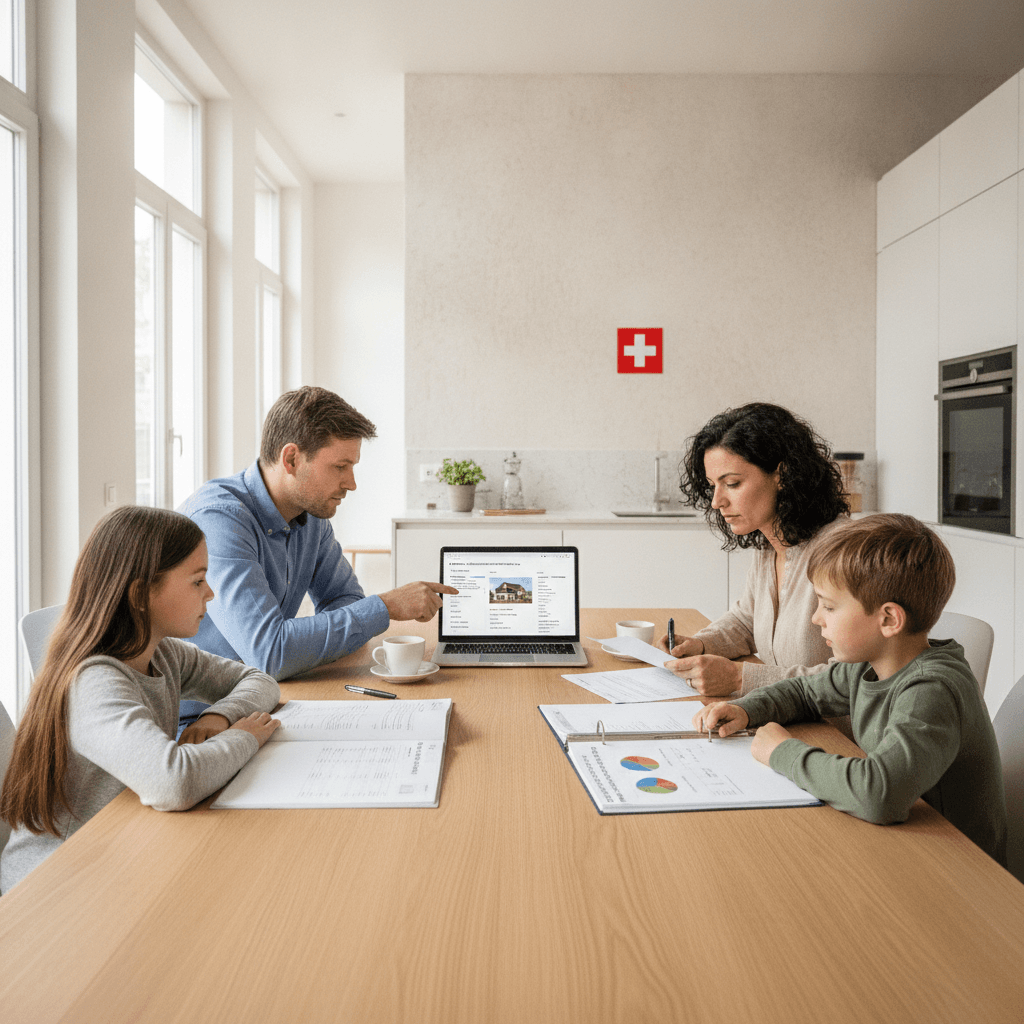
How to Move to Switzerland with a Family? A Step-by-Step Guide
The complete process for Hungarian families relocating to Switzerland: permits, schooling, health insurance, housing, and budgeting — based on 2024–2026 regulations.
When should you start preparing?
Most processes – especially finding accommodation and enrolling children in school – take longer in Switzerland than in Hungary. Experience shows that a realistic preparation window is 3–6 months before arrival. Those organising the move independently, without employer support, should plan for closer to 6 months.
Below, we walk through each step in the generally recommended order.
Preparation: what documents will you need?
Swiss authorities expect you to register at the local residents' registration office (Einwohnerkontrolle / Contrôle des habitants) within 14 days of arrival. The following documents are typically required:
Valid passport or national identity card (for every family member)
Employment contract or proof of self-sufficiency (bank statement, business registration)
Rental agreement or proof of accommodation
Birth certificates (for children)
Marriage certificate (if applicable)
Passport-sized photographs (typically 2–4)
Hungarian civil registry documents must be submitted with an apostille and a certified translation into German, French, or Italian if the canton requires it. Translation and certification requirements may vary by canton.
What permit will a Hungarian citizen and their family receive?
As a Hungarian citizen – and therefore an EU citizen – you may stay in Switzerland for the first 3 months without any registration obligation. If you take up employment, you must apply for a B permit (Ausländerausweis B) which is issued by the cantonal immigration authority (Migrationsamt / Office cantonal de la population). The permit is initially valid for 5 years if the employment contract is open-ended; for fixed-term contracts, it is issued for the duration of the contract.
A spouse and children accompanying the employee are also entitled to a B permit, even without their own employment, on the basis of the primary applicant's status. Important: the spouse's permit also entitles them to take up independent employment.
Work permit and the situation of family members
The application for a B permit is typically initiated by the employer at the cantonal Migrationsamt, but it is also possible for the employee to submit it themselves within 14 days of arrival. The process works as follows:
The employer notifies the Migrationsamt (in many cantons, via an online portal).
The employee and family members appear in person at the Einwohnerkontrolle.
The permit is sent by post; processing time is typically 2–6 weeks, varying by canton.
For a spouse from a third country (e.g., a non-EU/EFTA citizen), the process is more complex: a visa is required, and the application must be initiated at the Swiss embassy before relocating. This case requires separate guidance.
Finding accommodation and signing a lease
The Swiss rental market — particularly in the greater Zürich, Genève, Basel, and Bern areas — is extremely tight. Supply is low, demand is high, and landlords require detailed documentation from applicants.
What do you need to know when applying for a rental?
A Swiss landlord will typically ask for the following:
Betreibungsregister extract (debt enforcement register — a certificate showing no negative entries; for newcomers to Switzerland this is not yet available, and an employer's reference letter can partially substitute for it)
Proof of the last 3 months' salary or a copy of the employment contract
Copy of identity card / passport
Completed application form (Bewerbungsformular)
For newcomers, the absence of a Betreibungsregister extract is a disadvantage. It is worth obtaining an employer's reference letter and, if possible, a Swiss reference.
How much is the deposit (Mietkaution)?
Under Swiss law, the deposit (Mietzinskaution) may not exceed 3 months' rent. It must be held in a blocked bank account (Sperrkonto), which the tenant cannot access until the end of the lease. This represents a one-off but significant capital requirement at the time of moving in.
What should you expect in terms of rental prices?
The rental prices vary considerably by city and canton. Indicative monthly rents based on 2024–2025 data for a 3–4 room apartment (approx. 70–90 m²):
Zürich (city): CHF 2,800 – 4,500
Genève (city): CHF 2,600 – 4,200
Basel (city): CHF 2,000 – 3,200
Bern (city): CHF 1,800 – 3,000
Small town / rural canton: CHF 1,400 – 2,200
These are approximate figures; the current market conditions and the condition of the property can significantly affect them.
Schooling for children: from kindergarten to secondary school
In Switzerland, education falls under cantonal jurisdiction, so the details of the system — the starting age, grading, and secondary school selection — vary from canton to canton. A few points that apply generally:
Compulsory school age typically begins at 4–5 years old (at the Kindergarten / école enfantine level) and continues until the age of 15–16.
Schooling is free and compulsory in the public sector.
Enrolment takes place at the local school authority (Schulamt / Direction scolaire), typically at the same time as or shortly after registering your address.
Children may undergo a language assessment and, if needed, be placed in an integration class (Aufnahmeklasse / classe d'accueil), where they receive intensive language preparation before joining a mainstream class.
Hungarian-language education and weekend schools
Several cities in Switzerland have Hungarian weekend schools, which hold classes based on the Hungarian national curriculum. Such institutions exist in Zürich, Bern, and Genève. These do not replace state schooling, but they help children maintain their connection to the Hungarian language and culture.
Private schools and international schools
Switzerland has numerous private and international schools (e.g. English-, French-, or German-language), which can be an alternative — particularly for shorter stays or when a child does not yet speak the local language. Their annual fees typically range from CHF 15,000 to CHF 40,000, and they do not receive state funding.
Health insurance for the family
In Switzerland, health insurance (Krankenversicherung / assurance maladie) is compulsory and provided by the private sector. The system is governed by the federal KVG/LAMal (Bundesgesetz über die Krankenversicherung).
When must it be taken out?
You are required to choose a health insurer within 3 months of registering; the coverage is valid retroactively from the date of registration. If someone fails to take out insurance, the canton will assign one to them and recover the premiums afterwards.
How much is the monthly premium?
The premium depends on age, canton, the insurer chosen, and the level of the deductible (Franchise / franchise). Indicative figures for 2025:
Adult (26+): CHF 350 – 600
Young adult (19–25): CHF 250 – 450
Child (0–18): CHF 90 – 150
Premiums can vary by as much as 40–50% between cantons. Zürich and Genève tend to be the most expensive, while the central cantons (e.g. Appenzell, Uri) are cheaper.
Deductible (Franchise) and co-payment (Selbstbehalt)
The annual deductible for adults can be chosen between CHF 300 and CHF 2,500. A higher deductible means a lower monthly premium, but greater out-of-pocket costs in the event of illness. For children, the deductible can be CHF 0.
Supplementary insurance (Zusatzversicherung / assurance complémentaire)
Basic KVG/LAMal coverage only includes essential care. Dental, optical, a private hospital room, or treatment abroad — for these, supplementary insurance is worth considering, though it is neither mandatory nor standardised.
Hungarian social security and NEAK (OEP)
Upon moving to Switzerland, your entitlement under your Hungarian social security number (TAJ) ceases. You must notify NEAK (formerly OEP) of your relocation abroad. When visiting Hungary, it is also possible to obtain an EHIC card (European Health Insurance Card) issued by Switzerland — however, the Swiss system is not built around the EHIC; KVG/LAMal is the basic insurance there.
Social benefits and family allowances
Child allowance (Kinderzulage / allocations familiales)
In Switzerland, every parent in employment is entitled to a child allowance (Kinderzulage). The amount varies by canton, but the federal minimum since 2023 is:
CHF 200/month per child up to age 16
CHF 250/month for children aged 16–25 (if in education)
Some cantons pay higher amounts. The allowance is paid by the employer together with the salary, and the employee claims it through the cantonal Familienausgleichskasse (FAK) system.
Maternity and paternity leave
Maternity leave (Mutterschaftsurlaub): 14 weeks, 80% of salary (maximum CHF 220/day), through the APG/RPC system.
Paternity leave (Vaterschaftsurlaub): 10 working days (2 weeks), also with 80% income replacement.
Social assistance (Sozialhilfe)
EU citizens' entitlement to social assistance in Switzerland is limited: if someone is unable to support themselves and requires social assistance, this can affect the renewal of their residence permit. This is an important risk factor to consider during the planning phase.
Budget planning: what should a family expect?
The table below estimates the monthly expenses of a family of 2 adults and 2 children living in the Zürich area, based on 2025 data. These are indicative figures; actual expenses may vary significantly depending on location, lifestyle, and age.
Expense item | Estimated monthly amount (CHF) |
|---|---|
Rent (3–4 rooms, Zürich agglomeration) | CHF 2,500 – 3,500 |
Health insurance (4 people) | CHF 900 – 1,400 |
Groceries | CHF 800 – 1,200 |
Transport (pass, without a car) | CHF 400 – 600 |
Childcare / nursery | CHF 800 – 2,000 |
Other (clothing, leisure, phone, internet) | 500 – 900 |
Total (approximate) | 5,900 – 9,600 |
The cost of daycare (Krippe / crèche) is one of the most significant variables: at full price it can reach CHF 2,000–3,000 per month, but income-based subsidies (Subventionierung) can substantially reduce this.
Integration opportunities: community, language learning, work
Language integration
In Switzerland, the official language depends on the canton of residence: in the eastern cantons (Zürich, Bern, Basel, Aargau) it is German, in the western cantons (Genève, Vaud, Neuchâtel) it is French, and in the canton of Ticino it is Italian. Swiss German (Schweizerdeutsch) is the language of everyday communication and differs significantly from standard written German — this can be a real challenge at first.
Many cantons offer free or subsidised integration language courses. It is worth checking the Migrationsamt website for local opportunities.
Hungarian communities in Switzerland
Active Hungarian communities, cultural associations, and church organisations operate in Zürich, Bern, Genève, and Basel. They organise regular events and can serve as a valuable informal network for newcomers.
Employment for spouses
A spouse holding a B permit — even if obtained on the basis of the primary applicant's status — may work independently in Switzerland without requiring a separate work permit. This is an important distinction compared to other immigration systems.
Sources
Swiss federal portal (ch.ch): https://www.ch.ch/en/
State Secretariat for Migration (SEM – Staatssekretariat für Migration): https://www.sem.admin.ch
Federal Social Insurance Office – AHV/AVS and APG: https://www.bsv.admin.ch
Federal Office of Public Health – KVG/LAMal: https://www.bag.admin.ch
Premium comparison tool (Priminfo, federal): https://www.priminfo.admin.ch
Swiss Conference of Cantonal Ministers of Education (EDK – cantonal education system): https://www.edk.ch
Familienausgleichskassen – cantonal child allowances: https://www.bsv.admin.ch (FAK section)
Property search platforms: https://www.homegate.ch, https://www.immoscout24.ch
Related Articles
Before moving to Switzerland: what steps do you need to take?
What should you know about the Swiss labour market as a Hungarian citizen?
Which canton is the best place to start a new life in Switzerland?
What do you need to know about Swiss employment contracts and probationary periods?
Swiss residence permits in 2026: L, B and C types for Hungarians
Hungarian weekend schools in Switzerland: everything you need to know
In Brief
Moving to Switzerland requires 3–6 months of preparation, including applying for a B permit (work and residence permit), finding housing, and arranging health insurance. Monthly expenses for a family of four in the Zürich area are estimated at CHF 5,900–9,600, with rent and childcare being the largest items, while child allowance (CHF 200–250/month) and maternity leave (14 weeks at 80% pay) provide meaningful family support.
Key Takeaways
- Start your preparations 3–6 months before arrival, especially if you are organising the move independently — finding housing and enrolling children in school both require significant lead time.
- Ensure all required documents are apostilled and accompanied by certified German, French, or Italian translations before you arrive in Switzerland.
- Apply for a B permit — either through your employer or independently — within 14 days of arrival. The permit is valid for 5 years under an open-ended contract and covers your spouse and children as well.
- Budget for monthly rent of CHF 2,500–3,500 in the Zürich agglomeration and CHF 900–1,400 for health insurance for a family of four — these are the two largest items in your budget.
- Choose a health insurer within 3 months of registering, and factor in cantonal premium differences (Zürich and Genève tend to be more expensive, while inland cantons are cheaper).
- Register your child with the school authority (Schulamt) at the same time as your residential registration — public schooling is free and compulsory, though an integration class may be recommended if needed.
Frequently Asked Questions
How long does it take to obtain a B permit in Switzerland?
Processing time for a B permit is typically 2–6 weeks and varies by canton. The application can be submitted by the employer or the employee to the cantonal Migrationsamt within 14 days of arrival, and the permit is sent out by post.
Which documents need to be apostilled?
Hungarian birth certificates, marriage certificates, and other official documents must be apostilled and accompanied by certified translations into German, French, or Italian — the exact requirements may vary by canton.
Can an EU citizen end up relying on social assistance in Switzerland?
EU citizens' entitlement to social assistance in Switzerland is limited, and becoming dependent on it can affect the renewal of a residence permit. This is an important factor to consider during the planning phase.
How much does childcare cost in Switzerland?
Full-price nursery (Krippe) fees can reach CHF 2,000–3,000 per month, but income-based subsidies (Subventionierung) can reduce this significantly. The final cost depends heavily on available public support and the cantonal system in place.
What language learning options are available for integration?
Many cantons offer free or subsidised integration language courses. Swiss German (Schweizerdeutsch) is the language of everyday communication and differs considerably from standard written German. The local Migrationsamt website is a good starting point for finding options in your area.
Is a spouse entitled to work independently with a B permit?
Yes, a spouse holding a B permit — whether obtained in their own right or derived from the primary applicant — is entitled to take up employment in Switzerland independently, without requiring a separate work permit.
How long is parental leave in Switzerland?
Maternity leave is 14 weeks at 80% of salary (up to CHF 220/day), paid through the APG/EO (income compensation scheme). Paternity leave is 10 working days (2 weeks), also at 80% income replacement.
This guide is available after registration
During the launch period, the full knowledge base is available with free registration.
CHF 0 during launch
- All guides and checklists
- Downloadable PDF templates
- Sample documents
- Early access to new content
Preview - the guide continues after login