Are Teachers Overburdened in Swiss Inclusive Schools?
Svájcban az integráló iskola azt jelenti, hogy a különböző támogatási igényű gyermekek lehetőség szerint együtt tanulnak. Ez azonban nem jelenti azt, hogy minden gyermek ugyanazt a feladatot és támogatást kapja. A vita fő kérdése, hogy az iskolák rendelkeznek-e elegendő pedagógiai és gyógypedagógiai kapacitással; a megoldások kantononként, községenként és intézményenként eltérhetnek. Magyar családok számára különösen fontos a nyelvi beilleszkedés és a sajátos nevelési igény elkülönítése, valamint az iskola javaslatának konkrét tisztázása.
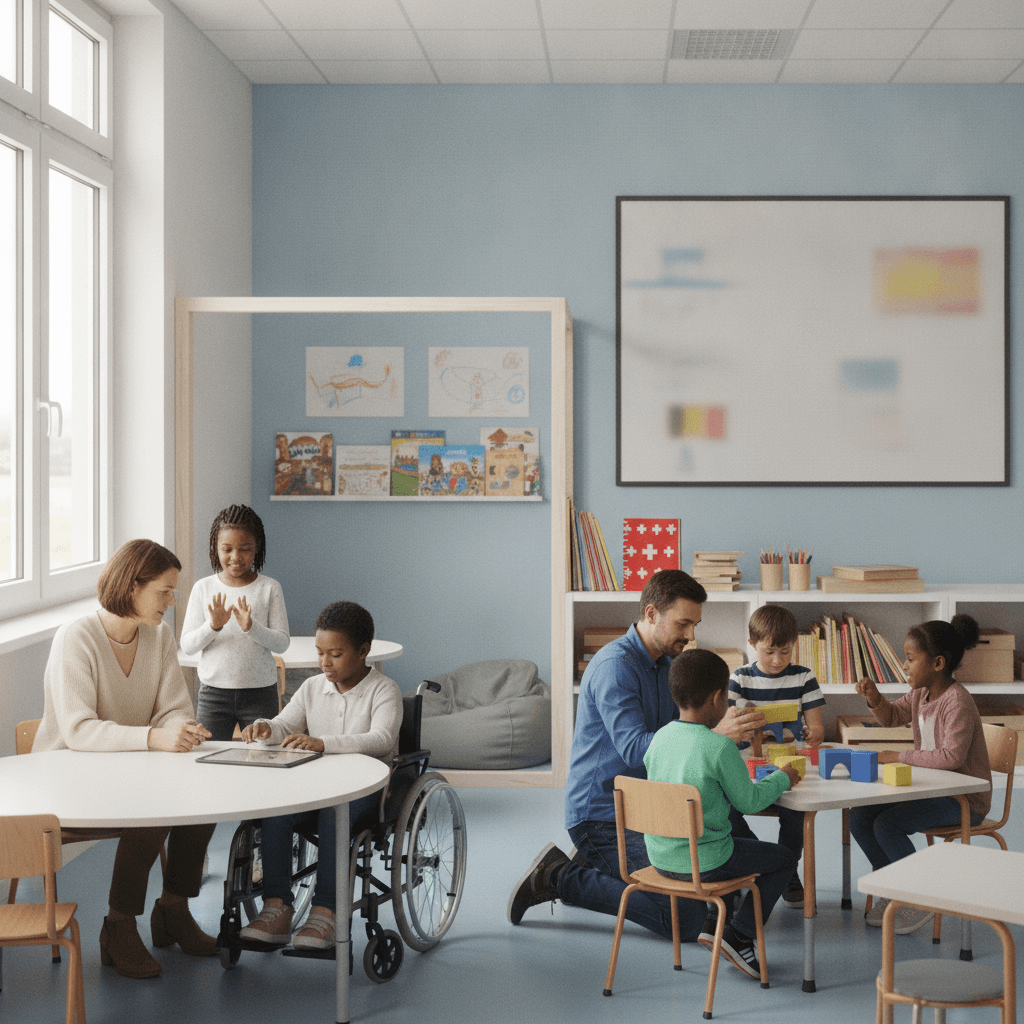
What does an integrative school mean in Switzerland?
An integrative school (Integrative Schule) is an educational approach in which children with different support needs learn together wherever possible. The term integrative education (integrativer Unterricht) refers to learning in a shared classroom.
The concept of a school oriented toward inclusion (inklusionsorientierte Schule, or inklusive Schule) emphasizes the principle of learning together. In practice, however, it is not enough for a Hungarian family to be familiar with this principle: it is also important to understand how the school in question organizes support.
The German term often used for a student with special educational needs is Schülerinnen und Schüler mit besonderem Bildungsbedarf, abbreviated as SuS mit Förderbedarf. Such children’s learning may be supported by a school special-needs teacher, namely Schulische Heilpädagogin or Schulischer Heilpädagoge (SHP).
Integration does not mean that every child receives the same task and the same assistance in every lesson. The key question is whether the school can create an appropriate learning environment for the child while also ensuring that the other pupils in the class continue to progress.
Why has the debate about integrative education flared up again in Switzerland?
The debate has intensified because tensions have emerged between the aim of integration and the realities of day-to-day school operations. Public discussion simultaneously addresses the desire for children to be educated together, teachers’ workload, and the role of separate forms of support.
The Swiss Teachers’ Association, LCH (Dachverband Lehrerinnen und Lehrer Schweiz) and its president, Dagmar Rösler, are also important participants in the debate. The German term for teacher overload is: Überlastung der Lehrpersonen.
The issue is particularly sensitive because teachers’ workload is not merely an employment matter. When a class includes a wide range of learning, behavioural or support needs, this can affect the organisation of teaching, communication with parents and the scope for individual development.
As a Hungarian parent, it is advisable to distinguish between two things:
The principle of an integrating school means that children should not be automatically separated.
The practice of a particular school shows what professionals, forms of support and group organisation arrangements are actually available.
A national debate therefore does not, in itself, indicate what support the child will receive in a particular municipality or school.
Are teachers really overburdened?
According to the central finding of a teacher survey reported in the press, the integrative model places excessive demands on many teachers, and a significant proportion of respondents consider the system unsuccessful. The debate is therefore not only about education policy objectives, but also about the conditions required to implement them.
Criticism concerning teachers’ workload can be properly understood only if it is not attributed to a single child or family. In running a class, a teacher must teach, attend to individual needs, coordinate with specialists and maintain contact with parents at the same time.
The role of the school’s special-needs teacher may be particularly important in this situation. For the family, however, it is not only relevant whether the institution has an SHP, but also how the child’s support is integrated into the school week.
A common misunderstanding among Hungarian families is that the difficulty of linguistic integration is automatically regarded as a special educational need. The two situations are not the same. The child their Swiss schooling journeyTherefore, it is advisable to discuss specific observations with the teacher, the school management and, where necessary, the designated specialists.
How are the cantons returning to separate classes?
The German term for support classes, i.e. segregated groups, is Förderklassen. The debate surrounding these shows that integration and separate support are not necessarily mutually exclusive, but rather are emerging as solutions that need to be balanced with one another.
In the context of the Zürich Cantonal Council, the Förderklassen-Initiative is also part of the education debate. The name of the initiative itself indicates that the issue of separate support groups is also on the political agenda.
In the canton of Basel-Stadt, Riehen and Bettingen will introduce a new framework concept from the 2026/2027 school year. The specific aim is to strike a balance between segregation and integration.
This local example is relevant because it highlights that school organisation in Switzerland is not based on a uniform nationwide practice. For a family, the canton concerned, municipality, school district and institution’s approach is decisive.
Term | German designation | What does it indicate to parents? |
|---|---|---|
Integrative school | Integrative Schule | A school that emphasises the principle of children learning together. |
Integrative education | Integrativer Unterricht | A form of teaching and support provided in a shared class. |
Förderklasse | Förderklasse | A term for a separate group providing targeted support. |
Schulische Heilpädagogin / Schulischer Heilpädagoge | Schulische Heilpädagogin / Schulischer Heilpädagoge | A professional involved in providing special educational support. |
besonderer Bildungsbedarf | besonderer Bildungsbedarf | A support need that the school may assess and organise separately. |
What does the “Schule für alle” counter-initiative call for?
The “Schule für alle” counter-initiative represents the other side of the debate surrounding inclusive education. Pro Infirmis and organisations representing people with disabilities in Zürich are also active in the public discourse on the issue.
The name means “school for everyone” in English. The initiative’s presence is a reminder that the debate about Förderklassen is not solely a matter of organisation or budgeting. It also concerns children’s participation, equal access and their sense of belonging to the educational community.
For Hungarian families, this means that it is not advisable to assess the solution proposed by the school solely on the basis of whether it is labelled “integrated” or “separate”. What matters is how specifically the proposal supports the child’s learning, safety and development.
If the school initiates a meeting, it may be useful to ask the following questions in writing:
What support does the school recommend for the child?
Who coordinates the educational consultations concerning the child?
Is a Schulische Heilpädagogin or Schulischer Heilpädagoge involved in the process?
How will the parent be informed about the next steps?
In what language and in what form will the family receive the information in writing?
What are the consequences of a shortage of places in special education?
The issue of places in special education is one of the most challenging points in the debate, because providing appropriate support is not merely a matter of principle. If a child needs a specialised educational environment or additional professional support, organising this may require cooperation between the school, local authorities and the family.
A Sonderschulen, that is, special education schools, are therefore also mentioned in public debate. Questions relating to these options may depend on local regulations and institutional capacity.
For parents, the most important practical question is not which model is right at national level. What matters is whether the school assesses the child's situation understandably, explains its recommendation clearly, and enables the family to participate in the discussions.
For a Hungarian-speaking child, it is also worth clearly distinguishing the language situation from learning or developmental issues. If a parent does not fully understand a German-language school document, it is advisable to clarify its meaning before giving consent or making a statement.
What does all this mean for Hungarian families living in Switzerland?
At a Swiss school, discussions about a child's support often involve several people: the class teacher, school management, a special education teacher and the parents. Hungarian families can participate meaningfully in these discussions if they prepare in advance by familiarising themselves with the main concepts and formulating their own questions.
The national or cantonal debate surrounding inclusive schools is no reason for a family to automatically assume that there is a problem with its own child. At the same time, attention is warranted if the school repeatedly initiates discussions about the child's progress, participation in the classroom or need for further support.
At the meeting with the school, parents should also briefly explain which languages the child uses at home, how long the child has attended a Swiss school, and what previous school experiences they had in Hungary. This can help ensure that the child's situation is not assessed from only one perspective.
Sources
NZZ: debate surrounding inclusive schools and the workload of teachers
Canton of Basel-Stadt: new framework concept for Riehen and Bettingen
Related Articles
In Brief
The debate over Swiss inclusive schools centres on the tension between the aims of shared education and the conditions required for its day-to-day implementation. Teacher overload, special-needs support and separate classes vary from canton to canton and from one institution to another, so families need to understand the specific support system offered by the school in question.
Key Takeaways
- When assessing school support, do not focus solely on the labels “inclusive” or “separate”; consider the specific solution that supports the child’s learning, safety and development.
- If a consultation takes place, ask what support the school recommends, who coordinates the process and whether a school-based special-needs teacher (SHP) is involved.
- Distinguish difficulties integrating into a German-speaking school from special educational needs; the child’s situation should be assessed on the basis of specific observations.
- Check in what form and in which language the school provides written information about the next steps.
- When describing the child’s background, explain which languages are spoken at home, how long the child has attended school in Switzerland and what previous school experiences they have had.
- Bear in mind that support options may depend on the canton, municipality, school district and institutional capacity.
Frequently Asked Questions
What does an inclusive school mean in Switzerland?
An inclusive school is an educational approach in which children with different support needs learn together wherever possible. This does not mean that every pupil receives the same tasks or support in every lesson.
Are teachers in inclusive schools really overburdened?
According to the teacher survey presented in the article, the integrative model places excessive demands on many teachers, and a significant proportion of respondents consider the system unsuccessful. The debate therefore concerns not only the aim of integration, but also the staffing and organisational conditions required for its implementation.
What is the difference between difficulty integrating linguistically and special educational needs?
Difficulty learning the language used at school in Switzerland is not, in itself, the same as having special educational needs. The child’s situation should be discussed with the teacher, school leadership and, where necessary, specialists, on the basis of specific observations, background information and school experiences.
What is the role of a school-based special-needs teacher?
A school-based special-needs teacher, known in German as Schulische Heilpädagogin or Schulischer Heilpädagoge, may be involved in providing specialised educational support. For families, it is important not only whether an SHP is available at the institution, but also how the child’s support is integrated into the school week.
What is a Förderklasse?
A Förderklasse is a class providing developmental or separate support. In Switzerland, the relationship between such groups and inclusive education is debated at both cantonal and local level; the actual arrangement depends on the school concerned and the available capacity.
What should parents ask during a school consultation?
It is worth clarifying what support the school recommends, who coordinates the educational consultations, whether a special-needs teacher is involved in the process and what the next steps are. It is also important to establish in which language and in what form the family will receive written information.
Is support standardised across inclusive schools in Switzerland?
No. School organisation and support options may depend on the canton, municipality, school district and institutional capacity. A national or cantonal debate alone does not show what support a child will receive at a particular school.
Related articles
How Long Does Integration Work in Schools in Switzerland?
In Switzerland, integration is the guiding principle, but partially segregated solutions may also be used, depending on the child’s needs, the situation in the class and cantonal regulations.
Hungarian Weekend Schools in Switzerland: Everything You Need to Know
How can you preserve your child's Hungarian language skills in Switzerland? We've compiled the locations, tuition fees, and enrollment information for weekend schools.