How Long Does Integration Work in Schools in Switzerland?
Svájcban a különleges oktatási igényű gyermekek támogatását főszabály szerint a rendes iskolai környezetben kell megszervezni, az „integráció a szeparáció előtt” elv alapján. Ez azonban nem zárja ki a fejlesztő csoportokat, fejlesztő osztályokat vagy más részben elkülönített formákat. A döntést a gyermek egyéni támogatási szükséglete, a SAV vizsgálat és az adott kanton, település, illetve iskola gyakorlata határozza meg.
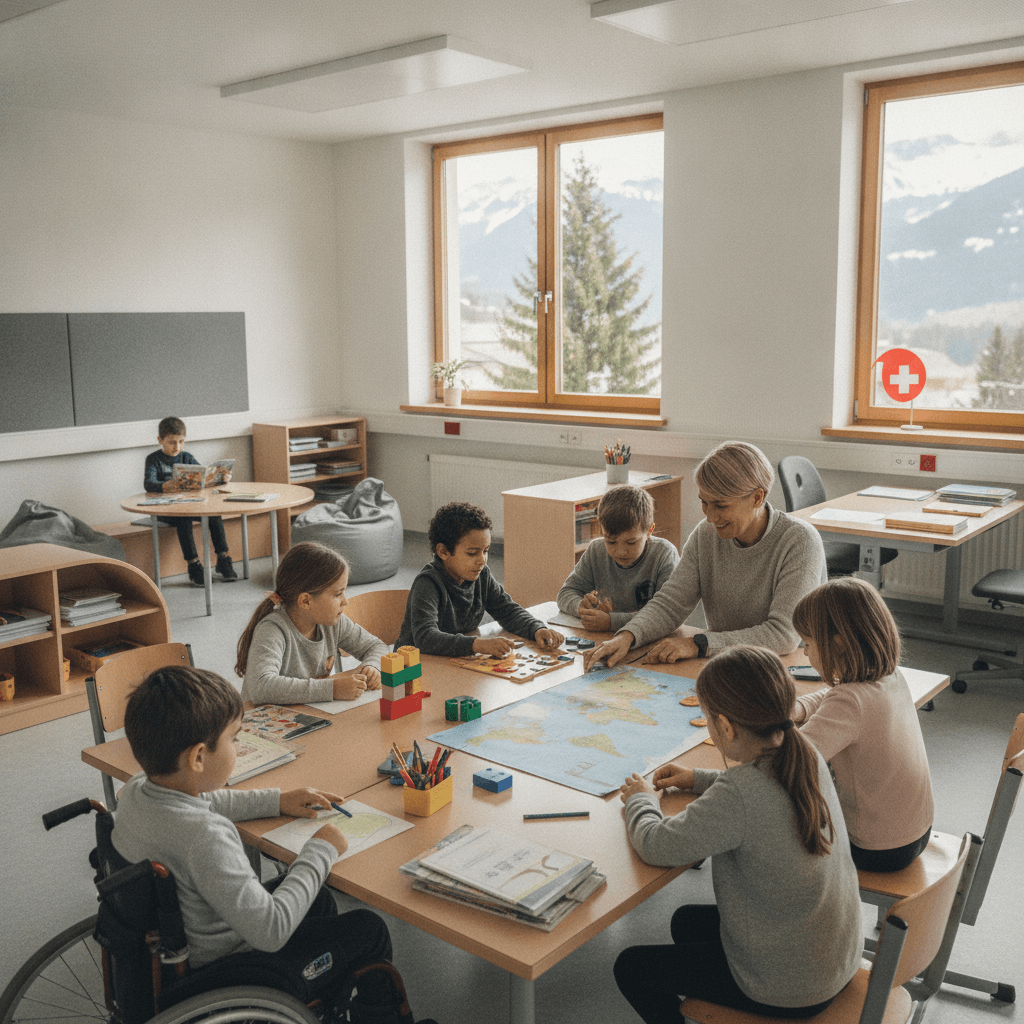
What does integrated education mean in Switzerland?
In Switzerland, integrated education refers to an approach in which support for children with special educational needs (besonderer Bildungsbedarf) is primarily organised within the mainstream school environment. The starting point is not separating the child, but identifying the educational support they require.
Article 2.2 of the special education concordat of the Swiss Conference of Cantonal Education Directors, the EDK (Schweizerische Konferenz der kantonalen Erziehungsdirektorinnen und -direktoren)—the Sonderpädagogik-Konkordat—sets out the principle of “integration before separation”. This education policy guideline, in force since 2007, establishes the priority of integration.
The principle does not mean that every child must participate in the same form of teaching. The actual need for support must be assessed individually in every case. The question is not merely whether the child attends the same building or class as other children, but also whether they receive the support genuinely necessary for learning and participation in the community.
Clarifying these concepts can be particularly useful for Hungarian families. The Hungarian term “special educational needs” cannot automatically be equated in every case with a Swiss school classification. In Switzerland, the framework for educational support is determined within the cantonal system.
Why does the integrative school model divide teachers?
The debate about integration centres on how to reconcile support tailored to an individual child with the conditions required to teach the class as a whole. The goal of inclusion alone does not resolve situations in which a child needs intensive, sustained support.
In professional public discourse, the Swiss Teachers’ Association, the LCH (Dachverband Lehrerinnen und Lehrer Schweiz) and its president, Dagmar Rösler, also feature in the debate about the conditions for integrative schooling. The debate is not the same as asking whether a child is “suitable” for school. Rather, it concerns the organisational and pedagogical framework needed to make mainstream education and individual support work simultaneously.
The name gfs.bern also comes up in Switzerland’s public debate on integrated education. For families, the practical lesson is that “integrated” and “separate” solutions are not always two rigidly distinct categories. Transitional and partly segregated forms may also exist.
The tension becomes particularly visible when continuity in classroom teaching and the need for development support tailored to one child arise at the same time and in the same place. In such cases, it is not enough to decide based on an abstract label: the child’s situation, support needs and the school’s framework must be assessed together.
What role does the tension between inclusion and teaching conditions play?
The aim of inclusion is to ensure that special educational needs do not automatically lead to segregation. At the same time, the question of teaching conditions examines what form of support provides a workable learning environment for both the child and the class.
Joint education is not merely an administrative solution when it creates a learning situation that is understandable, manageable and safe for the child. It is equally important that the learning opportunities of the other children are not impaired over the long term.
That is why the Swiss debate is not solely about whether to support or oppose segregation. It also concerns whether there is a place for targeted developmental groups, special support classes or temporary, small-group learning settings. The cantons provide different answers to this question.
A Kleinklasse, meaning a small class, and the concept of a Förderklasse, or support class, may initially seem similar to Hungarian parents. However, the specific content must always be understood in light of the arrangements applied by the relevant canton and school.
What partially separated arrangements is Basel-Stadt introducing?
In autumn 2024, the Basel-Stadt cantonal parliament adopted a package of measures to further develop integrative schooling. The package is gradually restoring partially separated support arrangements.
The measures include support groups (Fördergruppen), support classes (Förderklassen) and learning islands (Lerninseln) established for children with behavioural difficulties. These do not represent a complete abandonment of the principle of integration, but rather its cantonal reinterpretation.
The example of Basel-Stadt highlights that, in the Swiss education system, the implementation of integration is not based on a uniform nationwide model. Hungarian families should therefore not assume that a type of school familiar in one canton will automatically be available in another.
The appropriate solution for a child may be fully integrated, partially separated or support organised in another way. More important than the designation is what specific assistance and learning framework the chosen arrangement provides.
What would implementation of the Förderklassen-Initiative make possible in Zürich?
The government of the Canton of Zürich, the Regierungsrat, presented its proposal for implementing the Förderklassen-Initiative in November 2025. The proposal would allow municipalities to refer individual children to separate support classes.
The proposal concerns children with behavioural difficulties or those whose learning is severely impeded. The transfer would last for at least half a school year.
This proposal applies to the canton of Zürich, not to Switzerland as a whole. In Swiss education matters, cantonal differences are decisive, so the family’s place of residence or planned place of residence may directly affect which forms of support are considered.
For Hungarian parents, the term “separate class” can understandably cause concern. When assessing the decision, however, it is advisable to clarify precisely whether it is intended to be temporary or permanent, what its educational purpose is, and how it relates to the child’s overall development in primary school.
What does the law provide for integration and separation?
The EDK Special Needs Education Concordat contains the principle of “integration before separation”. This principle gives priority to integrated solutions in special needs education.
In Swiss specialist terminology, the abbreviation BehiG also appears in discussions concerning legal and social issues affecting people with disabilities. However, the specific form of school support is not determined by a single abbreviation or principle, but by an individual needs assessment and the cantonal system.
The principle of integration therefore does not make the debate about partially separate forms of support meaningless. On the contrary: the question is which framework best supports the child’s learning and participation in the individual case.
How is a child’s need for support determined?
The child’s ability to be integrated and the level of support required are determined using the standardised assessment procedure, SAV (Standardisiertes Abklärungsverfahren). Cantonal school psychology services participate in the assessment.
The purpose of the SAV is to ensure that the decision is not based solely on impressions or on a single difficulty. The process serves to determine the child’s need for support and the educational framework suited to it.
A family arriving from Hungary should keep the child’s previous school, developmental and specialist reports organised and safely stored. These can help the Swiss school and school psychology service gain an understanding of the child’s background, but the Swiss support decision is made within the framework of the local procedure.
What should Hungarian families living in Switzerland know?
One of the most important starting points for Hungarian families is that educational and special needs provision in Switzerland may differ from canton to canton. It is not enough to ask generally about “the Swiss system”: the arrangements of the specific canton, municipality and school must always be examined.
A child’s diagnosis in Hungary, developmental history or previous school support may provide important background information. However, it does not replace the Swiss needs assessment under the SAV.
The language situation must also be distinguished from a special educational need. After moving, a child has to adapt simultaneously to a new school language, class community and learning structure. It may therefore be helpful for the family to review in advance what kind of educational support, support group or support class the school offers.
During discussions with parents, it is advisable to ask clear questions: What is the purpose of the support, how is it provided, who is involved in the decision, and when will the situation be reassessed? This gives the family more than just a label and helps them better understand the reasons for the proposed course of action for the child.
What practical questions should be asked when choosing a school?
When choosing a school, the family should clarify more than whether the school describes itself as integrative. The key question is how it puts integration into practice and what forms of support are available within the local system.
The following questions may help during the initial discussion:
What forms of support are available at the school? Ask about integrated support, support groups (Fördergruppen), support classes (Förderklassen) and any small classes (Kleinklassen).
Who determines the need for support, and through what procedure? Clarifying the role of SAV and the cantonal school psychology service helps explain the decision-making process.
What is the purpose of the proposed support? It should be clear to the family whether the support is intended to address learning, participation in the school community, behavioural situations, or a combination of these.
How long will the proposed measure last? Zürich canton’s proposal provides for placement in a support class for at least half a school year; other cantons may have different regulations or practices.
How do they maintain contact with parents? The family can make a responsible decision only if it understands what information it will receive about the child’s support and progress.
Sources
EDK – principles of integrative schooling and the Special Education Concordat
Canton of Basel-Stadt – further development of integrative schooling
Canton of Zürich – proposal for implementing the Förderklassen-Initiative
Watson – LCH’s position on resources for integrative schooling
Related Articles
In Brief
In Switzerland, integration takes priority over separation, but this does not mean that every child must be educated in the same setting. Support is determined through an individual needs assessment and cantonal regulations, so the appropriate solution may be fully integrated, partially segregated or provided in a special education class.
Key Takeaways
- Check the specific support options available in the canton and at the school, as integration practices may vary from one canton to another.
- Organise the child’s previous school, developmental and expert documentation, but expect the Swiss decision to be based on the local SAV procedure.
- During discussions with the school, clarify whether integrated support, a Fördergruppe, Förderklasse or Kleinklasse is available.
- Ask what the proposed support is intended to achieve, who makes the decision and when the situation will be reassessed.
- Distinguish language-adaptation difficulties from special educational needs, as both may be present at the same time.
- Do not focus solely on the school’s use of the term “integrative”; also examine what concrete assistance and learning framework it provides for the child and the class.
Frequently Asked Questions
What does integrated education mean in Switzerland?
It means that support for a child with special educational needs is primarily organised within the regular school environment. The priority given to integration does not mean that every child must participate in the same form of instruction; support must be determined individually.
Is a child with special educational needs automatically placed in an integrated class?
No. Integration is the principle given priority over separation, but the actual educational setting is determined based on the child’s support needs and the system of the relevant canton. A partially segregated or special education setting may also be considered.
Who determines what support the child needs?
The SAV, or Standardisiertes Abklärungsverfahren, plays a role in determining the child’s needs. Cantonal school psychology services are involved in the process, and the decision is not based solely on one difficulty or impression.
Does Switzerland accept a diagnosis or expert documentation issued in Hungary?
A diagnosis from Hungary, developmental history and previous school support may provide important background information. However, they do not replace the Swiss needs assessment, as the support decision is made through the local procedure.
What partially segregated educational settings may exist in Switzerland?
Depending on the canton and school, options may include special education groups, Fördergruppen, special education classes, Förderklassen, small classes, Kleinklassen, and other temporary learning arrangements. The specific meaning of these terms is not identical in every canton.
What did Basel-Stadt change in integrative education?
In autumn 2024, the Basel-Stadt parliament adopted a package of measures that gradually reinstates partially segregated special education settings. These include Fördergruppen, Förderklassen and Lerninseln for children with behavioural difficulties.
What should be known about the proposed implementation of the Zürich Förderklassen-Initiative?
In November 2025, the Zürich cantonal government presented a proposal that would allow municipalities to refer some children to separate special education classes. The proposal forms part of the regulations applicable in Zürich and mentions a minimum duration of half a school year; it is not a nationwide Swiss rule.
Related articles
How strong is English teaching in Swiss secondary schools?
English teaching in Switzerland varies from canton to canton. English is a compulsory foreign language, but the cantons determine the number of lessons, curricula and teaching methods.

Council of States Decides on Swiss Tuition Fees for EU Students
The decision points towards equal tuition fees for EU and Swiss students, but further parliamentary steps and a referendum are required for the change to take effect.
Are Teachers Overburdened in Swiss Inclusive Schools?
In the debate over Swiss inclusive schools, teachers’ workload, support classes and available places have once again taken centre stage.