How strong is English teaching in Swiss secondary schools?
English teaching in Switzerland varies from canton to canton. English is a compulsory foreign language, but the cantons determine the number of lessons, curricula and teaching methods.
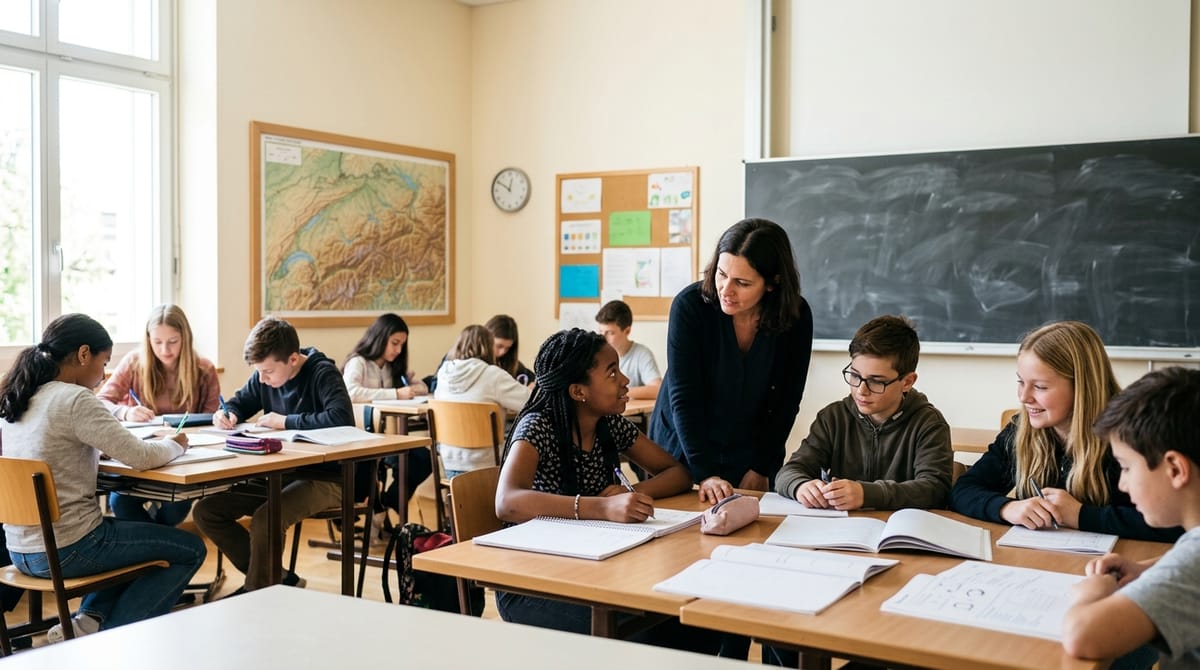
Why might students in Zürich and Genève learn English differently?
In Switzerland, education is a cantonal responsibility, so there is no single nationwide English curriculum, number of lessons, or teaching methodology. A student in Zürich and one in Genève both learn English, but the way education is organised locally may differ.
The framework is coordinated by EDK, the Swiss Conference of Cantonal Ministers of Education (Schweizerische Konferenz der kantonalen Erziehungsdirektorinnen und -direktoren). At the same time, the cantons define the details of education within their own remit.
The EDK curricula and regional harmonisation agreements play a role in this. These include the HarmoS-Konkordat, an agreement aimed at harmonising certain elements of compulsory schooling.
In the German-speaking regions, Lehrplan 21, while in French-speaking Switzerland, Plan d’études romand (PER) may serve as important reference points for curriculum-related matters. For a family, this means that it is not enough simply to ask: “Does the school offer English?” The real question is how English learning is structured in the relevant canton and at the relevant school level.
What does the cantonal difference mean in practice?
The cantons determine the number of lessons within their own remit. Therefore, the intensity of English teaching cannot be described by a single weekly number of lessons applicable throughout Switzerland.
The organisation of teaching may also differ. The type of school, the student’s educational pathway, and the local curriculum can all influence the role English plays.
Question | Swiss principle | What does this mean for the family? |
|---|---|---|
Is English compulsory? | Under the EDK-Sprachenstrategie, English is one of the two compulsory foreign languages. | English is part of language learning in public education. |
Is the number of lessons standardised? | No, the cantons decide this within their own remit. | You need to request the specific school's timetable separately. |
Is the methodology uniform? | There is no nationwide federal methodology. | It is advisable to ask the school directly about how English lessons are structured. |
Which other language is taught alongside English? | A second national language is also compulsory. | The canton’s linguistic environment is particularly important when choosing a school. |
What does the Swiss language strategy stipulate about English lessons?
According to the EDK national language strategy, EDK-Sprachenstrategie every student must learn two foreign languages during compulsory schooling: a second national language and English. This underscores the established place of English in Swiss public education.
The second national language may be German, French or Italian. Which language takes priority may depend on the canton’s linguistic environment.
In lower secondary education, that is, at Sekundarstufe I level, English is one component of language education. Hungarian families often refer to this level as “secondary school,” but in Switzerland it is important to distinguish precisely between lower and upper secondary education.
*Lower secondary education (Sekundarstufe I, Sekundarschule):* the upper stage of compulsory schooling, where students also receive foreign-language instruction.
*Upper-secondary education (Sekundarstufe II):* the level of education following compulsory schooling.
*Academic secondary school (Gymnasium, or in some cantons Kantonsschule):* a type of upper-secondary institution whose language offering is also shaped by local regulations and the school’s programme.
The principle of two foreign languages does not mean that every school has the same number of hours, uses the same textbooks, or applies the same speaking-focused methods. Compulsory language learning and the actual quality of teaching are two separate issues.
Why is this important for Hungarian families moving to Switzerland?
For a child arriving from Hungary, English lessons are only one part of linguistic integration. The family should consider the school’s language of instruction, the second national language and the role of English together.
If the child previously learned English at a Hungarian school, it is not advisable to assume automatically that they will be at the same point in the curriculum in Switzerland. Because of differences in curricula, the sequence of languages and cantonal organisation, the individual school situation needs to be clarified.
It is particularly useful for Hungarian families to consider three aspects in advance:
What language is used for everyday instruction? English lessons do not replace learning the local school language, which may also be crucial for understanding the other subjects.
What level of English does the child already have? It is advisable to discuss with the school how the child’s previous English learning fits into the work of the local class.
What educational pathway lies ahead for the child? The Sekundarstufe I, Sekundarstufe II, and the academic-track pathway may differ. The place of language subjects should therefore be considered not in isolation, but as part of the child’s overall educational pathway.
Before moving, parents should check not only the canton of residence but also the language programme of the designated local school. This is particularly important if the family considers continuing the child’s education in English an important factor.
Do young people in Switzerland really have weaker English skills than the international average?
There is no single nationwide answer to this question simply because English is compulsory in Switzerland. The fact that it is a compulsory subject does not mean that the same results are achieved in every canton, type of school or group of learners.
The EF English Proficiency Index (EF EPI) is often mentioned when comparing countries’ English proficiency. However, when assessing a child’s actual school-based English skills, the school’s curriculum, assessment practices and the child’s own language background provide the family with more directly relevant information.
“Good English teaching” may encompass several distinct questions:
How much emphasis is placed on speaking skills in English lessons?
How are written and oral performance assessed?
Are there opportunities to catch up or to work at a higher level?
How do they handle situations in which the child previously learned English under a different curriculum?
How is English connected to learning the second national language?
When interpreting the school’s responses, it is advisable to avoid general national comparisons. In Switzerland’s decentralised education system, the practices of a specific institution may be far more important for the family’s everyday life.
What challenges may English teachers in public schools face?
The quality of English teaching is influenced not only by the curriculum and the number of lessons, but also by teachers’ responsibilities. English teachers may sometimes teach other subjects as well, such as German.
Some reports associate this, in certain cases, with methodological rigidity or shortcomings in pronunciation. This does not mean that such a problem exists in every school or with every teacher, but it does justify parents asking specific questions about teaching practices.
Early foreign-language education in Switzerland is also the subject of educational policy debate. The FDP and certain cantonal initiatives have proposed discontinuing early foreign-language teaching in primary school and suggested that language learning should begin at Sekundarstufe I level.
The arguments included the claim that early language instruction may overburden children or impair their mother-tongue skills. The debate itself shows that the role of English in schools is not a settled or uniformly managed issue.
What information should you ask the school for?
When contacting the school, it is advisable to use a short, specific list of questions, either in writing or during a personal conversation. This enables the family to make a decision based not on general impressions, but on information applicable to the child’s individual situation.
Which curriculum applies to English teaching? Ask whether the school organises language teaching on the basis of the Lehrplan 21, the Plan d’études romand (PER), or another local framework.
How are English and the second national language taught? The two foreign languages are compulsory, but the local language sequence and organisation are important practical matters for the family.
How many English lessons are included in the child’s current timetable? The number of lessons should be requested directly from the school concerned, rather than inferred from a nationwide rule.
How does the school assess the English skills of newly arrived children? This is particularly important if the child has already studied English for several years in Hungary.
What support does the student receive if their prior knowledge differs? This may concern catch-up support, group placement, or the opportunity to progress at a higher level.
What proportion of the English lesson is devoted to oral communication? This helps you understand which language skills the school prioritizes.
Who teaches English, and do they teach other subjects as well? The question is not intended to assess the teacher, but to help clarify how teaching is organized.
Sources
The Local – How well is English taught in Switzerland’s secondary schools?
Eurydice / – Teaching and learning in general upper secondary education
Related articles
In Brief
In Switzerland, English is one of the two compulsory foreign languages, but there is no nationally standardised English curriculum, number of lessons or teaching methodology. Actual teaching practice may vary by canton, school type and the programme of the individual institution.
Key Takeaways
- According to the EDK-Sprachenstrategie, pupils must learn English and a second national language during compulsory schooling.
- The number of English lessons is not uniform across Switzerland: the cantons decide this independently.
- In German-speaking regions, Lehrplan 21 may provide an important curricular framework; in French-speaking Switzerland, the Plan d’études romand (PER) may play this role.
- Compulsory English learning alone does not indicate which teaching methods are used or what results pupils achieve.
- When moving, it is advisable to clarify the school’s language of instruction, language programme and assessment of the newly arrived child’s knowledge.
Related articles
Council of States Decides on Swiss Tuition Fees for EU Students
The decision points towards equal tuition fees for EU and Swiss students, but further parliamentary steps and a referendum are required for the change to take effect.
Are Teachers Overburdened in Swiss Inclusive Schools?
In the debate over Swiss inclusive schools, teachers’ workload, support classes and available places have once again taken centre stage.
How Long Does Integration Work in Schools in Switzerland?
In Switzerland, integration is the guiding principle, but partially segregated solutions may also be used, depending on the child’s needs, the situation in the class and cantonal regulations.