Do construction sites in Switzerland have to close during heatwaves?
Svájcban a hőség miatt jelenleg nem tekinthető automatikusan országosan kötelezőnek az építkezések leállítása. Rendkívüli melegben azonban a munkáltatónak a konkrét hőterheléshez kell igazítania a munkaszervezést, például korábbi munkakezdéssel, árnyékos pihenőhellyel, ivóvízzel, megfelelő pihenőkkel és a megterhelő feladatok átszervezésével. A genfi SIT szakszervezet kötelező munkaleállítást követel. A munkavállaló jelezze korán a rosszullétet, és kérjen érthető utasítást.
Why is heat particularly hazardous on construction sites?
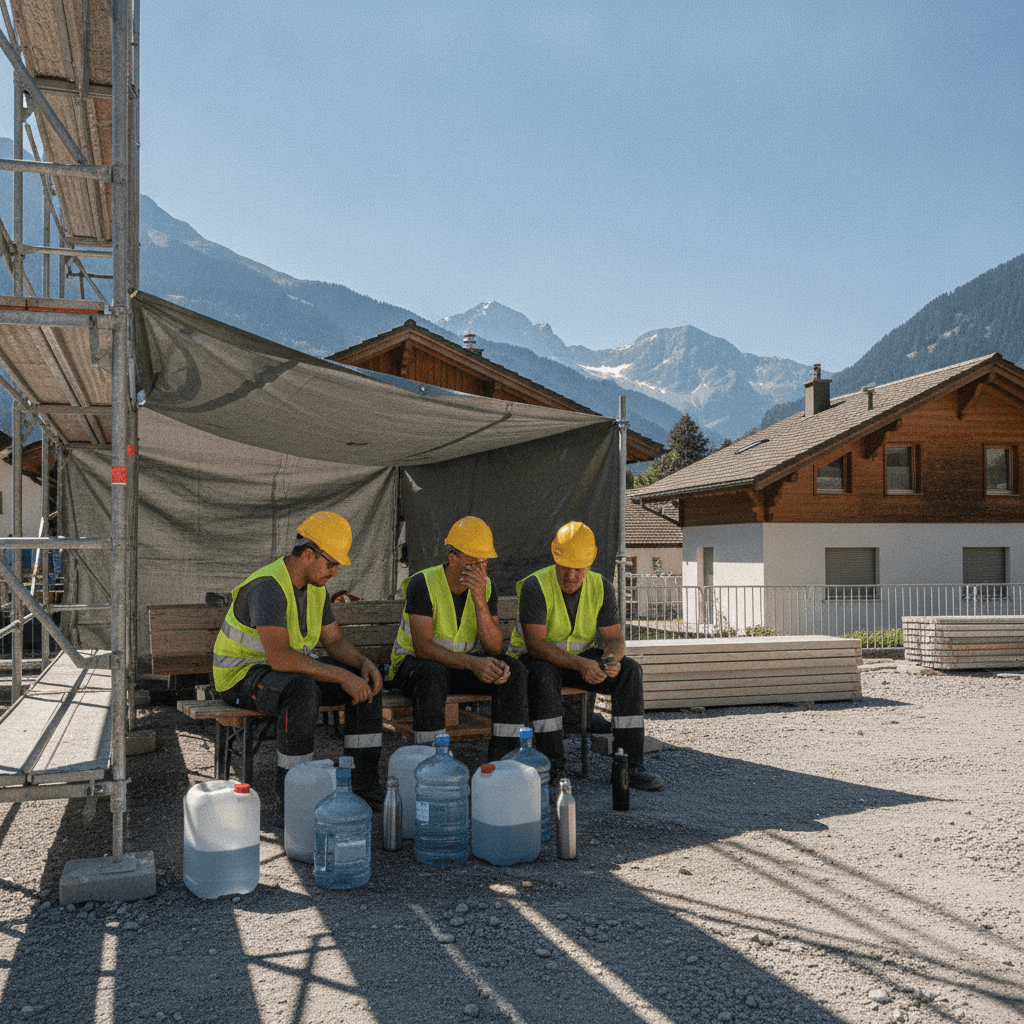
Construction work in hot weather combines several sources of strain: physical labour, direct sunlight, wearing protective equipment and, in many cases, a heat-reflecting built environment all make the work more difficult at the same time.
In an office, temperature may cause discomfort, but on scaffolding, roofs, road construction sites or during concreting, high heat exposure can become a direct occupational safety risk. Reduced concentration, feeling unwell or rushing are particularly dangerous in jobs involving machinery, vehicles, work at heights or the handling of heavy materials.
A heatwave (Hitzewelle) therefore cannot be handled in the same way at every workplace. An air-conditioned office, a workshop and a construction site exposed to sunlight may require different measures.
For Hungarians working in Switzerland, a practical challenge may be that occupational safety instructions are given in German, French or Italian. If an instruction is unclear, it is advisable to clarify it with the direct supervisor or the person responsible for occupational safety before starting work.
What does the Geneva SIT trade union demand in extreme heat?
The Geneva SIT trade union is calling for mandatory work stoppages during periods of extreme heat. At the heart of this demand is the principle that workers exposed to heat—including construction workers—should not have to rely solely on protection determined by individual workplace decisions.
The issue is not whether summer heat is uncomfortable, but at what point heat exposure becomes so severe that work organisation must be changed substantially. SIT criticises the current situation because protection is not equally predictable and consistent for everyone affected.
In this debate, the term “heat leave” or a work stoppage due to heat (Hitzefrei) means that work would have to be suspended mandatorily in specified cases of extreme heat. This would be particularly significant for outdoor and physically demanding work.
The issue may affect sectors beyond construction as well. Those working in road construction, horticulture, logistics, agriculture, municipal services and outdoor maintenance may be particularly affected.
Does statutory “heat leave” exist in Switzerland?
The question of mandatory work stoppages due to heat in Switzerland is part of a broader debate about occupational safety, employer responsibility and specific working conditions. The Geneva SIT trade union’s demand is specifically aimed at making work stoppages mandatory during extreme heat.
Working in hot weather cannot be separated from the Swiss occupational safety framework. An important point of reference is the Employment Act (Arbeitsgesetz, ArG) and the associated ArGV 3 ordinance implementing it.
In practice, it is not enough for an employer simply to issue a general warning about the heat. The way work is performed must be adapted to the circumstances: working on a roof in the midday sun may require a different decision from tasks carried out under cover or in alternating shifts.
Employees do not have to decide on their own what level of health risk is acceptable. Heat-related problems should be reported to the direct supervisor, and employees should ask for the instructions to be clear.
What health protection obligations does an employer have in extreme heat?
Occupational health protection (Occupational health protection) means that the risk posed by heat must also be taken into account when organizing work. Employer measures must be adapted to the actual working environment, not merely to the official air temperature recorded on a given day.
On construction sites, it is advisable to clarify the following questions in advance:
The start of the working day: Starting work earlier during hot weather can reduce the proportion of work carried out in the strongest sunlight.
The organization of working and rest periods: The location, timing and actual use of breaks must all be clearly defined.
Availability of a shaded rest area: A break provides protection only if the area can genuinely be used, is accessible and is not skipped because of the pace of work.
Access to drinking water: Workers must know where drinking water is available at the worksite and under what conditions.
Reorganizing tasks: Scheduling or sharing particularly strenuous tasks exposed to sunlight may be a matter of occupational safety.
Clear information: As a Hungarian-speaking employee, you should ask for comprehensible instructions if language barriers affect safety communication on site.
Several employers and subcontractors often work simultaneously on Swiss construction sites. It is therefore particularly important to clarify who is responsible for organizing work on site, providing rest areas and communicating the daily protective measures.
What role do SECO, Unia and SBV play?
The State Secretariat for Economic Affairs (SECO) is one of the central Swiss institutions responsible for occupational safety matters. The Labour Act (Arbeitsgesetz, ArG) and the framework of ArGV 3 are also relevant to interpreting occupational health protection.
Trade unions also play a prominent role in the issue of construction work in hot conditions. Unia and Syna appear as employee representatives in debates on workplace protection.
The Swiss Association of Master Builders (Schweizerischer Baumeisterverband, SBV) is an important representative of the employer side in the sector. Practical solutions for heat protection in construction are therefore not merely individual workplace issues, but also sector-wide work organisation issues.
As a Hungarian employee, it is advisable to distinguish between three levels:
Level | What does this mean in practice? |
|---|---|
Workplace level | Daily start times, tasks, breaks and on-site instructions are determined at this level. |
Sector level | Trade unions and employer organisations also discuss joint expectations regarding heat. |
Regulatory level | SECO and the cantonal authorities are involved in occupational safety frameworks. |
How does Valais canton apply the WBGT index?
In July 2026, Valais canton expanded its measuring network with 32 new meteorological probes. The purpose of the expansion is to monitor the WBGT index in real time.
The WBGT index (Wet Bulb Globe Temperature) is also known in Hungarian as wet-bulb globe temperature or the heat stress index. It does not consider air temperature alone, but evaluates temperature, humidity, wind and radiation together.
This approach is particularly relevant for the construction industry because heat exposure cannot be fully described by a single temperature reading taken in the shade. On the same day and in the same municipality, exposure may differ between a shaded, well-ventilated location and a sunny worksite that reflects heat.
The measure taken by Valais is a cantonal solution. In Switzerland, practical responses to heat can vary from canton to canton and from one workplace to another, so it is not advisable to infer a nationwide rule from the experience of a single municipality.
MeteoSwiss weather information, together with conditions on site, can help in reviewing the organisation of daily work. For employees, however, the key question remains what specific protective measures are in place at the construction site in question.
What special consideration is given to pregnant and breastfeeding employees?
In Switzerland, the protection of pregnant and breastfeeding employees is also covered by the Maternity Protection Ordinance (OProMa / Mutterschutzverordnung). During periods of heat, it is particularly important that the employee concerned does not rely solely on informal arrangements.
In such circumstances, it is advisable to inform the employer of the working conditions in good time. If the employee is Hungarian and the language used for company information is not clear to them, requesting written communication or interpreting assistance may be appropriate.
The individual health situation and the precise nature of the work may require an individual assessment. During discussions at the workplace, it is advisable to record which tasks, working hours or on-site conditions are causing difficulties.
What can a Hungarian employee do in Switzerland during periods of heat?
Protection against heat works best when employees do not raise the issue only once they are already feeling unwell. At the start of the working day, it is advisable to clarify how that day's tasks will be organised and where they can go to rest during breaks.
The following practical steps may help:
Ask for clear instructions on site: If it is unclear when breaks are scheduled or whom to contact in case of illness, this must be clarified before starting work.
Raise the issue early: Do not try to conceal feeling unwell, dizziness or weakness caused by the heat from colleagues or supervisors.
Document the discussion: In a dispute, it may be useful to note when, to whom and what heat-related problem was reported.
Seek support from employee representatives: Unia or Syna may be a suitable starting point if the workplace does not adequately address health and safety issues related to heat.
Do not sign a document you do not understand: If the content of an accident-related, medical or employment-law declaration is unclear, ask for an explanation in a language you understand.
Hungarian employees may face additional difficulties because of a more vulnerable position at work, for example during a probationary period, under a short-term contract or when working as a subcontractor. Raising a workplace safety issue is not impolite, however: safe working conditions are a fundamental workplace matter.
Sources
Related Articles
In Brief
According to the article, Switzerland has no nationwide, automatically applicable “heat leave”, but during exceptionally hot weather employers must adapt work organisation and protective measures to the actual heat exposure. On construction sites, earlier starts, shaded rest areas, drinking water, adequate breaks and reorganising tasks are particularly important; the Geneva SIT trade union is calling for mandatory work stoppages.
Key Takeaways
- Before starting work, clarify the day’s tasks, break arrangements, the location of a shaded rest area and access to drinking water.
- During exceptionally hot weather, check whether work organisation takes account of solar radiation, humidity, wind and radiant heat.
- If occupational safety instructions in German, French or Italian are unclear, ask your direct supervisor or the responsible person for an understandable explanation.
- In the event of dizziness, weakness or feeling unwell, report the problem immediately to your supervisor and colleagues.
- In a dispute, record when, to whom and what heat-related problem you reported.
- If the workplace does not properly address heat protection, contact Unia or Syna for support, and do not sign documents you do not understand.
Frequently Asked Questions
Do construction sites in Switzerland have to close during hot weather?
According to the article, there is no nationwide rule that automatically requires all construction sites to close during hot weather. However, employers must adapt work organisation and protective measures to the specific working conditions and heat exposure. The Geneva SIT trade union is calling for mandatory work stoppages in exceptionally hot weather.
Does a statutory “heat leave” exist in Switzerland?
The article does not establish that a nationwide mandatory “heat leave” exists. The issue relates to Swiss occupational safety rules, particularly the Arbeitsgesetz and the ArGV 3 ordinance, while SIT is advocating the introduction of mandatory work stoppages.
What measures should be clarified on a Swiss construction site during hot weather?
It is advisable to clarify the start time, break arrangements, use of a shaded rest area and access to drinking water in advance. The timing and distribution of particularly strenuous or sun-exposed tasks should also be reconsidered.
What can a Hungarian worker do if they do not understand the instructions concerning hot weather?
The worker should request a clear explanation from their direct supervisor or the person responsible for occupational safety before starting work. Accident, health or employment-law documents that are not understood should not be signed without an explanation; requesting written communication or language assistance may be appropriate.
When should heat-related illness be reported?
Feeling unwell, dizziness or weakness should be reported to the supervisor and colleagues at an early stage. According to the article, it is not advisable to wait until the condition becomes serious.
What is the WBGT index, and why is it important on construction sites?
The WBGT index, or heat stress index, does not consider air temperature alone; it assesses temperature, humidity, wind and radiation together. In July 2026, Valais expanded its measurement network with 32 new meteorological probes to monitor the WBGT index in real time.
Related articles

The number of banking jobs in Switzerland declined further
At the end of September, the ten largest Swiss banks had 1.7% fewer job postings for positions based in Switzerland than in August.

Swiss AI job market is expanding rapidly
The number of Swiss job postings related to AI has risen by 32% year on year. Growth is being driven primarily by SMEs and the public sector.

Is There an Automatic Annual Salary Increase in Switzerland?
In Switzerland’s private sector, there is no general statutory obligation to grant annual salary increases. Separate agreements may play a role in inflation-linked adjustments.