Why Does Switzerland Celebrate Its Birthday on August 1?
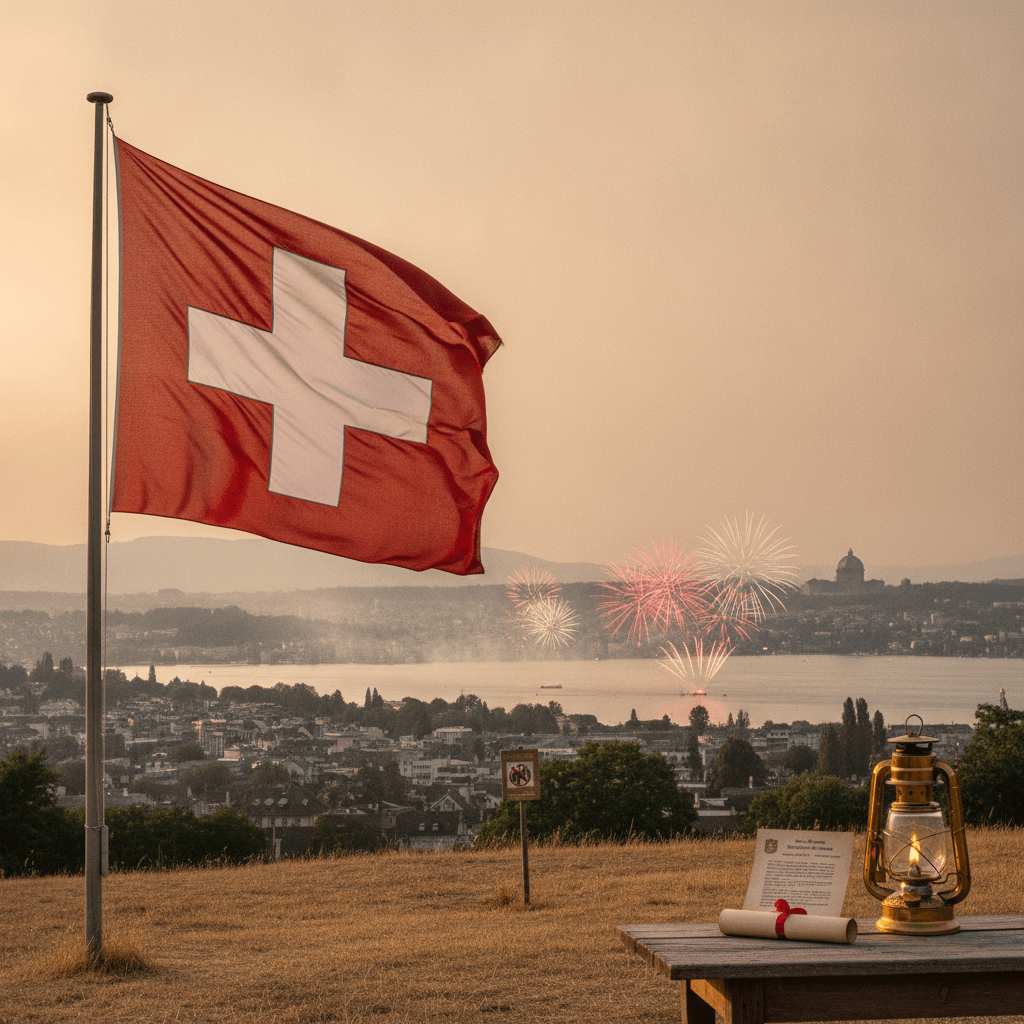
August 1 is Switzerland’s national holiday, but its historical origins and holiday regulations should be considered separately. In 2026, drought may lead to restrictions on fireworks.
What is the true historical background of the national holiday on 1 August?
The history of Switzerland’s federal holiday on 1 August is best understood on two separate levels: the interpretation linked to written historical sources and the story preserved as a national legend. The two have become closely intertwined in Swiss collective memory, but they do not have the same evidentiary value.
When discussing its historical origins, the Federal Charter, in German Bundesbrief, is a central concept. The names Uri, Schwyz and Unterwalden also regularly appear in festive narratives. These designations form part of public discourse about the founding of Switzerland, but a celebratory story cannot replace source-critical historical analysis.
The Rütli oath (Rütlischwur) is, by contrast, an element associated with the national founding legend. In the story, the Rütli meadow (Rütliwiese) plays a role. Its cultural significance is nevertheless real: through ceremonial speeches, school curricula, theatrical productions and tourism references, it remains a common point of reference for many Swiss people today.
Distinguishing between the two strands of the story is important because Switzerland did not emerge from a single, undisputed “birthday moment”. Today’s Swiss Confederation is the result of a long process of historical, political and institutional development. The 1 August holiday is a symbolic day of remembrance for this development.
As a Hungarian reader, it is easy to look for parallels with a state-founding holiday, but the logic of Switzerland’s federal system differs from the Hungarian state tradition. The coexistence of the cantons, municipalities and federal level can also be seen in today’s forms of celebration: programmes, opening hours and fire-safety regulations are not completely identical everywhere.
Why should the Federal Charter and the Rütli oath be distinguished?
The Federal Charter (Bundesbrief) is a concept linked to a written historical record, whereas the Rütli oath (Rütlischwur) is the best-known element of the national founding legends. Both may be mentioned in an article about the holiday, but it is not advisable to treat them as having the same degree of historical certainty.
The name Rütli meadow (Rütliwiese) is a particularly powerful symbol in the Swiss national self-image. This does not mean, however, that every account associated with the site and the oath can be read as a historical document.
A precise historical interpretation requires original archival materials, historical overviews and museum sources. The aim of this article is therefore not to repeat the details of the founding legend as fact, but to show that the Swiss national holiday is both historical memory and a community tradition.
When and why did 1 August become Switzerland’s official day of remembrance?
Today, 1 August is Switzerland’s federal holiday (Bundesfeier); however, the precise legal and political chronology of the holiday’s official recognition should be cited from verified historical and legal sources. Beyond historical remembrance, the national holiday’s present-day significance lies in publicly celebrating the country’s political community.
The role of the Federal Council (Bundesrat) and the cantons in Swiss public life is also apparent on public holidays. In some municipalities, speeches, community dinners, lantern parades or musical programmes take place, while elsewhere the celebrations are quieter.
A single national date does not mean that commemorations are identical everywhere. Events may be organised differently in the city of Zürich than in a small Alpine municipality or in the canton of Basel-Stadt. The organisation of the holiday, the programmes and the security measures may vary depending on local responsibilities.
When choosing a programme for 1 August 2026, it is advisable to check the latest announcement directly from the relevant city, municipality, tourism region or event organiser. An event that has traditionally taken place may be modified because of drought, fire risk or other safety reasons.
Since when has the Swiss national holiday been regarded as an official public holiday?
1 August is a nationally significant federal holiday, but its implications for employment law and opening hours should not be described through one simple rule. Working hours, supplements, substitute days off and business opening may all be affected by the employment contract, the sector, the canton and the rules of the particular employer.
Paragraph 3 of Article 110 of the Swiss Federal Constitution is a relevant reference point when examining the legal basis of the 1 August holiday. In an individual employment-law situation, however, it is not enough to know only the constitutional provisions: the collective agreement, the individual contract and the workplace rota may also be decisive.
Hospitals, transport providers, catering establishments, hotels, airports and certain tourism providers may operate on public holidays. The employer’s HR department, the applicable collective employment agreement or the cantonal labour authorities can provide precise information about the rights and remuneration of people working on 1 August.
Hungarian employees should in particular clarify their schedule in writing at their first Swiss workplace if they are not yet familiar with the system for public holidays. It is not advisable to automatically rely on practices associated with Hungarian public holidays.
How does the exceptional drought affect traditional holiday fireworks?
In July and August 2026, exceptional heat and drought are affecting large parts of Switzerland, so stricter fire-lighting and fireworks restrictions have been introduced in several places. The prohibitions vary by canton and municipality, so the locally applicable regulations should always be checked before the 1 August programme.
The German term for a fireworks ban is Feuerwerksverbot. The restriction may affect not only large, organised displays but also rockets, firecrackers, Roman candles, sparklers and other pyrotechnic devices used by private individuals. The specific devices and areas subject to a ban can only be determined on the basis of the local authorities’ current announcement.
The canton of Basel-Stadt and the city of Zürich are often searched for in connection with holiday restrictions, but in August 2026 it is not safe to rely on earlier social media posts or last year’s rules. The period of validity, geographical scope and exemptions of a particular ban may change rapidly.
What to check before setting off on 1 August 2026
Check the fire safety notice issued by the canton where you live, as the fire danger level and the geographical scope of any ban may vary from canton to canton.
Check the official information provided by your municipality or city, as local bans or additional restrictions may apply alongside the cantonal rules.
Check the event organiser’s latest notice, as an announced fireworks display or bonfire may still be cancelled on the day of the celebration.
If the rules are unclear, do not take pyrotechnic devices with you, as their legality is not determined by whether other people are using fireworks.
Take particular care with open flames and waste in natural areas, as even a small spark can pose a significant risk during dry periods.
watson.ch also reports on fire and fireworks bans in its August 2026 overview, but in practice, official cantonal or municipal notices should be treated as the primary source of information.
Will shops and services be open on 1 August?
There is no nationwide opening-hours rule that applies to every shop and service provider on 1 August. Actual opening hours may vary by shop, municipality, canton and type of service.
Shops at major railway stations and airports may be open according to holiday or Sunday opening hours. According to information for 2026, examples of such exceptions may include Zürich main station, Zürich HB Shopville, and some shops at Bern and Basel SBB stations.
Airports also have shops that may be open, including some Migros, Coop or Lidl locations. This does not mean that every airport shop or every Swiss branch of a particular chain will be open: opening hours should always be checked on the individual location’s website or in the information posted at its entrance.
Shops at petrol stations, such as some Coop Pronto locations, may also remain open. Shops in major tourist regions may be open as well, but this depends on local decisions.
What should you expect when shopping and travelling?
If you are arriving in Switzerland or setting off on a longer journey on 1 August, it is advisable to buy any necessary food, medication and basic household supplies the day before. Shops at railway stations, airports and petrol stations can be useful alternatives, but their selection, prices and opening hours may differ from those of regular shops.
Restaurants and other hospitality venues, museums, cable cars, swimming areas and tourist services may likewise have individual opening hours. A holiday programme or tourist attraction may be open, operate on a modified schedule, or offer a different range of services because of fire safety restrictions.
On public holidays, conclusions about the customer-facing and administrative availability of the Swiss Federal Office for Customs and Border Security (BAZG) should be based solely on BAZG’s current information. This article does not make any general statement that customs offices are closed on 1 August.
Sources
watson.ch – Overview of the 2026 Swiss National Day
watson.ch – Cantonal fire and fireworks bans before 1 August 2026
watson.ch – Swiss shops open on 1 August 2026
Related Articles
In Brief
August 1, known in German as *1. August*, is Switzerland’s national holiday (*Schweizer Bundesfeiertag*), marked across the country by community events, speeches and traditionally, fireworks. The Federal Charter (*Bundesbrief*) and the Rütli Oath (*Rütlischwur*) are often mentioned together when explaining the holiday’s historical origins, but documented historical facts should not be conflated with the national founding legend. In August 2026, extreme heat and drought may restrict celebrations in many places through fire-lighting and fireworks bans (*Feuerwerksverbot*).
Key Takeaways
- August 1 is Switzerland’s national holiday, known in German as *Schweizer Bundesfeiertag* or *Bundesfeier*.
- The Federal Charter (*Bundesbrief*) and the Rütli Oath (*Rütlischwur*) belong to different historical categories: the latter should also be understood as part of the national founding legend.
- The way Switzerland celebrates varies by canton and municipality, so local programmes should be checked separately.
- In August 2026, severe drought may result in fire-lighting and fireworks bans in many places.
- Whether fireworks are permitted must always be determined based on the latest official regulations issued by the relevant canton or municipality.
- Some station, airport, petrol station and tourist-area shops may be open, but there is no general rule that applies to all shops.
Frequently Asked Questions
What is celebrated in Switzerland on August 1?
August 1 is Switzerland’s national holiday, known as the *Schweizer Bundesfeiertag*. The day is linked to the historical memory of the Swiss Confederation and to its present-day political and community identity. Local celebrations vary from canton to canton and from municipality to municipality.
Are the Federal Charter and the Rütli Oath the same thing?
They should not be treated as identical. The Federal Charter (*Bundesbrief*) refers to a concept linked to a written historical source, whereas the Rütli Oath (*Rütlischwur*) is a well-known element of Swiss national founding legends. They may be mentioned together in a festive context, but they have different historical statuses.
Can private individuals use fireworks on August 1, 2026?
This depends exclusively on the current fire-safety regulations of the relevant canton and municipality. Due to the heat and drought in July and August 2026, restrictions have been introduced across significant parts of Switzerland. Check the local fireworks ban (*Feuerwerksverbot*) before setting off or purchasing fireworks.
Will Migros or Coop be open on August 1?
There is no uniform answer. Some shops at railway stations, airports or other special locations may remain open, while a conventional shop in an urban or residential area may have different opening hours. It is advisable to check the specific shop’s online opening hours directly.
Where are you most likely to find an open shop?
More shops may be open at major railway stations, airports, petrol stations and in certain tourist areas. Examples cited in 2026 overviews include Zürich HB Shopville, certain station outlets in Bern and Basel SBB, and some Coop Pronto shops. However, opening hours may vary from one shop to another.
Do people have to work on August 1 in Switzerland?
The possibility and conditions of working may depend on the sector, employment contract, collective agreement and the employer’s staffing arrangements. Work on public holidays may occur in hospitality, transport, healthcare and tourism. For individual cases, the employer’s written information is authoritative.