What was at stake in the vote, and what did the SVP want?
The initiative "No to a Switzerland of 10 Million!" (Volksinitiative „Nein zu 10 Millionen!") sought to enshrine in the constitution that Switzerland's population must not exceed 10 million before 2050. Achieving this would have required curbing immigration to a degree that, given current trends, could only have been accomplished by terminating the Agreement on the Free Movement of Persons with the EU (FZA — Freizügigkeitsabkommen).
Switzerland's current population stands at 9.1 million, more than a quarter of whom are foreign nationals. The SVP (Schweizerische Volkspartei — Swiss People's Party) argued that rapid population growth is placing excessive strain on housing, transport, healthcare, and education infrastructure.
The initiative was backed exclusively by the SVP — all other major parties, employer associations, and trade unions campaigned against it.
What was the outcome of the vote, and why was it close?
The final result: 54.79 percent voted No, and 45.21 percent voted Yes. Turnout was nearly 59 percent, well above the typical Swiss referendum average of around 49 percent.
The narrow result can be attributed to several factors:
The SVP consistently wins around 30 percent of Swiss parliamentary votes, yet this time it managed to bring nearly 46 percent of voters to its side.
Opinion was sharply divided between urban and rural Switzerland (covered in detail in the next section).
The campaign was intense: Geneva-based political scientist Pascal Sciarini, speaking to AFP, described the outcome as a "minor defeat" for the SVP, noting that the party had mobilised voters at a far higher rate than its parliamentary weight would suggest.
How does the Swiss voting system work — and why was a cantonal majority also required?
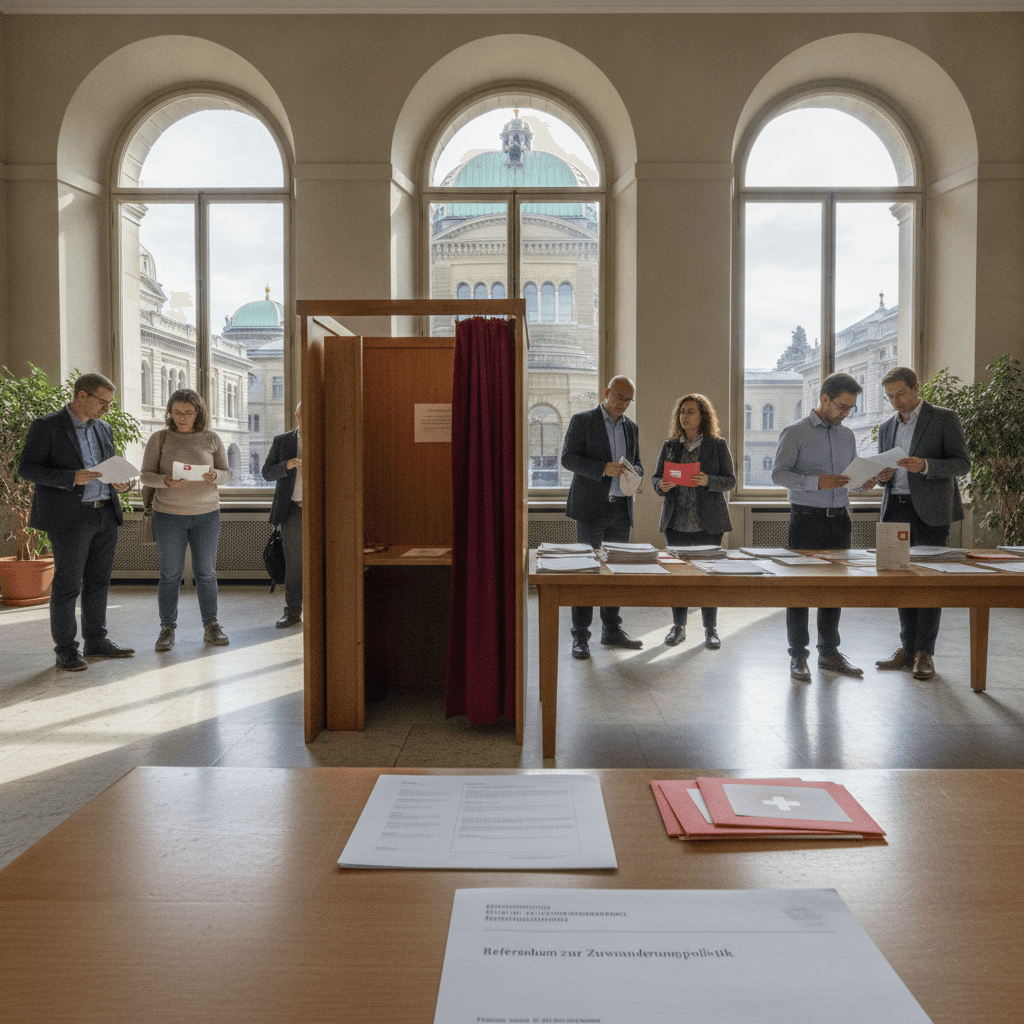
In Switzerland, referendums aimed at amending the constitution (Volksinitiative) require a double majority:
A majority of all votes cast must point in the same direction (popular majority).
A majority of the 26 cantons — at least 14 — must also return a majority in the same direction (cantonal majority).
This dual requirement (Volksmehr and Ständemehr) ensures that neither densely populated cities nor small rural cantons can unilaterally determine the content of the constitution.
In the case of the "against 10 million" initiative, 13 of the 26 cantons voted No — among them Basel-Stadt (73.48% No), Genève (over 65% No), and Zürich (60.03% No). Yes votes dominated in rural cantons, but the high turnout and strong rejection in urban cantons proved decisive for the overall result.
Why did cities and rural areas vote differently?
The urban-rural divide (Stadt-Land-Graben) has long been a defining feature of Swiss politics, and this vote was no exception.
Rural cantons: The share of Yes votes was higher. In smaller communities, the signs of infrastructure pressure — housing costs, overcrowded schools, transport capacity — are more keenly felt, and the SVP has traditionally held a strong base in these areas.
Urban cantons: The no votes dominated. In major cities, economic actors — companies, research institutes, hospitals — are heavily dependent on foreign labour. Among urban voters, the economic consequences of losing the bilateral agreements also proved a stronger argument.
Lucas Golder, political scientist at GFS Bern, told the SRF public broadcaster that the high turnout in urban areas corrected the rural yes-trend, and this ultimately decided the outcome.
Why does this matter for EU–Switzerland relations and Hungarian workers?
Hungary is an EU member state. This means that Hungarian citizens are entitled to work in Switzerland and apply for a residence permit (B or L permit) — under the same conditions as any other EU/EFTA national — based on the Agreement on the Free Movement of Persons (FZA).
Had the initiative passed, Switzerland would have faced the termination of the FZA. The possible consequences:
Area | Possible impact in the event of FZA termination |
|---|---|
Employment | Quota-based permit system, longer waiting times |
Residence permit | Stricter conditions, fewer automatic renewals |
Diploma recognition | The SBFI (Staatssekretariat für Bildung, Forschung und Innovation) procedure could become more complex |
Social security | Coordination rules (AHV/AVS, pension) would have required renegotiation |
Wages | Worker protection (flanking measures) is partially tied to the FZA |
A rejection therefore means the continuation of the current situation: for Hungarians heading to or working in Switzerland the applicable conditions do not change as a direct result of this vote.
How did economic actors and political parties react?
Employers and trade unions — which often stand on opposite sides on many issues — this time shared the same position.
Employers' side: The economiesuisse (the umbrella organisation of Swiss employers) director Monika Ruhl, speaking to the RTS public broadcaster, described the outcome of the vote as an "important result" for relations with the EU.
Trade unions: The Swiss Trade Union Federation (Schweizerischer Gewerkschaftsbund / USS) stated in a press release that voters had "said no to isolation".
Social Democrats (SP): Party co-president Cédric Wermuth described the result as a "huge relief" and noted that the campaign had been unusually heated in tone.
Centre Party: Parliamentary group leader Yvonne Bürgin emphasised that the rejection does not mean the debate is over. Politicians must take seriously the concerns about infrastructure pressure — the vote result is not an acquittal, but a mandate.
SVP: Marcel Dettling, the party president, expressed his disappointment and pointed out that the majority of rural cantons shared the SVP's position. SVP parliamentary representative Thomas Aeschi said the result sends a "very strong message" that a significant portion of the Swiss population is not satisfied with current immigration trends.
What does the result mean for the future of Swiss immigration policy?
The failure of the initiative does not mean that the question of immigration will disappear from the Swiss political agenda. A few important takeaways:
The SVP secured over 45 percent support: this signals that anti-immigration sentiment remains strong, and the party is expected to come forward with further initiatives.
Bilateral negotiations continue: Switzerland and the EU are currently in active talks about renewing the bilateral agreements (Bilaterale III). The rejection gives the Swiss government a stable basis for negotiations.
Infrastructure pressure is real: The housing shortage, healthcare capacity, and transport congestion are problems acknowledged across the entire political spectrum — the debate is about how to solve them, not whether they exist.
The next voting cycle: The SVP is expected to return with another, possibly revised proposal. Hungarians living in Switzerland would do well to keep an eye on the ch.ch and the Federal Chancellery (Bundeskanzlei) voting calendar.
Sources
Federal Chancellery (Bundeskanzlei / Chancellerie fédérale): www.bk.admin.ch — voting results and voting calendar
Swiss Federal Statistical Office (Bundesamt für Statistik / BFS): www.bfs.admin.ch — population data
The Local Switzerland: "Swiss reject divisive anti-immigration proposal" — https://www.thelocal.ch/20260614/breaking-no-to-10-million-vote-set-for-nail-bitin
economiesuisse (Swiss employers' association): www.economiesuisse.ch
Swiss Trade Union Federation (Schweizerischer Gewerkschaftsbund / USS): www.sgb.ch
Related Articles
Swiss residence permits in 2026: L, B and C types for Hungarians
The complete guide to the Swiss healthcare system for Hungarians
What you need to know about Swiss employment contracts and probationary periods
Before moving to Switzerland: what steps do you need to take?
Everything about Switzerland: what's worth knowing about the small giant
In Brief
Switzerland rejected the initiative to cap the population at 10 million by a majority of 54.79% — a vote that would have led to the termination of the Agreement on the Free Movement of Persons with the EU (FZA). The result followed a clear urban–rural divide: major cities (Zürich, Genève, Basel) voted against it due to their economic dependence on foreign labour, while rural cantons supported the SVP proposal. For Hungarian workers, the rejection means that the current equal-footing conditions with other EU citizens remain fully in place.
Key Takeaways
- The outcome of the vote does not directly affect the employment conditions of Hungarian workers in Switzerland — the FZA agreement remains fully valid.
- The urban–rural divide was decisive: major cities (Zürich, Genève, Basel-Stadt) voted against the initiative due to their economic actors' dependence on foreign labour, while rural cantons supported the SVP proposal because of infrastructure pressures.
- The SVP secured over 45% support, signalling that anti-immigration sentiment remains strong — the party is expected to come forward with further initiatives.
- The double majority requirement (a majority of votes cast and a majority of cantons) ensured that neither the populous cities nor the rural cantons could determine the outcome on their own.
- Infrastructure pressures (housing shortages, transport congestion, healthcare capacity) are a genuine concern acknowledged across the political spectrum — the debate is about how to address them, not whether they exist.
- Hungarians living in Switzerland would do well to monitor future SVP initiatives and the Federal Chancellery's voting calendar, as immigration will remain firmly on the political agenda.
Frequently Asked Questions
What is the FZA (Freizügigkeitsabkommen) and how does it affect Hungarian workers?
The FZA is the Agreement on the Free Movement of Persons between EU/EFTA member states and Switzerland. It allows Hungarian citizens, as EU nationals, to work in Switzerland, apply for residence permits, and acquire social security entitlements. The rejection of the initiative means this agreement remains in force and conditions will not become more restrictive.
Why did cities and rural areas vote differently?
Economic actors in major cities (Zürich, Genève, Basel) — companies, research institutions, hospitals — are heavily reliant on foreign labour, so terminating the FZA would have posed a serious economic threat. Rural cantons, by contrast, supported the restriction due to infrastructure pressures (housing costs, overcrowded schools, transport), and the SVP has a traditionally strong base in those areas.
What does the double majority requirement mean in Swiss votes?
For referendums aimed at amending the constitution, two conditions must be met in Switzerland: more than half of all votes cast must point in the same direction (popular majority), and at least 14 of the 26 cantons must have a majority in the same direction (cantonal majority). This ensures that neither the populous cities nor the rural cantons can determine the content of the constitution on their own.
What could have been the consequences of terminating the FZA for employment?
Terminating the FZA would have meant a switch to a quota-based permit system with longer waiting times. The conditions for residence permits would have become stricter, the process for recognising qualifications would have grown more complex, and the rules coordinating social security entitlements would have required renegotiation.
How did employers and trade unions respond to the vote?
Employers (economiesuisse) and trade unions (USS) — organisations that typically stand on opposite sides — took the same position this time. Both supported rejection, as terminating the FZA would have posed economic and social risks.
What does the rejection mean for future Swiss immigration policy?
The rejection does not close the debate on immigration. The SVP secured over 45% support, reflecting strong anti-immigration sentiment, and the party is expected to bring forward further initiatives. Infrastructure pressures remain a genuine concern acknowledged across the political spectrum.
Why was the result close if 54.79% ultimately voted no?
The result was close because the SVP managed to mobilise voters at a far higher rate — nearly 46% — than its parliamentary weight (around 30%) would suggest. Turnout of 59% also significantly exceeded the usual average of 49%, reflecting strong urban mobilisation in favour of rejection.