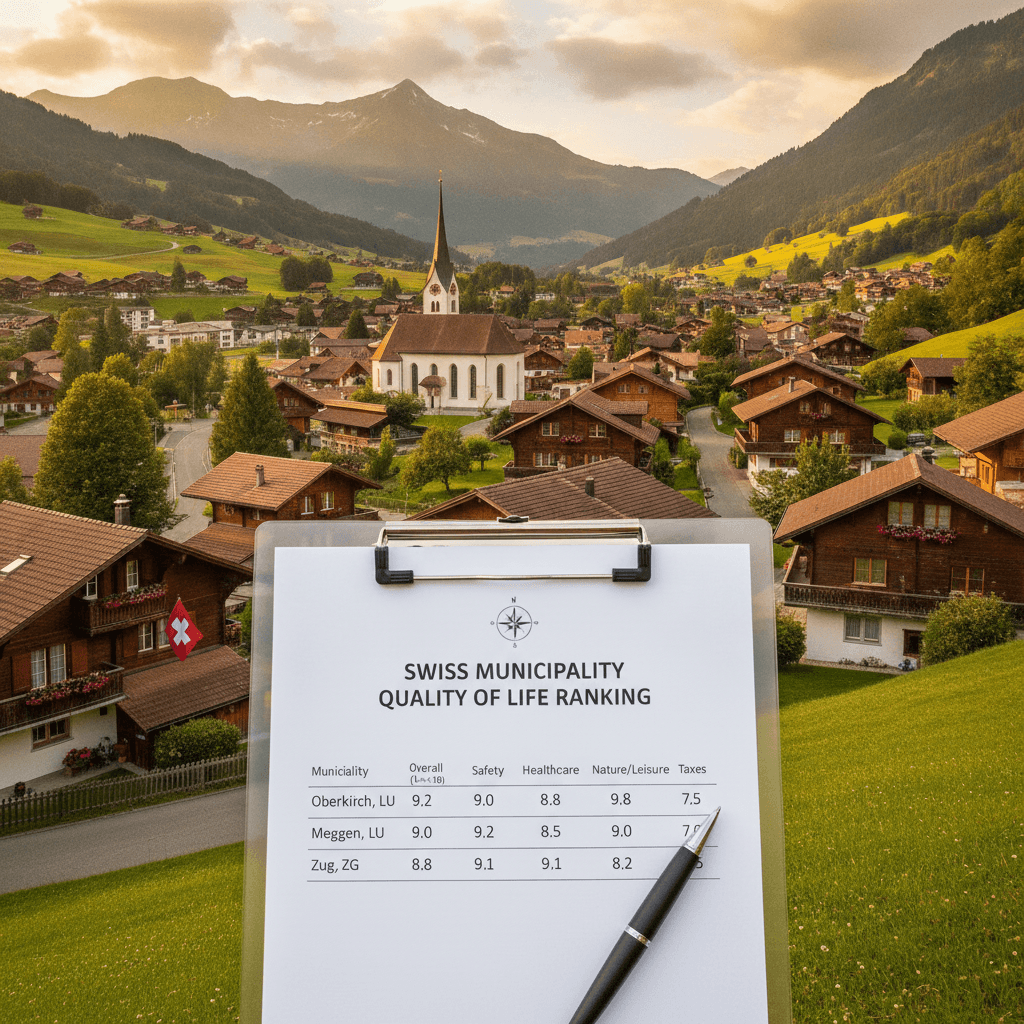
Why does choosing the right municipality in Switzerland matter?
In Switzerland, choosing where to live is not merely a matter of personal taste — it has direct financial and quality-of-life consequences.
Tax burdens vary by canton and even by municipality within a canton. The same income means a completely different tax bill in Zug, Schwyz, or Genève. The basic health insurance premium (Krankenkasse / KVG-prämie) also varies by canton. Transport connections, school options, density of medical services, and property prices all depend on the specific municipality.
Anyone moving to Switzerland is not simply choosing a country — they are choosing a specific administrative unit whose tax system, services, and community will shape their everyday life. That is why analyses that measure all these factors together are well worth taking seriously.
The Bilanz ranking methodology: 56 criteria and 966 municipalities
In 2026, Bilanz — the Swiss financial and business magazine — carried out its regular, large-scale municipal comparison. The study included 966 Swiss municipalities with at least 2,000 residents, each scored against 56 criteria.
The main evaluation categories covered the following areas:
Category | Sample indicators |
|---|---|
Property market | Housing prices, rental vacancy rate, residential construction activity |
Labour market | Unemployment rate, share of the services sector |
Demographics | Share of young residents, population growth |
Taxation | Average tax burden, taxable income, tax revenue |
Accessibility | Jobs and residential areas reachable by public and private transport |
Infrastructure | Number of doctors, pharmacies, hospitals, schools, and shopping centres |
Leisure and Culture | Range of cultural and sporting opportunities |
Safety and Environment | Number of crimes, earthquake risk, noise levels, hours of sunshine |
This methodology provides a comprehensive picture, but it is important to note: the weighting of scores and the relative importance of each category are decisive factors, and Bilanz does not always make these weights fully transparent.
Why Oberkirch won – Canton Luzern, 5,000 residents
The top-ranked Oberkirch (Canton Luzern) achieved outstanding scores in every evaluated category.
The town's key characteristics:
Size: just over 5,000 residents, including nearly 12% foreign nationals.
Location: direct access to Lake Sempach, with views of the Alps.
Transport: Luzern is 21 km away, reachable in approximately 30 minutes by both train and car.
Community life: according to Bilanz, it is characterized by a vibrant community life and a diverse range of sports and cultural offerings.
Its size and character: small enough to retain its rural character, yet close enough to the city to take advantage of urban infrastructure.
As Mayor Raphael Kottmann puts it, Oberkirch is "in the thick of things, yet has preserved its rural charm." This duality — accessibility and tranquility at once — explains why it performed so well in the complex scoring system.
The top 10 municipalities: geographic and linguistic patterns
The full top 10 list:
Oberkirch (Luzern)
Horn (Thurgau)
Maienfeld (Graubünden)
Altendorf (Schwyz)
Freienbach (Schwyz)
Zug (Zug)
Cham (Zug)
Lachen (Schwyz)
Hergiswil (Nidwalden)
Feusisberg (Schwyz)
The pattern is clear: all ten municipalities are located in Central Switzerland, and all ten are German-speaking. The canton of Schwyz appears four times, and Zug twice, in the top ten. This concentration is no coincidence — but it doesn't necessarily mean these are objectively the best places in Switzerland.
The limitations of the ranking — overrepresentation of German-speaking areas
Bilanz itself did not explain in detail why German-speaking municipalities dominate to such a degree. Several possible reasons come to mind:
Statistical reason: A larger share of Switzerland's territory and population is German-speaking. There are simply more municipalities in this region that reach the 2,000-inhabitant threshold required to be included in the study.
Methodological reason: certain criteria — such as the level of tax burden — may automatically favour the traditionally low-tax Central Swiss cantons (Zug, Schwyz, Nidwalden). If tax relief is given a high weighting in the scoring system, French- or Italian-speaking cantons with higher tax burdens are placed at a disadvantage, even if they excel in other respects.
What the ranking does not measure: lifestyle, linguistic community, cultural ties, Mediterranean character, mountain tourism. These do not feature among the 56 criteria — or if they do, they carry little weight.
None of this invalidates the analysis, but it does serve as a reminder that choosing a place to live based on a single ranking is not advisable.
French- and Italian-speaking Switzerland in the ranking — the areas around Mies, Ascona, and Lugano
Municipalities from Francophone and Italian-speaking Switzerland appear only much further down the list:
Ranked 32nd: Mies (canton of Vaud) — this is the first French-speaking municipality in the ranking.
Ranked 38th: Lutry (Vaud) – on the shores of Lake Geneva, near Lausanne.
Ranked 51st: Collonge-Bellerive (Canton of Geneva)
Ranked 176th: Sorengo (Ticino) – the highest-ranked municipality in Ticino.
Ranked 266th: Collina d'Oro (Ticino)
Ranked 398th: Paradiso (Ticino)
Important context: in other rankings, these regions fare considerably better. Zürich, Geneva and Lausanne regularly appear among the world's "smartest cities." Ticino municipalities — Ascona, Bosco Gurin, Morcote — also rank prominently on lists of Switzerland's finest villages. The Bilanz ranking is therefore not the only benchmark, nor the most comprehensive one.
What does this mean for Hungarians moving to or already living in Switzerland?
The Bilanz ranking is a useful starting point, but it is not sufficient on its own as a basis for decision-making. A few practical considerations worth keeping in mind:
Tax optimisation and choice of residence: Municipalities in the cantons of Zug and Schwyz rank so highly because their tax burdens are among the lowest in Switzerland. If tax efficiency is your top priority, these cantons are well worth prioritising — though property prices there are also high and competition is fierce.
Language community and integration: For native Hungarian speakers, German-speaking Switzerland (Deutschschweiz) is generally the first port of call, as the majority of job opportunities and Hungarian communities (particularly around Zürich, Basel and Bern) are concentrated here. The top 10 municipalities, however, are small towns — not necessarily where most Hungarians actually live.
French- and Italian-speaking Switzerland: If you work in French or Italian, or simply prefer these regions, don't be put off by their lower rankings. The quality of life, infrastructure, and job markets in Geneva, Lausanne, and Lugano speak for themselves — they simply excel by different measures.
Small town vs. big city: The top 10 municipalities are small towns of 2,000–20,000 residents. If you're looking for big-city infrastructure, a diverse community life, and direct airport access, the greater Zürich, Geneva, or Basel area is likely a more important factor for you than which small town topped a magazine ranking.
Property purchase and Lex Koller: As EU citizens, Hungarian nationals can purchase property in Switzerland under the Agreement on the Free Movement of Persons (FZA) — however, the Lex Koller (the law restricting property acquisition by foreigners) may still apply to EU citizens in certain cases. Always verify this point before committing to a specific purchase.
Sources
Bilanz (Swiss financial magazine) — 2026 municipality ranking: bilanz.ch
The Local Switzerland — "Revealed: The 'best municipality' in Switzerland to live in 2026": thelocal.ch
Federal Tax Administration (ESTV / AFC) — cantonal tax calculator: estv.admin.ch
Federal Statistical Office (BFS / OFS) — municipal data: bfs.admin.ch
Agreement on the Free Movement of Persons (FZA / ALE) — EUR-Lex and admin.ch
Related Articles
In Brief
According to Bilanz financial magazine's 2026 analysis, the best municipality in Switzerland is Oberkirch in the canton of Luzern — a small town of barely 5,000 residents on the shores of Lake Sempach. The ranking assessed 966 municipalities across 56 different criteria. The entire top 10 is concentrated in the German-speaking region of central Switzerland, which also highlights certain limitations of the methodology. ---
Key Takeaways
- The Bilanz 2026 ranking evaluated 966 Swiss municipalities across 56 criteria; the top spot goes to Oberkirch in the canton of Luzern.
- The entire top 10 consists of small, German-speaking towns in central Switzerland — a result attributable partly to statistical and partly to methodological factors.
- French- and Italian-speaking Swiss municipalities perform better in other rankings (e.g. smart cities, best villages); Bilanz is not the only benchmark.
- In Switzerland, your choice of municipality has a direct impact on your tax burden, health insurance premiums, and access to public services.
- Hungarian citizens, as EU nationals, can generally purchase property in Switzerland, though Lex Koller may impose restrictions in certain cases — this is worth clarifying in advance.
- No single ranking should be the basis for choosing where to live; personal priorities such as language, community, employment, and taxes are the decisive factors.
Frequently Asked Questions
Why did Oberkirch win the Bilanz 2026 ranking?
Oberkirch, a small town of 5,000 residents in the canton of Luzern, achieved outstanding scores across every evaluated category — property market, tax burden, infrastructure, accessibility, and community life. It has direct access to Lake Sempach, and Luzern can be reached by train in under 30 minutes.
Why do French- and Italian-speaking Swiss municipalities rank so poorly?
Bilanz offered no detailed explanation. A likely reason is that the German-speaking part of Switzerland has proportionally more and larger municipalities eligible for inclusion in the study. Additionally, certain criteria — such as a low tax burden — automatically favour the central Swiss cantons.
Is the Bilanz ranking a reliable basis for choosing where to live?
It is a useful starting point, but not sufficient on its own. It does not measure, for example, the presence of a linguistic community, cultural ties, or lifestyle fit. It is worth supplementing it with other sources — cantonal tax calculators, local property market data, and personal visits.
As a Hungarian citizen, can I buy property in one of the top 10 municipalities?
Hungarian citizens, as EU nationals, can generally purchase property in Switzerland under the Agreement on the Free Movement of Persons (FZA). Lex Koller may impose restrictions in certain cases — particularly for holiday properties or in designated zones. Legal advice is recommended before any specific purchase.
Where do most Hungarians in Switzerland live?
The largest concentrations of the Swiss-Hungarian community are found in the agglomerations of Zürich, Basel, and Bern, with smaller communities in Genève and Lausanne. These cities do not feature in the Bilanz top 10, but from a labour market and community perspective they remain the most relevant destinations for most newcomers.
What is the tax advantage of the cantons of Zug and Schwyz compared to others?
Zug and Schwyz are among the cantons with the lowest personal income tax burden in Switzerland. This explains why they perform so well in the Bilanz ranking, where tax burden is one of the evaluation criteria. The precise difference depends on income level and family status and can be calculated accurately using cantonal tax calculators (e.g. estv.admin.ch).
Why don't Zürich, Genève, or Lausanne appear in the top 10?
The ranking examined 966 municipalities of varying sizes and types. Major cities typically have higher property prices, greater noise levels, and heavier tax burdens, all of which lower their overall scores. The Bilanz ranking is not looking for the 'best big city' — it seeks the most well-rounded municipality across all criteria. ---