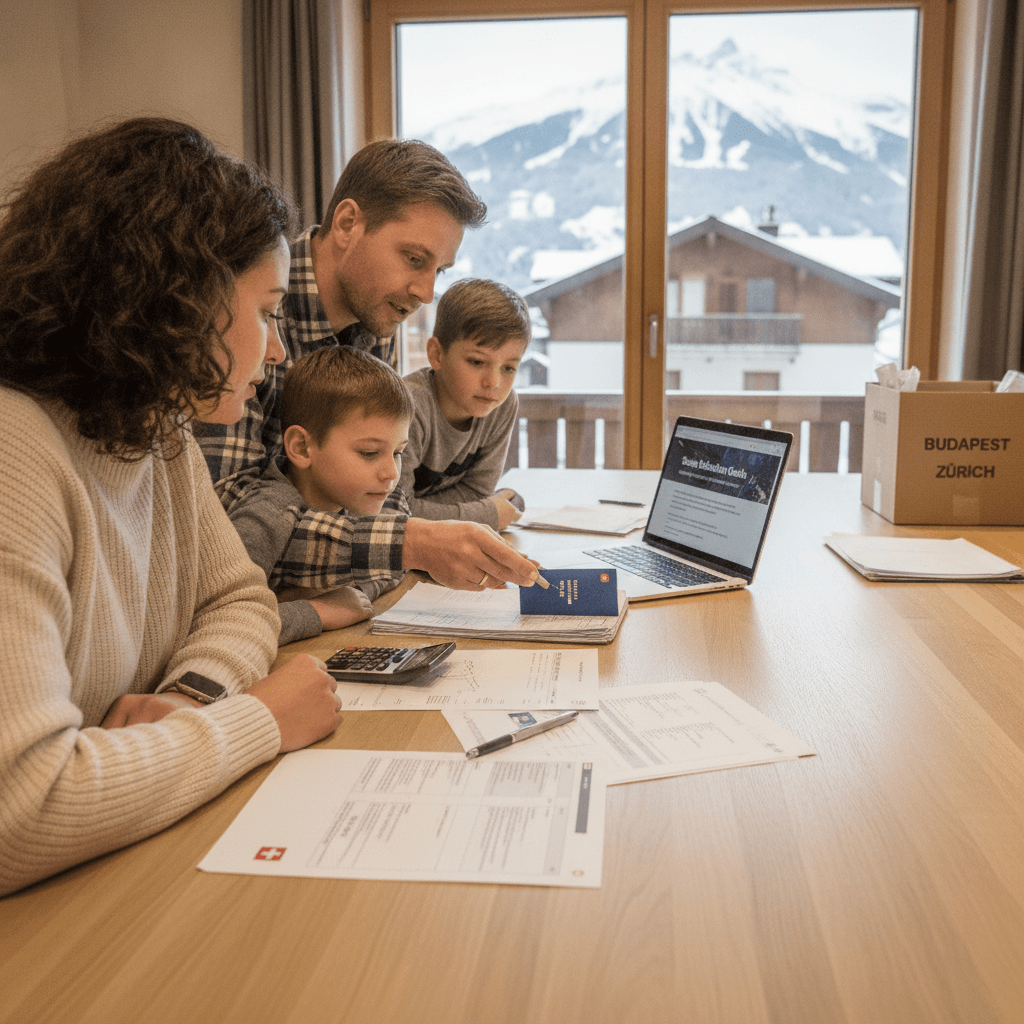
How Can a Hungarian Family Move to Switzerland? | svajc.com
Költözés családdal
Moving to Switzerland with Your Family: What to Expect and How to Prepare
A factual guide for Hungarian families covering the legal, financial, and practical steps of relocating to Switzerland — updated for 2026.
12 min readFree
How should you prepare in good time for relocating with your family?
The most common mistake families make is underestimating how much preparation time is needed. The Swiss housing market is tight, administrative processes are slow, and school places are limited — so it's worth starting your planning at least 3–6 months before the move.
What needs to be sorted out in Hungary beforehand?
The following steps should be completed before the move, while still in Hungary:
Deregistering your address from your Hungarian residence (at the local municipality or document office). This is not mandatory at the time of moving, but it is required in order to cancel your OEP membership and resolve your Hungarian tax residency status.
Suspending your social security number / deregistering from OEP.
, your Hungarian social insurance entitlement can no longer be maintained in parallel. Deregistration must be handled at the relevant health insurance fund.
Resolving tax residency. Under the Hungarian–Swiss double taxation agreement (1981, as amended), residency is determined by the principle of "habitual place of abode". If the entire family relocates, tax residency shifts to Switzerland from the first full calendar year — however, during the transitional year, filing obligations may arise in both countries.
Authenticating diplomas and certificates. School reports, birth certificates, and marriage certificates must be provided with an Apostille (Hague Convention certification) if they are required by Swiss authorities. It is also advisable to have children's school reports translated (by an accredited translator) in addition to the Apostille.
Clarifying your employment offer or self-employment permit in advance. As an EU/EFTA citizen travelling to Switzerland — which Hungarian citizens qualify as under the FZA (Freizügigkeitsabkommen, Agreement on the Free Movement of Persons) — you may take up employment without a work permit, but you must register for a residence permit within 14 days of starting your employment.
What legal and administrative steps are required after arrival?
Address registration (Anmeldung)
Within 14 days of arrival you must register with the local residents' registration office (Einwohnerkontrolle / Contrôle des habitants). This applies to every family member, including children.
The following documents are generally required for registration:
valid passport or national identity card (for each family member)
rental agreement or document proving property ownership
employer's confirmation letter (if arriving on the basis of employment)
completed registration form (format varies by canton)
Residence permit (Ausländerausweis)
As a Hungarian citizen with EU status, B permit (Ausländerausweis B) is available to anyone who holds an employment contract of at least 1 year. For contracts shorter than 1 year, an L permit (short-term residence permit / Kurzaufenthaltsbewilligung) applies. The permit is issued by the cantonal migration authority (Migrationsamt / Office cantonal de la population), but the application is typically submitted through the Einwohnerkontrolle.
Important: spouses and children (up to age 18) are automatically entitled to residence under the FZA if the primary earner holds a B permit — however, their permits must still be applied for separately.
Mandatory health insurance (KVG / LAMal)
In Switzerland, health insurance does not go through your employer: every individual must choose their own insurer (Krankenkasse). The mandatory basic insurance (Grundversicherung / assurance de base) must be taken out within 90 days of arrival — and will be valid retroactively from the date of arrival.
A few important things to know:
The premium (Prämie) varies by canton, age, and the chosen deductible (Selbstbehalt / franchise). In 2026, a monthly premium for an adult can range between CHF 300 and CHF 600 depending on the canton; for children it is lower (approximately CHF 100–150/month).
You can switch insurer once a year, by 31 October (effective for the following year).
For low-income households, a premium subsidy (Prämienverbilligung / réduction de primes) can be claimed from the canton — many newly arrived residents are unaware of this and therefore don't take advantage of it.
In Switzerland, education falls under cantonal jurisdiction, so the details of the system differ between Zürich, Bern, Geneva, Vaud, and Basel-Stadt. The underlying principle, however, is uniform: children of compulsory school age (generally from age 4–5) must be enrolled in school, and this is free of charge in state schools.
After registering at the Einwohnerkontrolle, enrolment is generally initiated automatically by the local school (Schulverwaltung / direction scolaire). Parents do not need to search for a school themselves — the district school assigned based on their place of residence will accept the child.
What is not automatic: placement in a language support class (DaZ – Deutsch als Zweitsprache, or the FIDE programme). Parents need to request this, and the school will typically carry out a level assessment.
How much does relocating to Switzerland with a family cost? Realistic figures
Swiss living costs are high — but salaries are higher too. What matters is the ratio between the two. Below we present the typical monthly expenses of a middle-class Hungarian family of 2 adults and 2 children living in the Zürich area with approximate figures (based on data current at the start of 2026).
Expense Category
Approximate Monthly Amount (CHF)
Rent (3–4 room apartment, Zürich agglomeration)
2,800–3,800
Health insurance (2 adults + 2 children)
900–1,400
Food and household
1,200–1,600
Transport (2 passes, public transit)
400–600
Childcare / daycare (if needed)
1,000–2,500
Phone, internet, streaming
150–250
Clothing, miscellaneous
300–500
Total (approximate)
6,750–10,650
Note: childcare costs (nursery/daycare, Kita / crèche) vary significantly by canton and can be reduced through income-based subsidies. In Zürich, a full-time Kita place can cost CHF 2,000–2,500/month without subsidies; in Bern or rural cantons, this is lower.
One-time start-up costs
In the first few months, several one-time expenses will arise:
Security deposit (Mietkaution / dépôt de garantie): typically 2–3 months' rent, held in an escrow account (not with the landlord, but at a bank)
Furniture / moving costs: CHF 2,000–8,000 (depending on how much you bring with you)
Recommended liquid reserve before moving out: at least 3 months of projected expenses, i.e. approximately CHF 20,000–30,000 (in early 2026, CHF 1 ≈ HUF 420–440, though this fluctuates — always check the current exchange rate).
How do children integrate? Education, social services, and support
Structure of the school system
In Switzerland, the school system is canton-based, but since the HarmoS agreement (2009) the core structure has been harmonised:
Kindergarten: ages 4–6, 2 years, compulsory in most cantons
Primarschule (primary school): ages 6–12, 6 years
Sekundarstufe I (lower secondary school):Ages 12–15, 3 years – this is the level where career path decisions begin (academic track vs. vocational training)
A child arriving from Hungary is generally placed in the year group appropriate for their age, but will attend parallel language support classes (DaZ) for a transitional period. This is nothing to be ashamed of and is not a disadvantage – Swiss schools routinely handle newly arrived foreign children.
Hungarian weekend schools
In Zürich, Bern, Genève, and Basel there are Hungarian weekend schools, which help preserve the Hungarian language and culture. These typically hold sessions on Saturdays and are partly funded by the Hungarian state. Exact contact details and enrolment conditions may change from year to year – local Hungarian community Facebook groups and the Community section of svajc.com provide up-to-date information.
Child benefit payments
In Switzerland, child benefit (Familienzulage / allocations familiales) is paid for children, with amounts and conditions varying by canton, though federal minimums apply:
Child allowance (Kinderzulage): at least CHF 200/month per child (up to age 16)
Education allowance (Ausbildungszulage): at least CHF 250/month (for dependent children aged 16–25 who are still in education)
The allowance is typically paid by the employer alongside the salary, and the employer claims it from the cantonal fund. Self-employed individuals and the unemployed can claim it through a separate fund.
Important from a Hungarian perspective: if one parent remains in Hungary and is entitled to child benefit there, EU coordination rules (Regulation EC 883/2004) mean that the two countries' allowances do not stack — the country paying the higher amount covers it in full, and the other country only tops up the difference (if any). It is worth clarifying this in advance.
What are the most common mistakes, and how can they be avoided?
1. They look for an apartment before arriving, without knowing the Swiss rental market The Swiss housing market — especially in Zürich, Genève, and Basel — is extremely tight. Listings attract dozens of applicants and Swiss landlords favour those with local references, a Swiss employment contract, and a clean credit history. Applying from Hungary, remotely, is nearly impossible. Solution: plan for temporary accommodation (Airbnb, a short-term rental, or company housing) for the first 1–3 months, and search for a permanent home from there.
2. They underestimate the deposit and the liquidity needed in the first few months Many people expect their first paycheck to cover the initial costs. In reality, due to the deposit (2–3 months' rent) and various one-off expenses, spending CHF 10,000–20,000 in the first month is not unusual.
3. They don't take out health insurance in time The 90-day deadline is strict. If someone misses it, the canton assigns an insurer — which is typically more expensive and does not come with the most favourable excess level.
4. They don't apply for premium subsidies Families on lower incomes or just starting out would in many cases be entitled to premium subsidies (Prämienverbilligung), but are unaware of this or simply don't submit the application. This can amount to several thousand CHF per year.
5. They don't get their children's school documents certified in advance If a child arrives at secondary school age, submitting previous school reports with Apostille certification and translation can take weeks — delaying enrolment and the course selection process.
6. Hungarian tax residency is not resolved If someone moves abroad but does not deregister in Hungary, both countries' tax authorities may consider themselves competent during the transitional year. This can result in double tax filing obligations — and potentially double taxation — even if the double taxation treaty ultimately resolves the situation.
When and how to seek help? Institutions and advisors
Swiss public institutions
Einwohnerkontrolle / Contrôle des habitants: address registration, submission of residence permit applications
Migrationsamt / Office cantonal de la population: issuance of residence permits, at cantonal level
Schulverwaltung / direction scolaire: school placement, DaZ programme
Cantonal social welfare office (Sozialamt / service social): health insurance premium subsidies, social assistance
AHV-Ausgleichskasse / Caisse de compensation AVS: old-age and disability insurance, family allowances
Hungarian institutions and communities
Embassy of Hungary, Bern: consular affairs, documents, Apostille
Hungarian Consulate General, Zürich: consular affairs for German-speaking cantons
Local Hungarian communities: Zürich, Bern, Genève, Basel – a contact list is available in the Community section of svajc.com
When should you bring in an expert?
A few situations where handling things on your own carries real risk:
If one parent is a third-country national (non-EU/EFTA) – their residence permit falls under a different procedure.
If one parent is arriving as self-employed or as a business owner – the tax and insurance structure is considerably more complex.
If the child has special educational needs (SEN) – placement within the Swiss system requires a separate procedure.
If one parent is staying in Hungary – a tax advisor is recommended to resolve the cross-border tax and social security situation.
The svajc.com advisor network is available for an initial 30-minute consultation at CHF 50 – for more complex situations, we provide a tailored quote.
When to bring in an advisor
This article provides guidance that applies to 80% of standard cases. In the situations below, however, individual circumstances vary so significantly that decisions based solely on this article may carry real risk:
One spouse is not an EU/EFTA citizen (e.g. a third-country national partner) – their residence permit falls under a different procedure, and processing time can be anywhere from 6 to 12 months.
One parent is arriving as self-employed or as a business owner – the tax and insurance structure is considerably more complex.
The child has special educational needs (SEN) – placement within the Swiss system requires a cantonal procedure, and the help of a specialist with local knowledge is invaluable.
One parent is remaining in Hungary, and the cross-border tax, social security, and welfare situation needs to be resolved.
Restructuring high-value assets (real estate, investment portfolio) in connection with the move.
Hungarian families relocating to Switzerland should allow 3–6 months of preparation time and settle Hungarian administrative matters in advance (deregistering your address, leaving the national health insurance scheme, and establishing tax residency). Within 14 days of arrival you must register with the residents' registry, take out mandatory health insurance, and enrol your children in school. Monthly living costs in the Zürich area range from CHF 6,750 to CHF 10,650 — but salaries are correspondingly higher.
Key Takeaways
Start preparing 3–6 months before your move: deregister your address, leave the Hungarian national health insurance scheme (OEP), and establish your tax residency in Hungary to avoid double taxation obligations.
Plan for a temporary first accommodation (Airbnb, short-term rental, or company housing) and search for a permanent home from there — Swiss landlords strongly prefer applicants who already have local references and a Swiss employment contract.
Within 14 days of arrival, complete your address registration and apply for a residence permit; within 90 days, take out mandatory health insurance to avoid being assigned to a more expensive insurer by the canton.
Apply for premium subsidies (Prämienverbilligung) for your children's health insurance if your income qualifies — this can save several thousand CHF per year.
Have your children's school records authenticated with an Apostille and translated while still in Hungary to speed up enrolment and the school-placement process.
Plan to have at least CHF 20,000–30,000 in liquid reserves before departure to cover the security deposit (2–3 months' rent), furniture purchases, administrative fees, and the first few months of living expenses.
Frequently Asked Questions
How far in advance should you plan a move to Switzerland?
It is advisable to start preparing at least 3–6 months before your move. The Swiss rental market is tight, administrative processes are slow, and school places are limited. This lead time is necessary to sort out Hungarian administrative matters, search for housing, and arrange school placement.
What needs to be sorted out in Hungary before the move?
You need to deregister your address at your local municipality, leave the Hungarian national health insurance scheme (OEP — as it cannot be maintained alongside Swiss health insurance), settle your tax residency, and have your diplomas and certificates authenticated with an Apostille and translated. You should also clarify your employment offer or business permit arrangements in advance.
What administrative steps must be completed immediately after arrival?
Within 14 days of arrival you must register with the residents' registry office (Einwohnerkontrolle) and apply for a residence permit; within 90 days you must take out mandatory health insurance. Children are automatically registered by the school, but parents need to request language support classes (DaZ — Deutsch als Zweitsprache) if needed.
How much does it cost for a family to live in Switzerland each month?
In the Zürich area, a family of two adults and two children can expect monthly expenses of CHF 6,750–10,650, covering rent (CHF 2,800–3,800), health insurance (CHF 900–1,400), groceries (CHF 1,200–1,600), and other costs. Childcare costs vary significantly by canton and can be reduced through income-based subsidies.
Related guides
🔒 How to Move to Switzerland with a Family? A Step-by-Step Guide
How much in liquid reserves should you have before moving?
It is recommended to have at least CHF 20,000–30,000 in liquid reserves, covering the security deposit (2–3 months' rent), furniture purchases, administrative fees, and the first few months of living expenses. This is necessary because your first paycheck will typically not cover the upfront costs of getting settled.
How does school enrolment work for children in Switzerland?
Education is a cantonal responsibility, but the core principle is consistent: children of compulsory school age (generally from age 4–5) must be enrolled in state school free of charge. After you register your address, the school will automatically register your child — however, parents should request language support classes (DaZ) if needed.
What child-related benefits are available in Switzerland?
Switzerland provides family allowances (Familienzulagen) for children: at least CHF 200/month per child (from birth to age 16) and CHF 250/month as a training allowance (for children aged 16–25 who are still in education). The allowance is generally paid by the employer, but the self-employed and unemployed can claim it through a separate compensation fund.