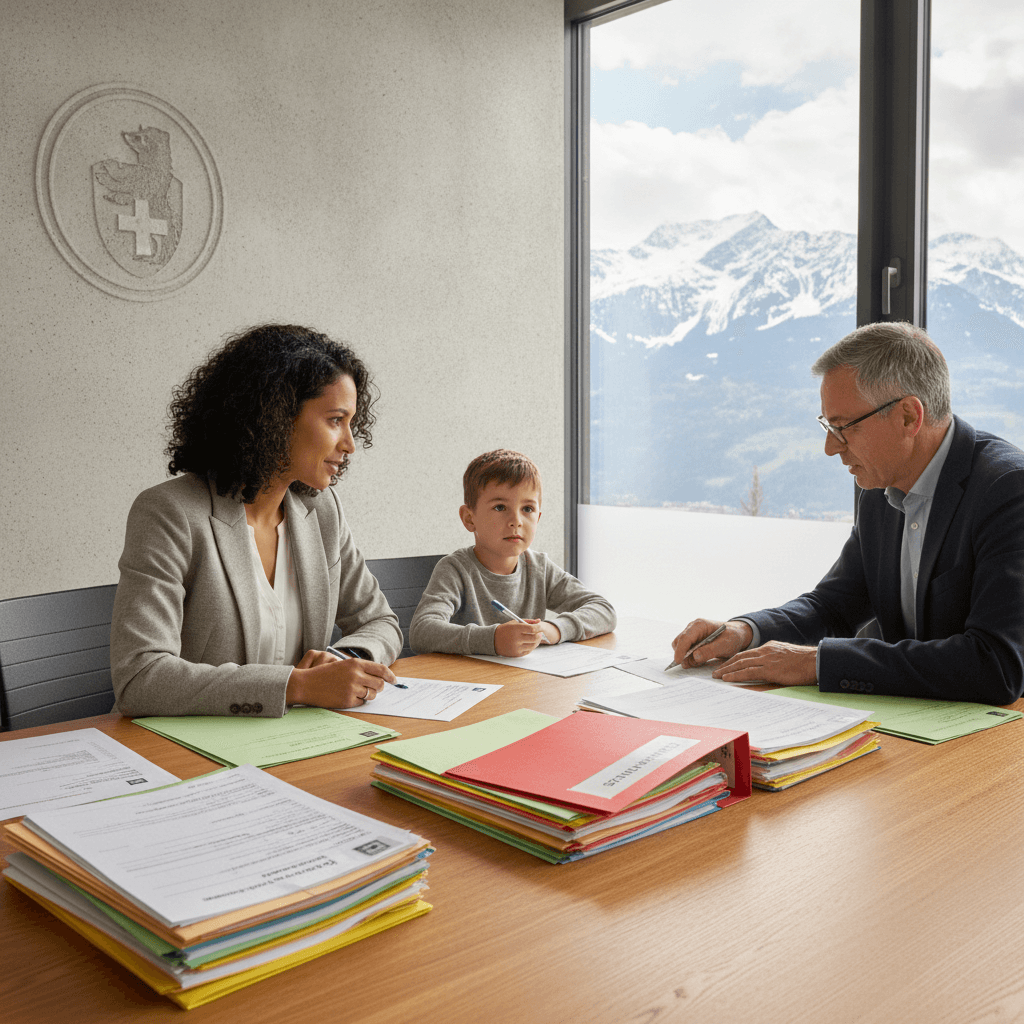
Egy anya és fia svájci oktatási dokumentumokkal konzultál egy hivatalnokkal egy modern irodában, amely alpesi panorámára néz. A jelenet a svájci iskolai beiratkozási procedúrát és adminisztrációs folyamatot szemlélteti.
How do we enroll our child in a Swiss school?
Step by step: documents for Swiss school enrollment, cantonal differences, integration support, and the most common parental mistakes — based on 2024–2025 data.
What is the structure of the Swiss education system — and what does it mean for Hungarian parents?
Swiss public education (Volksschule / école publique) covers 11 compulsory school years, organised by each canton under its own laws. The system is divided into two main stages:
Primary education (Primarstufe / école primaire): It includes the kindergarten years (Kindergarten, usually 2 years) and the primary school years (typically 6 years). The starting age for school varies by canton: in most cantons, Kindergarten is compulsory from age 4–5.
Lower secondary level I (Sekundarstufe I / école secondaire): This is school years 7–9, at the end of which the pupil moves on either to gymnasium (Gymnasium / Maturitätsschule), vocational school (Berufsschule) or another form of upper-secondary education. The Swiss system is highly selective at this point: the path to further education is determined partly by primary school performance and partly by cantonal admission procedures.
What should Hungarian parents know? In Hungary, compulsory schooling starts at age 6; in Switzerland, Kindergarten is compulsory from age 4–5. If your child was already in school in Hungary, the Swiss school will not necessarily place them in the same grade — placement is based on language level and educational background, not automatically on age.
What steps does the enrolment process involve?
The enrolment process can be broken down into the following main steps:
1. Register with the municipality of residence After arriving in Switzerland, you must register within 8–14 days (depending on the canton) with the Einwohnerkontrollénál (in German-speaking cantons) or the contrôle des habitants (in French-speaking areas). School enrolment for the child usually starts in parallel with this, or the municipality automatically notifies the responsible school.
2. Contact the responsible school The municipality will indicate the district school (Kreisschule / école de quartier). In some cantons, the school contacts the parent directly; elsewhere, the parent must apply. It is worth clarifying this with the municipality.
3. Admission or placement interview Especially for children from abroad, the school assesses the pupil’s level through a short interview or a set of tasks. This is not an exam, but a way to determine the appropriate grade and any need for integration support.
4. Placement in an integration class or regular class If the child does not yet speak the language of instruction, many cantons offer an integration or welcome class (Aufnahmeklasse / classe d'accueil). These usually last 1–2 school years.
5. Start of school The start of the school year varies by canton: August and September starts are the most common, but some cantons also offer a January entry point halfway through the year.
What documents are required for enrolment?
The following documents are requested in almost every canton. This list is not exhaustive — the school or municipality may ask for additional documents.
Document | Note |
|---|---|
Birth certificate | Hungarian original + certified translation (by a Swiss authority or a sworn translator) |
Residence permit (Ausländerausweis) | B, L or C permit; if still pending, the confirmation is also accepted |
According to the Swiss vaccination schedule; missing vaccinations can be caught up, but some cantons make them mandatory | |
Previous school reports | Hungarian original + translation; required for placement |
Parent’s identity document | Passport or identity card |
Proof of accommodation |
Translations: In Switzerland, there is no uniform rule on who may provide a certified translation. Some schools also accept a translation prepared by a parent, while others require a sworn translator (beeidigter Übersetzer / traducteur assermenté). It is worth clarifying this in advance with the school in question.
Hungarian civil registry certificates: If the document does not contain data in Latin script, or if the Swiss authorities request it, apostille certification is required. In Hungary, this is carried out by the issuing civil registry office or the territorially competent government office.
Public school, private school or international school — what is the difference and how much does it cost?
Public school (Volksschule / école publique)
Swiss public schooling is free and compulsory. Textbooks and basic supplies are provided by the school, but parents pay for some additional materials (e.g. excursions, meals). Meal contributions typically range from CHF 8 to CHF 15 per day, depending on the canton.
Private schools (Privatschulen / écoles privées)
Switzerland has many private schools that offer a Swiss curriculum, but with smaller class sizes or a special pedagogical approach. Annual tuition typically ranges from CHF 15,000 to CHF 30,000, though this varies widely by school and canton.
International schools
These are mainly found in Zürich, Genève, Basel and Bern. They offer English, French or IB (International Baccalaureate) curricula, and typically cater to children of employees sent to Switzerland by multinational companies. Annual tuition can be CHF 20,000 to CHF 40,000 or more.
When is it worth not choosing public school? If a child is coming to Switzerland for a shorter period (1–2 years), and the parent does not plan to settle long term, an international school can make it easier to reintegrate into the previous education system. If, however, the move is long term, public school usually provides a better foundation for local integration and for further education opportunities in Switzerland.
How does the school support language and social integration?
Integration and welcome classes
Most cantons offer some form of integration class (Aufnahmeklasse / classe d'accueil / classe d'intégration) for children who do not speak the language of instruction. Alongside intensive teaching of the local language, these classes also cover the core subjects. The duration is usually 1–2 school years, after which the child is integrated into a regular class.
Additional language support in regular class
Many schools offer DaZ (Deutsch als Zweitsprache — German as a second language) or FLS (français langue seconde) lessons alongside or instead of an integration class, which the child attends in addition to regular classes.
Social integration
Swiss schools generally work with smaller class sizes (an average of 18–22 pupils), which supports individual attention. Many schools assign a “study buddy” (Götti/Gotte system in some cantons) to a new child for the first few weeks. Parents’ involvement in school life (parent meetings, Elternabend) is expected, not optional — and these are usually held in the local language.
As a Hungarian parent: If you do not yet speak the local language fluently either, it is possible to request an interpreter for communication with the school. In some cantons, the school itself arranges an interpreter for the first meetings; elsewhere, the parent has to organise this. It is worth letting the school office know in advance.
How do the cantons differ? — Comparison of Zürich, Bern and Genève
In Switzerland, education is a cantonal responsibility, so procedures, deadlines and support measures differ from canton to canton. The comparison below is for information only; always check the details with the education authority of the canton concerned (Bildungsdirektion / Direction de l'instruction publique).
Aspect | Zürich | Bern | Genève |
|---|---|---|---|
Language of instruction | German (Hochdeutsch + Swiss German) | German | French |
Kindergarten start | Compulsory from age 4 | Compulsory from age 4 | Compulsory from age 4 |
Name of integration class | Reception class (AK) | Reception class | Classe d'accueil (CLIN/CLCO) |
Where to register | School administration / school secretariat | Municipality / school administration | Service des écoles (SRED) |
Start of the school year | End of August | End of August | End of August / September |
Share of private schools | High (especially in the city of Zürich) | Medium | High (many international schools) |
Zürich: There is a difference between the city and the canton. In the city of Zürich, registration takes place at the Schulsekretariat belonging to the school district (Schulkreis). The integration classes (Aufnahmeklassen) are well developed, and DaZ support is widely available.
Bern: Registration usually starts through the Gemeinde (municipality), and the school then takes over the process. The canton is bilingual (German- and French-speaking areas), so the language of instruction in the place of residence is decisive.
Geneva: The French-speaking canton operates a distinctive integration system. The CLIN (Classes d'Intégration) and CLCO (Classes d'accueil et d'intégration) classes provide structured French-language instruction for newly arrived children. Geneva has an exceptionally high density of international schools, which also increases pressure on public-school places in some districts.
What mistakes should parents avoid?
1. Delaying registration after arrival In Switzerland, compulsory schooling applies from the moment of registration. Delaying is not just an administrative issue — in some cantons, a fine may also be imposed.
2. Assuming the child will automatically be placed in the grade appropriate for their age Placement is decided by the school, and language level has a strong influence. This is not a disadvantage — the integration class is precisely there to help the child enter the regular class well prepared.
3. Ignoring the vaccination record In Switzerland, presenting the vaccination record (Impfausweis) is generally mandatory for registration. Missing vaccinations can be completed by the pediatrician (Kinderarzt / pédiatre), but that takes time. It is worth sorting this out before moving.
4. Underestimating the need for translations Not every school accepts Hungarian documents without translation. Obtaining a certified translation takes time — do not leave it until the last minute.
5. Treating private school as the “easier route” for integration Private schools do not necessarily offer better integration support than public education. If the goal is long-term integration into Swiss life, the Volksschule is generally more effective for that purpose.
6. Neglecting parent-school communication Swiss schools expect parents to take an active role. Elternabend (parent evening) and parent-teacher conferences (Elterngespräch / entretien parents-enseignant) are not optional — schools typically view absence negatively.
Sources
ch.ch — Switzerland’s official information portal: https://www.ch.ch/en/
State Secretariat for Education, Research and Innovation (SBFI): https://www.sbfi.admin.ch/
swissuniversities (higher education information): https://www.swissuniversities.ch/
Zurich Cantonal Education Directorate: https://www.zh.ch/de/bildung.html
Bern Cantonal Education Directorate: https://www.erz.be.ch/
Canton of Geneva — Direction générale de l'enseignement obligatoire (DGEO): https://www.ge.ch/organisation/direction-generale-enseignement-obligatoire-dgeo
Related Articles
In Brief
In Switzerland, enrolling a child in school varies from canton to canton, but the process generally starts with registration at the municipality of residence, after which the competent school carries out the placement. Public education is free and compulsory, but based on the child’s language level, academic background, and integration needs, the child may not necessarily be placed in the class corresponding to their age.
Key Takeaways
- After registering with the municipality of residence, school administration should be started immediately, because compulsory schooling applies from that point on.
- A child’s placement is determined not by age, but by language level and academic background.
- Enrollment typically requires a birth certificate, residence permit, vaccination record, previous school reports, and proof of housing.
- If the child does not speak the language of instruction, they may be placed in an integration or welcome class, which usually lasts 1–2 school years.
- Public education is free, but parents may have to pay for meals and certain extracurricular programs; tuition at private and international schools is significant.
- Parent-teacher meetings and active communication with the school are expected in the Swiss system, not optional.
Frequently Asked Questions
From what age is school or kindergarten compulsory in Switzerland?
In most cantons, Kindergarten is compulsory from age 4–5, and it is part of the Swiss public education system. Compulsory education covers a total of 11 school years, with organization varying by canton.
How does a child’s enrollment in a Swiss school begin?
The process usually starts with registration at the municipality of residence. After that, the municipality assigns the competent school, or the school contacts the family directly.
What documents are needed for enrollment?
Usually requested are the birth certificate, residence permit, vaccination record, previous school reports, the parent’s identity document, and proof of housing. Some documents may also need to be translated, and in certain cases an apostille certification is required.
Is a child automatically placed in the class corresponding to their age?
Not necessarily. Placement is decided by the school and also takes language level and academic background into account.
What happens if the child does not yet speak the language of instruction?
Many cantons offer integration or welcome classes, where the child receives intensive language support. In addition, some schools provide DaZ or FLS lessons alongside the regular class.
How much does public education in Switzerland cost, and how does it differ from private school?
Public education is free and compulsory, and the school provides textbooks and basic supplies. Annual tuition at private schools is typically CHF 15 000–30 000, while international schools may cost CHF 20 000–40 000 or more.
How do the school systems in Zürich, Bern, and Genève differ?
Education in Switzerland is a cantonal responsibility, so procedures and support measures differ. In Zürich, schooling is organized in German; in Bern, it is organized according to German- and French-speaking areas; and in Genève, education is French-speaking and operates with its own integration system.
This guide is available after registration
During the launch period, the full knowledge base is available with free registration.
CHF 0 during launch
- All guides and checklists
- Downloadable PDF templates
- Sample documents
- Early access to new content
Preview - the guide continues after login
Related guides
- How do I enroll my child in school in Switzerland?
- 🔒 How do we enroll our child in a Swiss school?