How to plan your first monthly budget in Switzerland
In your first monthly budget in Switzerland, list housing, the rental deposit, insurance, withholding tax and hidden fees as separate items.
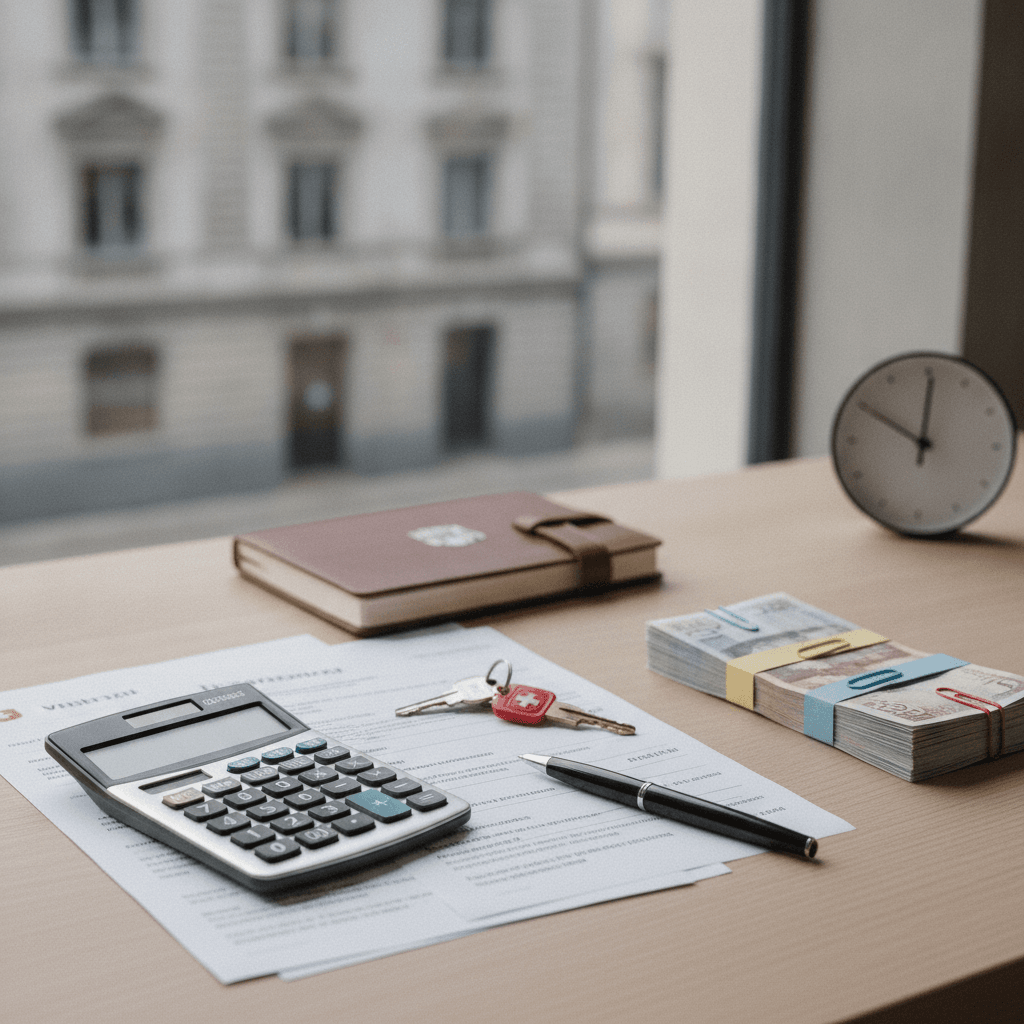
What one-off upfront costs should you expect when renting?
When renting a property, the first month's rent and the rental security deposit should be treated as separate financial items. In Switzerland, rent is paid one month in advance, so the first month's rent may already be due when moving in.
The rental security deposit (Mietkaution, or Mietzinsdepot) is not money that the landlord can use freely. According to the available sources, it must be placed in a blocked Swiss bank deposit account in the tenant's name (Mietkautionskonto) rather than transferred directly to the main landlord. This arrangement also provides important protection for the tenant: the money remains separate.
It is therefore advisable to include at least two separate housing-related items in the budget:
Cost item | What does it mean? | How should it be included in the first-month budget? |
|---|---|---|
First month's rent | The monthly rent specified in the contract, which is paid one month in advance in Switzerland. | Budget for the full amount stated in the rental agreement. |
Rental security deposit | Blocked security for the tenancy; it may be called Mietkaution or Rental deposit. | Include it in your plan as a one-off, separate upfront expense. |
Deposit account | A blocked account held in the tenant’s name, Mietkautionskonto. | Check which bank account the payment must be transferred to and by what deadline. |
Deposit insurance | A Mietkautionsversicherung may be an accepted alternative to a cash deposit. | Only factor it in if the landlord or property manager explicitly accepts it. |
A Mietkautionsversicherung, i.e. deposit insurance, may be an accepted alternative to a traditional cash deposit. However, the two arrangements are not the same: with a blocked deposit account, the tenant’s money is actually held in the account, whereas the terms, fee and landlord acceptance of an insurance arrangement must be checked separately.
What else should be requested before signing the tenancy agreement?
The monthly housing cost is not always the same as the amount initially stated in the listing. Your own budget should include only amounts set out in the tenancy agreement or provided in writing by the property manager.
Before signing the agreement and taking over the property, it is advisable to record the following in a separate list:
The total monthly rent: the basis for the first month’s budget is the amount payable under the agreement, not a national or city average.
The exact amount of the deposit and the payment method: the security deposit Mietkautionskonto account if a cash deposit is requested.
Payment deadlines: rent is due one month in advance, so the timing of the move directly affects the cash available.
Acceptance of deposit insurance: the Mietkautionsversicherung can only be a genuine alternative if the specific landlord accepts it.
Additional housing-related fees stated in the contract: include these in the monthly plan based on documented amounts rather than estimates.
Compared with budgeting in Hungary, a common misconception is to treat the security deposit as a “lost” expense. The money is locked away, but at the time of moving it is still unavailable for food, insurance or travel. It therefore increases the cash required for the first month in the same way as any other amount due.
How does compulsory health insurance work during the first few months?
The compulsory health insurance scheme is called Obligatorische Krankenpflegeversicherung (OKP). According to the available estimates for 2026, monthly basic insurance premiums for adults may fall within the range of CHF 300–380, but this is not a uniform nationwide rate.
The actual premium is affected by the canton of residence, the insurer chosen and the deductible selected. Therefore, CHF 300–380 can only serve as a starting point for planning, not as an amount that every adult arriving in Switzerland must automatically pay.
Insurance budgeting question | What does it depend on? | What should be included in the budget? |
|---|---|---|
Monthly basic insurance premium | Canton, insurer, chosen deductible. | Use the premium stated in the insurer's quote, not merely a national estimate. |
Total household cost | The number of insured adults and children, as well as each person's choices. | Plan each family member's insurance on a separate line. |
First month's cash flow | The insurer's billing schedule and the contract start date. | Check the exact payment date of the premium based on the insurer's documentation. |
The deductible is a choice linked to the insurance plan that also affects the monthly premium. For this reason, it is not advisable to decide solely on the basis of a lower monthly premium. Selecting the right plan requires considering the full-year risk, expected use of healthcare services and the differing circumstances of family members.
In addition to joining Swiss insurance, Hungarians relocating abroad must also treat the settlement of their Hungarian health insurance status as a separate administrative task. The exact procedure depends on individual circumstances and the applicable Hungarian rules, so it is advisable to maintain a separate “Hungarian administration / certificates” notes field in the Swiss monthly budget spreadsheet. Enter an amount here only if verified information has been received.
How much tax is deducted immediately from your salary as withholding tax?
Foreign employees who do not hold a C settlement permit (C permit) have withholding tax deducted directly from their salary by their employer each month (Quellensteuer). Therefore, the first-month budget should not be based solely on the gross salary stated in the employment contract.
The amount of withholding tax can vary significantly from canton to canton. According to the available sources, in addition to the canton, the rate may also be affected by marital status, the number of children and religious affiliation.
It is advisable to clearly understand the following distinction:
Term | What does it mean for the first-month budget? |
|---|---|
Gross salary | The salary amount stated in the employment contract, before deductions. On its own, it does not show how much money is actually available to spend. |
Withholding tax (Quellensteuer) | Tax deducted monthly by the employer directly from the salary for foreign employees who do not hold a C permit. |
The starting point for the actual budget; it should be determined based on the payslip. | |
Subsequent ordinary assessment (Nachträgliche ordentliche Veranlagung) | A tax return procedure is mandatory above an annual gross income of CHF 120,000. |
For cases exceeding an annual gross income of CHF 120,000, a subsequent ordinary assessment is mandatory, known in German as Nachträgliche ordentliche Veranlagung. This rule does not mean that withholding tax “disappears” from the first monthly budget: the first month's cash flow is still determined by the amount deducted by the employer and the actual payslip.
Because withholding tax depends on personal circumstances, it is not advisable to rely on percentage-based experiences of other Hungarian expats. The tax situation may differ for a household with children, a married employee, and a single employee, and the canton also matters. The first payslip received from the employer is the first verifiable data point.
What hidden fixed and variable costs should be factored in?
A “hidden” cost is not necessarily an improper or unexpected fee: it is often simply an item that does not appear in the property listing or in the gross salary. For this reason, even smaller, regularly recurring amounts should be tracked separately in the first monthly Swiss budget.
The typical monthly or annual cost items, supported by documentation, are as follows.
Type of cost | Indicative figure for 2026 | What should you watch out for? |
|---|---|---|
Food and household expenses | CHF 400–600 / month for a single person | This is an estimated range for a single person; it cannot automatically be applied to a family budget. |
Local monthly public transport pass | CHF 70–90 / month | The fare may vary by city. |
Halbtax | CHF 185 / year | The Halbtax is a discount travelcard used for travel nationwide; its annual fee must be budgeted separately. |
Mobile and home internet | CHF 50–100 / month combined | The actual amount depends on the plan, provider and usage. |
Serafe fee | CHF 335 / year per household | It applies to all private households, even if they do not have a television or radio. |
The CHF 400–600 estimate for groceries and household products is specifically a monthly range for a single person. It is not a family benchmark, nor does it mean that every single person spends the same amount. Shopping habits and choice of retailer also matter: according to the available source, Aldi and Lidl may be more affordable alternatives to the Coop and Migros chains.
The estimated monthly cost of a local public transport pass is CHF 70–90, but the price varies by city. For commuting, the budget should therefore include the fare for the specific route between home and work, rather than the price of a pass in another city.
The Halbtax annual fee is CHF 185. As this is an annual expense, it can be handled in two ways: as the full amount in the month of the annual purchase, or as a monthly provision for internal planning purposes. In the latter case, dividing the annual fee of CHF 185 by 12 months results in a monthly provision of approximately CHF 15.42. This is a mathematical allocation, not a separate charge.
What should you know about Serafe in 2026?
The radio and television fee (Radio- und Fernsehabgabe) is collected by Serafe AG. The fee must be paid per private household, even if there is no television or radio in the household.
In 2026, the fee is CHF 335 per year for each private household. For monthly budgeting purposes, this is approximately CHF 27.92 when spread over 12 months; however, the billing method and timing should be checked against the information provided by Serafe AG.
The research dossier contains no usable, verified information on the future amount of the Serafe fee, the possible timing of changes after 2026, or the related federal decision-making background. For this reason, this article does not include any forecast beyond the 2026 fee of CHF 335. When moving, it is advisable to check the current fee and the information applicable to the relevant period on Serafe’s official website.
How can a realistic sample budget for a single person in Switzerland be structured?
A single person’s sample budget for their first month in Switzerland is not one fixed “mandatory” amount, but a plan based on documents. The greatest uncertainty is usually caused by the actual cost of housing, the security deposit, tax deductions and insurance premiums.
The example below is not a national average and does not promise a complete monthly total. Its purpose is to show each item included in the available sources on a separate line.
Budget item for a single person | Treatment in the first month | Verified reference figure or data source |
|---|---|---|
Rent | Calculate using the full amount stated in the contract; payable one month in advance. | The contract for the specific property; the fact that payment is made in advance is stated in ETH Zürich’s guidance. |
Rental security deposit | One-off, separate initial expense. | To be paid into a Mietkautionskonto |
account; the exact amount is set out in the contract. | Basic insurance | Regular monthly expense. |
Estimated range of CHF 300–380 per month for adults; depends on the canton, insurer and deductible amount (excess). | This is deducted from salary and should not be treated as a separate payment. | Based on the employer’s payslip and the individual withholding tax category. |
Food and household expenses | Monthly variable expense. | Estimated range of CHF 400–600 per month for a single person. |
Local transport | Monthly recurring expense, if needed. | Estimated range of CHF 70–90 per month; may vary by city. |
Mobile phone and home internet | Monthly recurring expense. | Estimated combined range of CHF 50–100 per month. |
Serafe | Annual household fee, which can also be tracked monthly as a reserve. | CHF 335 per household per year in 2026. |
Halbtax | Annual expense or a dedicated monthly reserve. | CHF 185 per year. |
For the housing line, it is not advisable to enter a national or city-wide average rent if there is already a specific apartment offer. The rent stated in the contract and the deposit are the decisive figures. If there is no contract yet, it is best to leave the housing line temporarily blank or use separate scenarios for several possible apartments.
How can you create three scenarios?
Due to the uncertainty of first-month expenses, it may be useful to run three budgets in parallel. This is not a financial forecast, but a decision-support framework.
Minimum scenario: it includes only expenses for which a contract, insurer’s quote, or official invoice is already available.
Likely scenario: alongside documented items, includes a personally selected amount for food, transport and communication based on the known estimate ranges.
Contingency scenario: presents, in a separate budget, expenses that have not yet been documented but are considered necessary for the move; assign specific amounts to these only after verification.
In a regular monthly budget, one-off items should be kept in a separate column. If the deposit and the first month’s rent are combined with subsequent monthly living expenses, the first month will appear unnecessarily expensive, while the cash flow in the following months may have a different structure.
When moving from Hungary, it is also advisable to track the timing of Swiss and Hungarian administrative matters in a single calendar. In addition to Swiss housing, insurance and salary matters, attention may also be required for Hungarian health insurance status, obligations related to a Hungarian bank account, and documents for subsequent tax and pension coordination. The article does not assign monetary amounts to these items because the dossier contains no verified fee data.
Sources
First Step Swiss – Cost of living, taxes and quality of life in Switzerland 2026
Reddit r/askswitzerland – The real cost of living in Switzerland
Related Articles
In Brief
In your first monthly budget in Switzerland, first month's rent paid in advance, the blocked rental deposit and regular living expenses should be handled separately. Net income should be based on the actual payslip, while health insurance premiums should be determined according to the canton, insurer and deductible; a useful guideline for food and household costs for a single person is CHF 400–600 per month.
Key Takeaways
- Before signing the tenancy agreement, record the full monthly rent, the deposit amount, payment deadlines and any additional fees specified in the contract.
- Plan a cash rental deposit as a separate, one-off initial expense, and check whether it must be transferred to a Mietkautionskonto account.
- Only include rental deposit insurance in your calculations if the landlord or property manager explicitly accepts it.
- List each family member separately in the health insurance budget, based on the insurer's specific quote.
- Use the net amount available according to your first payslip, rather than your gross salary, as the starting point for your budget.
- Create minimum, likely and contingency scenarios, and keep one-off initial expenses separate from recurring monthly costs.
Frequently Asked Questions
What initial housing costs should you expect in Switzerland?
When moving in, the first month's rent and the rental deposit are the main housing-related items. In Switzerland, rent is paid one month in advance, and where the deposit is paid in cash, it must be placed in a blocked Mietkautionskonto account held in the tenant's name.
Is the rental deposit considered a lost expense?
No. The deposit is blocked security that remains separate; it is not money the landlord can use freely. However, it increases the liquidity needed in the first month, so it should be included as a separate, one-off item in the initial budget.
How much could compulsory health insurance cost in Switzerland?
According to available estimates for 2026, monthly basic insurance premiums for adults may range from CHF 300–380. The actual amount depends on the canton of residence, the insurer and the selected deductible, so the insurer's quote is decisive.
What should be used to determine disposable income for the first month?
The gross salary stated in the employment contract alone does not show the amount available to spend. The starting point for the budget is the net amount shown on the first payslip, which already reflects withholding tax and other deductions made by the employer.
What monthly costs should a single person budget for?
As a general estimate, monthly costs may include CHF 400–600 for food and household expenses, CHF 70–90 for local transport, and CHF 50–100 in total for mobile and home internet. These are not fixed amounts: they may vary depending on the city, provider and individual consumption.
How much is the Serafe fee in 2026?
In 2026, the Serafe fee is CHF 335 per year per private household, even if the household has no television or radio. For monthly planning, this is approximately CHF 27.92, but the timing and method of billing should be checked against Serafe's information.
How should you structure your first budget in Switzerland?
Prepare three versions: a minimum scenario with expenses already documented, a likely scenario with estimated food, transport and communication costs, and a contingency scenario for items that have not yet been confirmed. Track one-off costs, such as the deposit, in a separate column alongside recurring monthly expenses.
This guide is available after registration
During the launch period, the full knowledge base is available with free registration.
CHF 0 during launch
- All guides and checklists
- Downloadable PDF templates
- Sample documents
- Early access to new content
Preview - the guide continues after login