How can you move to Switzerland as an employee, step by step?
When moving to Switzerland as an employee, the main tasks include the customs declaration, registration within 14 days, insurance, exchanging your driving licence and registering your dog.
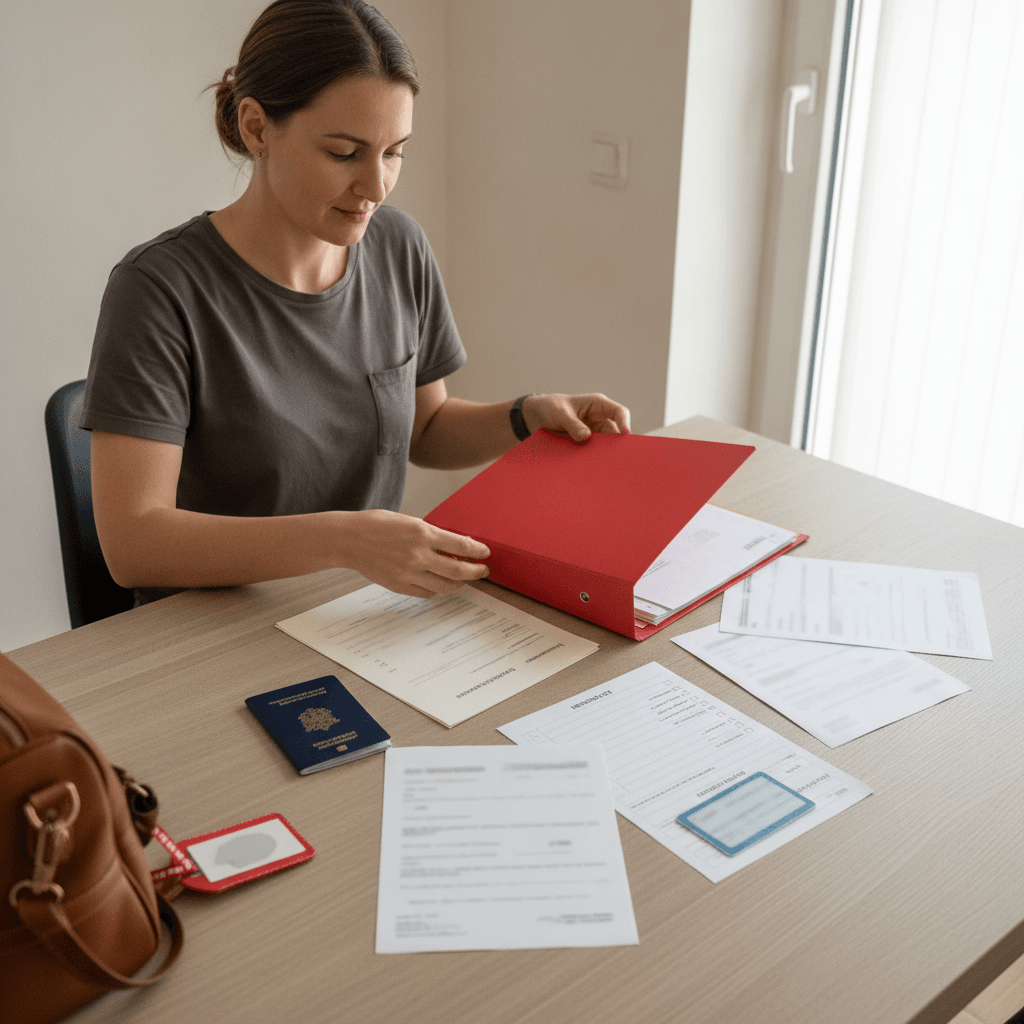
What is the best order for organising a move for employment purposes?
A move for employment purposes can be organised clearly by dividing the tasks into three periods: preparation before departure, crossing the border, and administrative formalities during the first weeks in Switzerland. The residence registration requires a valid identity document according to the dossier, proof of accommodation, and a Swiss employment contract.
The following checklist is based on the verified requirements set out in the research dossier. It does not replace the specific information provided by the destination municipality or canton.
Period | Primary task | What needs to be prepared or checked? |
|---|---|---|
Before departure | Preparing customs clearance for household goods | Customs declaration 18.44, as well as a detailed, itemised and signed inventory list. |
Before departure | Proof of accommodation and employment | A Swiss rental agreement or confirmation from the accommodation provider, as well as a Swiss employment contract. |
Upon arrival | Customs formalities | Documents relating to household goods should be kept readily accessible when crossing the border. |
After arrival | Registering at the place of residence | As an EU/EFTA citizen, this must be completed within 14 days and before work actually begins. |
During the first weeks | Choosing health insurance | Compulsory basic health insurance must be taken out; the applicable procedural deadline must be checked with an official cantonal or insurer source. |
During the initial period | Administration of the driving licence and the dog | The cantonal procedure for exchanging the driving licence must be completed, while for a dog, AMICUS and Gemeinde registration must be arranged. |
The residence permit (Aufenthaltsbewilligung) process is linked to registration of residence. This article focuses not on a detailed description of permit categories, but on the practical sequence of the actual relocation process. The right of residence, the type of permit and the practices of the municipality requesting documents may depend on the individual situation.
As a Hungarian citizen, it is advisable to keep Hungarian matters on a separate list as well. These may include health insurance status, registered address in Hungary, family members’ documents, bank accounts and certificates required from Hungarian authorities. The research dossier provided for this article does not contain verified procedural rules for these matters, so it does not specify concrete deadlines or steps.
Which documents are required for duty-free relocation to Switzerland (Form 18.44)?
According to the research dossier, duty-free treatment of household goods requires submission of the 18.44 customs declaration together with a detailed, itemised and signed inventory list. The document is called the customs declaration for household effects (Zollanmeldung für Übersiedlungsgut, Formular 18.44).
Form 18.44 is the key document for the customs clearance of household goods brought into Switzerland when relocating. It is not advisable to complete the form afterwards from memory: the inventory should be prepared alongside packing so that the contents of the boxes remain traceable.
An itemised inventory list is most useful when it does not merely contain general descriptions. Instead of descriptions such as “miscellaneous household items”, the categories and contents of the items being moved should be clearly identifiable. The research dossier specifically identifies the signed inventory list as a document to be submitted alongside Form 18.44.
What should be prepared for customs clearance?
Based on the dossier, at least the following two documents are required:
18.44 customs declaration: the document used for the customs clearance of household goods; its German name is Customs declaration for household effects when moving.
A detailed, itemised and signed inventory list: a list of the household effects being moved, which must be submitted together with form 18.44.
The official information provided by the Federal Office for Customs and Border Security (Federal Office for Customs and Border Security, BAZG) must be checked before departure. Details of the customs procedure, the manner of crossing the border, the involvement of a moving company and the nature of the specific shipment may raise further practical questions.
A moving company does not automatically assume your legal responsibility for the content of the documents. If you use a carrier, it is advisable to clarify in writing who completes form 18.44, who prepares the inventory and who presents the documents during the customs procedure.
How many days are available for registering with the local municipality?
EU/EFTA citizens must register with the local municipality within 14 days of arriving in Switzerland, and this must be completed before actually starting work. This 14-day rule specifically applies to EU/EFTA citizens and has been verified in the dossier.
Registration takes place with the municipality of residence. Depending on the language region, the authority may be called Gemeinde, Einwohneramt or Contrôle des habitants. In Hungarian, this process is referred to as residence registration; in German, it is called the Anmeldung bei der Gemeinde procedure.
The 14 days do not mean that registration can be postponed indefinitely until the start of work. Both requirements apply together: the matter must be arranged within 14 days of arrival and before actually starting work. If the employment contract specifies a very near start date, it is not advisable to postpone arranging registration until the days after arrival.
What documents may the Gemeinde request?
The research dossier identifies the following three types of documents for registration:
Required document | What is it for? |
|---|---|
Valid identity card or passport | To verify identity. |
Swiss tenancy agreement or confirmation from the accommodation provider | To prove accommodation in Switzerland and the place of residence. |
Swiss employment contract | To prove the purpose of employment and employment in Switzerland. |
The eMovingCH online system can be used where it is available in the relevant municipality. The online option cannot be assumed to be available in every Gemeinde, so it is necessary to check the website of the authority responsible for the place of residence to determine whether electronic registration is available or an in-person visit is required.
Proof of accommodation may present a practical obstacle if only temporary accommodation is available when employment begins. According to the dossier, confirmation from the accommodation provider may be an alternative to a tenancy agreement. However, the exact format of the document may be determined by the receiving Gemeinde.
How should compulsory Swiss health insurance be taken out?
In Switzerland, basic health insurance is compulsory for all residents, in German obligatorische Krankenpflegeversicherung or KVG for short. In everyday language, the term Krankenkasse is often used to refer to the insurer.
Compulsory basic insurance is not the same as an employer-provided benefit or private insurance maintained abroad. In the Swiss system, residents are subject to an insurance obligation. The federal-level authority in the healthcare system is the Federal Office of Public Health (Federal Office of Public Health, FOPH / BAG).
What is the deadline for taking out insurance?
The verified dossier provided for this article confirms the existence of mandatory basic insurance, but does not contain a usable, verified specific deadline for taking out a policy. It would therefore not be justified to state a specific number of days or months here.
It is therefore advisable to start selecting insurance while organising the move, but the specific deadline, required documents and procedure in the canton of residence must be checked against official information from FOPH/BAG, the canton or the chosen insurer. Insurance premiums and available options may also vary by municipality, canton, age group and insurance model.
Those moving with their family must review the situation of each person moving with them separately. This dossier does not detail the specific rules governing insurance arrangements for children, a spouse or a registered partner; official, individual verification is required for these.
How long do you have to exchange a foreign driving licence for a Swiss one?
The research dossier does not contain a usable, verified specific deadline regarding when the exchange of a foreign driving licence for a Swiss one must be initiated. For this reason, this article does not state a deadline in days or months.
The German term for the recognition or exchange of a foreign driving licence is ausländischen Führerausweis umtauschen. The procedure is handled by the cantonal road traffic authority, which is typically called Strassenverkehrsamt, in the French-speaking region Office cantonal des véhicules.
For licences issued by an EU/EFTA member state, the dossier indicates that the exchange generally takes place through a simplified procedure, without a practical or theoretical test, following an eye examination. “Generally” is important here: the individual case, licence category and cantonal practice may require additional documents or an examination.
Based on information from the Federal Roads Office (Federal Roads Office, FEDRO) and the competent cantonal road traffic authority, it must be determined which documents, eye examination and timing are required in your case. If a car is used regularly for commuting or work purposes, this should not be left until later.
What should you do if you are moving to Switzerland with a dog?
In Switzerland, every dog must be registered in the national AMICUS database and must also be declared to the local municipality because of the annual dog tax. The German term for dog registration is Hunderegistrierung, and the annual tax is called Hundesteuer.
Moving with a dog does not end at the border crossing. Registration with the Gemeinde of residence is also required because the municipality administers the obligation relating to the annual dog tax.
How much is the dog tax in Switzerland?
According to the dossier, the amount of dog tax varies by canton and municipality, typically ranging from CHF 100–200 per year. This refers solely to the annual dog tax; it does not include other costs associated with keeping the animal, possible veterinary care, training or insurance.
What to do when moving with a dog | Verified requirement |
|---|---|
AMICUS registration | Every dog must be registered in the national AMICUS database. |
Registration with the Gemeinde | The dog must also be registered with the local municipality. |
Payment of dog tax | The annual Hundesteuer is typically CHF 100–200, but varies by canton and municipality. |
For the health and border-entry requirements for importing animals, current guidance from the Federal Food Safety and Veterinary Office (Federal Food Safety and Veterinary Office, FSVO / BLV) must be consulted. The available dossier does not substantiate specific requirements concerning the dog's passport, microchip, vaccinations or veterinary examinations; therefore, no detailed rules on these are provided here.
Which mistakes can be avoided during the first weeks in Switzerland?
The most common organisational mistake is to focus the move exclusively on the employment contract and accommodation. Customs procedures, municipal registration, insurance and transport documents are separate processes involving different authorities or institutions.
Another recurring risk is confusing deadlines. The 14-day residence registration rule applicable to EU/EFTA citizens should not be treated as a general rule applying to “all foreign nationals”. As a Hungarian citizen, this rule is relevant because Hungary is an EU member state.
The third issue is overlooking cantonal differences. Dog tax, the availability of online registration, procedures related to exchanging a driving licence and many local administrative details are not the same in every municipality. The place of work and the canton of residence are not always the same either, so it is always necessary to clarify which authority is responsible for the matter in question.
Sources
State Secretariat for Migration (SEM) – FAQ: EU/EFTA citizens in Switzerland
svajc.com – How to take out health insurance in your first 3 months in Switzerland
Related Articles
In Brief
A move to Switzerland as an employee is best organised in three stages: before departure, at the border crossing and during the first weeks in Switzerland. As an EU/EFTA national, you must register your residence within 14 days of arrival, but before starting work; this generally requires an identity document, proof of accommodation and a Swiss employment contract.
Key Takeaways
- Prepare a detailed, itemised and signed inventory list for customs declaration form 18.44 while packing.
- Keep the documents required for customs clearance readily accessible when crossing the border.
- Check the registration procedure of the Gemeinde, Einwohneramt or Contrôle des habitants at your place of residence, and prepare your identity document, proof of accommodation and employment contract.
- Complete residence registration within 14 days of arrival and, in all cases, before starting work.
- Start selecting mandatory Swiss basic health insurance in good time, and verify the specific deadline through an official cantonal or insurer source.
- If you will use a car or move with a dog, separately arrange the cantonal driving licence exchange and AMICUS and municipal dog registration.
Frequently Asked Questions
In what order should you arrange a move to Switzerland as an employee?
The process can be divided into three stages: preparation before departure, customs procedures associated with crossing the border, and administration during the first weeks in Switzerland. First, employment, accommodation and documentation for household goods must be arranged; after arrival, residence registration and health insurance must be completed.
Which documents are required for customs clearance of household goods?
For household goods, you need to prepare customs declaration form 18.44, known in German as Zollanmeldung für Übersiedlungsgut, together with a detailed, itemised and signed inventory list. Rather than using general descriptions, it is advisable to list items and groups of items in a clearly identifiable manner.
By when must you register with the municipality at your Swiss place of residence?
As an EU/EFTA national, you must complete registration within 14 days of arriving in Switzerland, but before actually starting work. The procedure is handled by the municipality at your place of residence, which may be called Gemeinde, Einwohneramt or Contrôle des habitants.
Which documents may the Gemeinde request for registration?
According to the dossier, the required documents generally include a valid identity card or passport, a Swiss tenancy agreement or confirmation from the accommodation provider, and a Swiss employment contract. The eMovingCH online system can only be used in municipalities that provide it, so the procedure of the local authority must be checked separately.
When and how must Swiss health insurance be taken out?
Basic health insurance is mandatory for every resident in Switzerland and is also referred to as KVG or obligatorische Krankenpflegeversicherung. The specific deadline for taking out insurance, the required documents and the cantonal procedure must be checked using official information from FOPH/BAG, the canton or the chosen insurer.
What needs to be arranged when moving to Switzerland with a dog?
The dog must be registered in the national AMICUS database and also declared to the municipality at the place of residence. The annual dog tax, or Hundesteuer, varies by canton and municipality and, according to the dossier, is typically between CHF 100 and CHF 200; border-crossing requirements must be checked against the current FSVO/BLV guidance.
What deadline applies to exchanging a foreign driving licence for a Swiss one?
The available dossier does not contain a verified, specific number of days or months for exchanging a driving licence. For licences issued by an EU/EFTA member state, the exchange is generally handled through a simplified procedure without a practical or theoretical test, following an eye examination; however, individual requirements must be checked with the competent cantonal road traffic office.
This guide is available after registration
During the launch period, the full knowledge base is available with free registration.
CHF 0 during launch
- All guides and checklists
- Downloadable PDF templates
- Sample documents
- Early access to new content
Preview - the guide continues after login