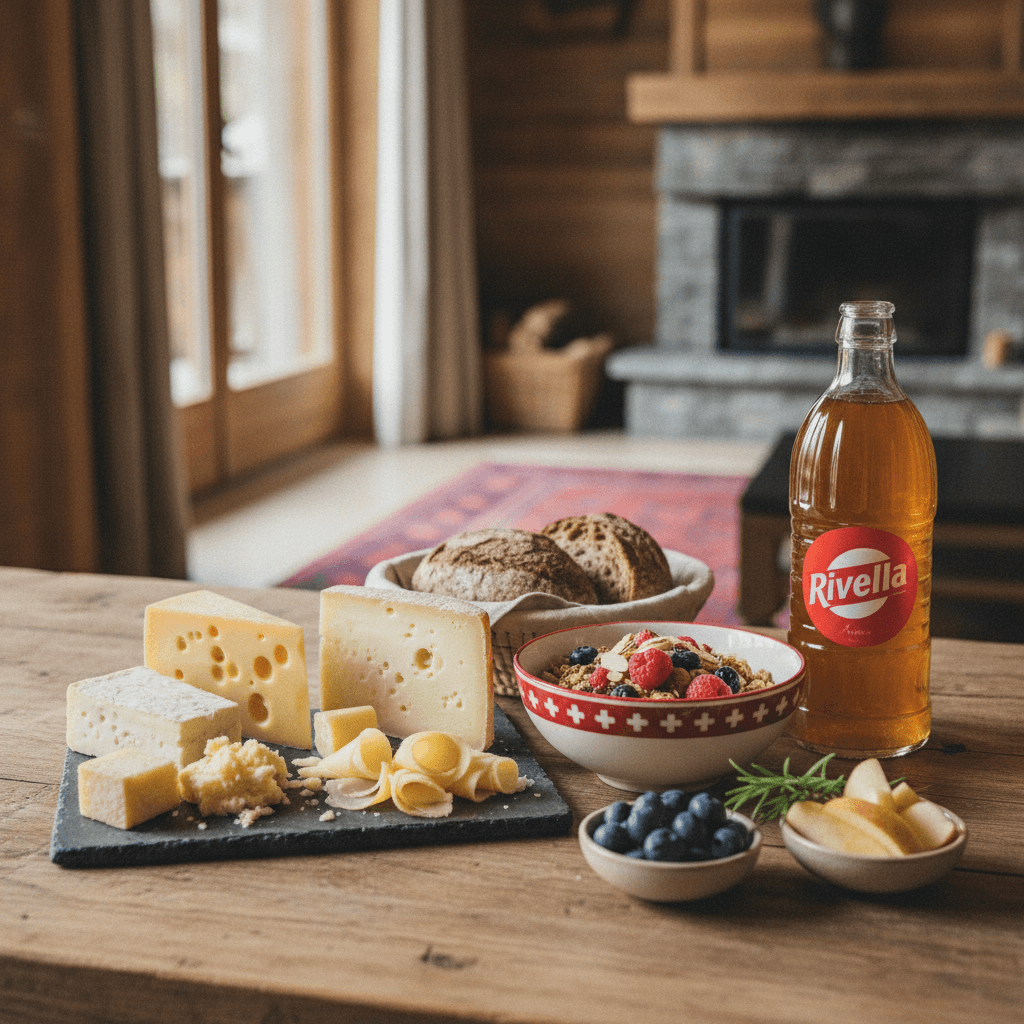
What does "Swiss cheese" actually mean?
There is no product called "Swiss cheese" in Switzerland. Anyone using this term is most likely referring to Emmentaler — that yellow, hole-riddled cheese known simply as "Swiss cheese" in many countries around the world.
In Switzerland, however, Emmentaler is just one of several hundred local cheeses. The most well-known include:
Cheese name | Characteristics | Canton / region of origin |
|---|---|---|
Emmentaler | Holey, mildly nutty flavour, semi-hard | Canton of Bern, Emmental valley |
Gruyère (Greyerzer) | Firm, slightly salty, aged | Canton of Fribourg |
Appenzeller | Strong, spicy, herbal | Canton of Appenzell |
Raclette | Served melted, mildly salty | Canton of Wallis (Valais) |
Sbrinz | Hard, also used grated | Central Switzerland |
If you go to a shop in Switzerland and ask for 'Swiss cheese,' the shopkeeper won't know what you mean. It's worth learning the specific name — that's the first step to finding your way around a Swiss grocery store.
Is Swiss cuisine really bland?
This is one of the most widespread misconceptions — and Cenovis alone disproves it.
Cenovis is a dark brown, thick yeast extract paste developed in 1931 by a brewery in the canton of Aargau: it was made from the yeast used in beer fermentation and is exceptionally rich in vitamin B1. The flavour is intensely salty with a slightly bitter edge — similar to the English Marmite or Australian Vegemite. On its own it is almost unbearably strong; it is eaten spread on bread with a thick layer of butter.
Cenovis has been part of Swiss military rations since 1955 — which shows that it was not some exotic delicacy but an everyday food.
Swiss cuisine is indeed more understated than Mediterranean cooking, but calling it 'bland' is inaccurate. It is better described as regionally diverse, ingredient-focused, and not heavily spiced. Raclette from the canton of Valais, the dried meat specialities of the canton of Graubünden (Bündnerfleisch), and Appenzeller cheese all represent bold, distinctive flavour profiles.
Is Swiss produce better than imported?
This is one of the most debated questions in everyday Swiss life. Many people swear by the 'Schweizer Qualität' (Swiss quality) label and are willing to pay a premium for locally produced goods. Others regularly cross the border — into France, Italy, or Germany — to shop at lower prices.
An important fact: in Switzerland, food prices can be 60–80% higher than the EU average, depending on the product and the canton. This is not a myth but a documented reality, confirmed by the Federal Statistical Office (Bundesamt für Statistik, BFS).
Is Swiss produce genuinely better? There is no scientific consensus on this. Swiss agricultural regulations are indeed stricter than the EU average in certain areas (e.g. antibiotic use, animal welfare standards), but that does not automatically mean every Swiss product tastes better. Ultimately, it is a matter of personal taste and values — but the fact of higher prices is not.
'Swiss Miss' is not Swiss — and other brand misconceptions
The well-known American hot cocoa mix 'Swiss Miss' is, despite its name, not a Swiss invention. It was developed in the United States in the 1950s by a Sicilian immigrant and was initially served only on airline flights. In Switzerland, it is virtually unknown.
This is a good example of a broader phenomenon: many 'Swiss' brand names or products are in reality foreign inventions made appealing through their Swiss associations in marketing. When moving to Switzerland, it is worth keeping this in mind — what you knew as 'Swiss' back home may be completely unrecognisable here.
What did the Swiss actually invent?
The list of Swiss gastronomic inventions is surprisingly long — and includes products recognised around the world.
Muesli (Birchermüesli): Developed around 1900 by Swiss physician Maximilian Bircher-Benner, originally for medicinal purposes. This breakfast dish made from oats, grains, nuts, seeds, and fruit is now enjoyed all over the world.
Instant coffee: Developed by Swiss company Nestlé in the late 1930s under the Nescafé brand. Since its commercial launch in 1938, it has become one of the most widespread forms of coffee in the world.
Cenovis: See above — a 1931 invention from Aargau, still produced to this day.
Aromat: A seasoning salt blend marketed by Knorr, found in virtually every Swiss household. Most commonly sprinkled on boiled eggs, but also used in soups and salads. Anyone moving to Switzerland will sooner or later come across it.
Chocolate: Although cocoa itself is not a Swiss invention, milk chocolate (Milchschokolade) and the conching process (the smoothing of chocolate) are Swiss developments. The 19th-century breakthroughs are credited to Daniel Peter and Rodolphe Lindt.
What is Rivella — and what makes it special?
Rivella is one of Switzerland's best-known soft drinks, produced since 1952. Its key ingredient is whey (Molke), and it has a mild, slightly sweet, hard-to-place flavour. It comes in four varieties: original (red), light (blue), green tea (green), and mango-aloe vera (yellow).
Outside Switzerland it is virtually unknown — exports are minimal. Among the Swiss, however, it carries a strong sense of nostalgia: many consider it the taste of their childhood.
From a Hungarian perspective: if you try it for the first time, the flavour may seem unusual. It's worth approaching it with an open mind — not every Swiss classic wins you over on the first sip.
Strange-sounding but actually delicious Swiss dishes
In Swiss cuisine, several dishes have names or ingredients that can seem off-putting at first. They are well worth trying nonetheless.
Cholera: Not the disease — but a savoury pie from the canton of Valais, developed during the 19th-century cholera epidemic, when people were unable to go to the market for fresh ingredients. It contains potatoes, onions, leeks, cheese, and apple, baked in a shortcrust pastry. A hearty, flavourful dish.
Älplermagronen: Swiss "alpine macaroni" — a combination of pasta, potato, cheese, onion, and cream, traditionally served with apple sauce. The sweet-and-savoury combination may seem unusual to Hungarians, but in Switzerland this dish is considered the ultimate comfort food.
Zürcher Geschnetzeltes: A creamy veal ragout with mushrooms, served with rösti. One of Zürich's most iconic dishes — and one that quickly wins over newcomers from abroad.
What should you know about Swiss food culture before moving?
Swiss eating habits differ from Hungarian ones in several ways — it's worth knowing these in advance so you're not caught off guard.
Meal times: Lunch in Switzerland is typically between 12:00 and 13:30, and dinner is eaten early, around 18:30–19:30. Late-night dining (after 21:00) is not common practice.
Canteen and workplace: The quality of workplace canteens (Kantine / Mensa) in Switzerland is generally good, and lunch break culture is well established. Most people don't bring food from home.
Regional differences: The cuisine of German-speaking Switzerland (Deutschschweiz), the French-speaking part (Romandie), and the Italian-speaking canton of Ticino differs considerably. French culinary influence is strong in Romandie, while Ticino leans Italian.
Price and quality: Swiss restaurants are expensive — a simple lunch in Zürich or Geneva typically costs around CHF 20–35. Supermarket own-brand products at Migros and Coop offer good value for money.
Availability of Hungarian food: In larger cities (Zürich, Bern, Geneva, Basel) you can find shops selling Hungarian groceries or order them online. Paprika, lecsó, kolbász, and other staples are available, but pricier than in Hungary.
Sources
The Local Switzerland: "Six common myths about Swiss food you need to stop believing" – https://www.thelocal.ch/20210326/six-common-myths-about-swiss-food-you-need-to-stop-believing
Cenovis AG official website – cenovis.ch
Bundesamt für Statistik (BFS) – Swiss food price statistics – bfs.admin.ch
Schweizer Käse / Switzerland Cheese Marketing – swisscheese.ch
Rivella AG – rivella.ch
Nestlé historical archive – nestle.com/aboutus/history
Related Articles
In Brief
There are many misconceptions about Swiss gastronomy — from identifying every holey cheese as "Swiss cheese" to claims that Swiss food is bland, to the origins of "Swiss Miss." Switzerland may not be France or Italy, but it has its own well-defined food culture, and getting to know it makes everyday life easier — whether you've just arrived or have been living here for a while. ---
Key Takeaways
- There is no product called "Swiss cheese" in Switzerland — Emmentaler (*Emmentaler*) is the correct name for the holey cheese.
- Swiss cuisine is not bland — it is restrained and regionally varied. Cenovis, Appenzeller cheese, and Bündnerfleisch all deliver bold, distinctive flavours.
- "Swiss Miss" cocoa powder is not a Swiss invention; muesli, instant coffee, and Aromat, however, are.
- Rivella is made from whey (*Molke*) and is virtually unknown outside Switzerland — the taste may be unusual, but it's worth trying.
- Swiss food prices are significantly higher than the EU average; many people cross the border to do their grocery shopping.
- Swiss food culture varies by region: the Romandie shows French influence, Ticino shows Italian influence, and Deutschschweiz follows its own traditions.
Frequently Asked Questions
What is Emmentaler, and why is it called "Swiss cheese" in so many places?
Emmentaler (*Emmentaler AOP*) is a semi-hard cheese from the Emmental valley in the canton of Bern, known for its characteristic large holes. Abroad — especially in the United States — any holey cheese tends to be called "Swiss cheese," but this term simply does not exist in Switzerland. Emmentaler is one of the most widely exported Swiss cheeses, which is how the misconception spread.
What is Cenovis, and how is it eaten?
Cenovis is a dark brown, thick yeast extract paste developed in 1931 by a brewery in Aargau. Its flavour is intensely salty with a slightly bitter edge. It is eaten spread on bread with a generous layer of butter — on its own it is far too strong. It is comparable to the British Marmite and the Australian Vegemite.
Is Swiss food really more expensive than imported food?
Yes — Swiss agricultural products are generally more expensive than imported ones, partly due to stricter production standards and partly due to higher labour and operating costs. Whether they taste better has not been scientifically proven; that is a matter of personal taste and values.
Where can you buy Hungarian food in Switzerland?
In larger cities — Zürich, Bern, Genève, Basel — there are shops selling Central and Eastern European groceries that also stock Hungarian products. Online ordering is also an option. Prices tend to be higher than in Hungary.
What is Rivella, and why is it unknown abroad?
Rivella is a Swiss soft drink that has been produced since 1952, made from whey (*Molke*). It has a mild, sweet, slightly tangy flavour. Its export is minimal and it is virtually unknown outside Switzerland. In Switzerland it carries strong nostalgic associations and comes in four varieties.
What is Cholera, and why is it called that?
Cholera is a savoury pie from the canton of Valais (*Kanton Wallis*), developed during the cholera epidemic of the 19th century — at the time, people could not go to market for fresh ingredients, so they baked a pie from storecupboard staples (potatoes, onions, cheese, apples). Despite its name, it is a tasty and filling dish.
How does Swiss food culture differ from Hungarian food culture?
The key differences are: mealtimes are earlier (dinner is typically around 18:30–19:30), restaurants are more expensive (a simple lunch costs 20–35 CHF), and food culture is strongly regional — the Romandie shows French influence, Ticino shows Italian influence. Swiss cuisine uses more restrained seasoning but places great emphasis on the quality of its ingredients.
Did the Swiss really invent instant coffee?
Yes — Nestlé, a Swiss company, developed Nescafé instant coffee, which was launched commercially in 1938. Muesli (*Birchermüsli*) was also created by a Swiss physician, Maximilian Bircher-Benner, around 1900. ---
