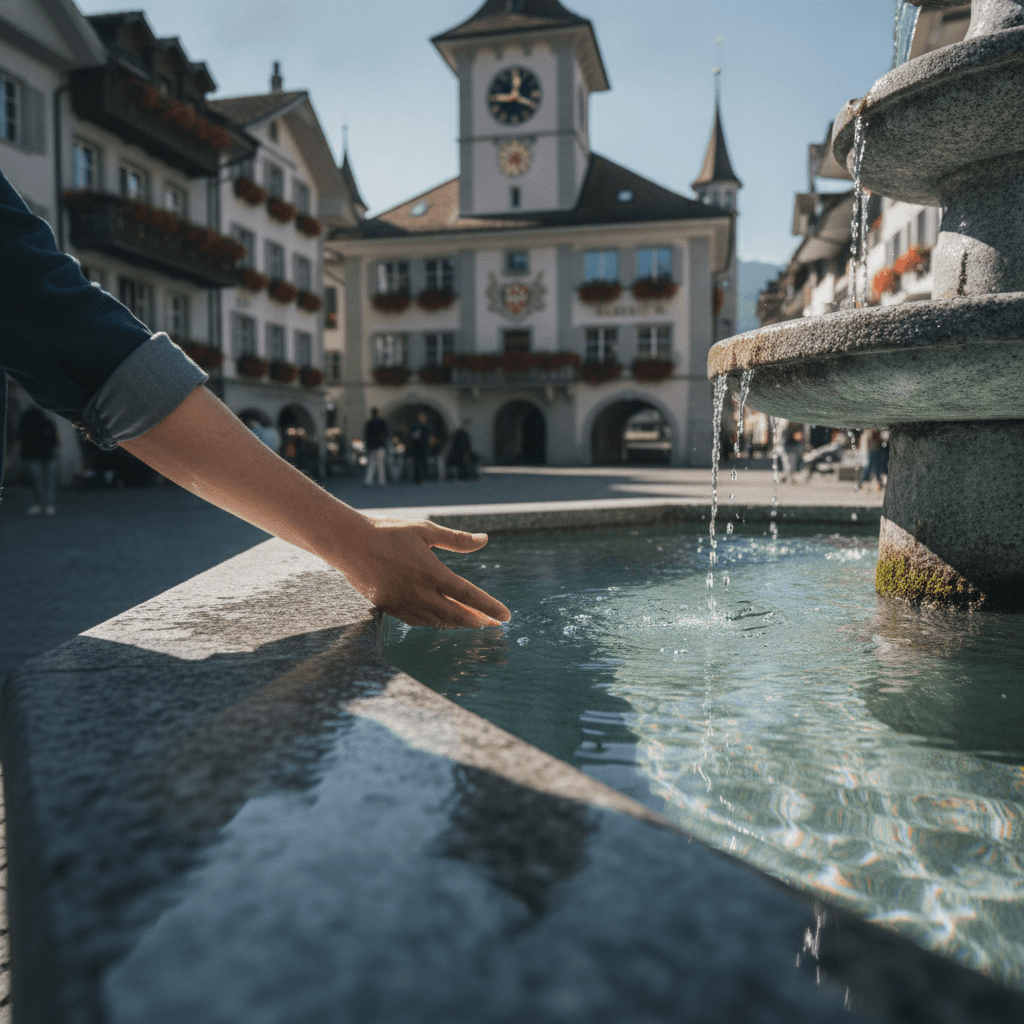
Why does this topic keep coming up in Switzerland?
Summers in Switzerland are getting increasingly intense. MeteoSchweiz (the Federal Office of Meteorology and Climatology) regularly issues level 3 or level 4 heat warnings — the latter being the highest on the national scale. At times like these, the nearest lake, river, or swimming pool can feel far away for city dwellers, while a fountain is right around the corner.
Cooling off in fountains is nothing new in Switzerland. In many cities, it's a tradition spanning decades — even generations. That said, the rules — as with so many things in Switzerland — vary by canton and city. Anyone unaware of the local regulations can easily find themselves in an awkward situation.
In which Swiss cities is it allowed to swim in fountains?
Below is a city-by-city summary of the rules currently in place. The source material is based on 2023 reporting by the Swiss daily Blick and Switzerland Tourism — it's worth checking with local authorities for the most up-to-date regulations, as rules may have changed in the meantime.
Winterthur — where fountain bathing is a local tradition
Winterthur (roughly 25 km northeast of Zürich) is the only major Swiss city without its own lake or significant river nearby. For decades, locals have made up for this by using the fountains in the city centre.
On hot days, the fountains along Steinberggasse become true gathering spots: locals sit on the fountain's edge, dangle their feet in the water, or submerge themselves completely. Bathing here is not merely permitted — the city and Switzerland Tourism actively promote it as a summer attraction.
Those looking to avoid the crowds can find a fountain in the Veltheim district, where the atmosphere tends to be quieter. One practical note: the city centre fountains are located in public spaces in plain sight, so you'll need a discreet corner for changing.
Aarau — 80 fountains, all open for cooling off
Aarau (the cantonal capital of Aargau) has nearly 80 fountains, and according to the city administration, cooling off in all of them is permitted. Full submersion is generally not possible given their size, but soaking your feet or splashing water on yourself is entirely acceptable.
The head of the civil engineering office at the mayor's office recommends the fountains on Rathausgasse and Metzgergasse in the old town. You can also wade into the small stream that runs through the city — a particularly pleasant alternative on hot days.
Bern — the Bundesplatz fountains are designed exactly for this
In the Swiss capital, the fountain system on Bundesplatz in front of the Bundeshaus (the federal parliament) is designed with the public in mind: water jets shoot up from the ground, and people are free to run or jump through them. Children especially love it. This is more of an interactive water feature than a traditional fountain — and that's precisely what it was designed for.
The rules are less clear-cut at the city's other fountains; Bundesplatz is the obvious, recommended spot.
St. Gallen — permitted, but with caution
In St. Gallen, wading and foot-soaking in fountains is allowed. However, the city urges visitors — especially those with children — to exercise care: the stone edges can be slippery, and water pressure and depth vary from fountain to fountain.
Recommended spot: the fountain at Roter Platz (Red Square) in the Bleichi district.
Zürich — permitted, but not encouraged
In Zürich, bathing in public fountains is generally permitted, but the city authorities do not actively encourage it. The reason is practical: some fountains feature decorative stucco elements and carved stone figures that can be damaged when climbed on.
The city council expects fountains to be treated with respect. In practice, this means: soaking your feet, scooping up water — fine. Climbing onto the fountain's edge or leaning on decorative elements — not recommended.
Basel — permitted, but avoid it at night
In Basel, bathing in public fountains is also permitted, but the city operations authority does not encourage it. In the past, repeated noise complaints were received due to people bathing at night — so it is especially advisable to refrain during evening and nighttime hours.
An important restriction: dogs are not allowed in the fountains — their fur can clog the filters and drains. This applies to all of Basel's public fountains.
At some fountains, bathing is completely prohibited because the basin contains moving mechanical elements that could cause injury. The Zschokke fountain (Zschokke-Brunnen) near the Wettstein bridge is a good choice — but only during the day.
Where is bathing in fountains prohibited?
Lucerne — prohibition on heritage protection grounds
In Lucerne, bathing in public fountains is prohibited. The reason is not aesthetic, but legal and heritage-related: the city's fountains are protected historical cultural assets (historische Kulturgüter). The distinctive figurative decorative columns (Brunnensäulen) can be damaged by climbing or impact, and their restoration is extremely costly.
The Lucerne road inspection authority (Strasseninspektorat) is unequivocal: the basins were not designed for bathing. In hot weather, the authorities recommend the shores of the Vierwaldstättersee (Lake Lucerne) as an alternative — which is indeed easily accessible from the city centre.
Summary table: fountain bathing by city
City | Bathing permitted? | Notes |
|---|---|---|
Winterthur | ✅ Yes, a tradition | Steinberggasse, Veltheim district |
Aarau | ✅ Yes | Rathausgasse, Metzgergasse; size is a limiting factor |
Bern | ✅ Yes (Bundesplatz) | Purpose-built water play feature |
St. Gallen | ✅ Yes, with caution | Extra care needed with children |
Zürich | ⚠️ Permitted, not encouraged | Do not touch decorative elements |
Basel | ⚠️ Permitted, not encouraged | Avoid at night; dogs not allowed |
Luzern | ❌ Prohibited | Protected monument — entry forbidden |
What should you keep in mind when cooling off at a fountain?
A few practical points that apply generally, regardless of the city:
Check the local rules. The list above is based on 2023 source material. Rules may change — if in doubt, contact your local city operations office (Stadtwerke, Tiefbauamt) or check the city's official website.
Do not climb on decorative elements. Carved stone figures, columns, and stucco ornaments are fragile. This is not just a cultural expectation — deliberate damage is a punishable offence.
Do not let dogs into the fountain. This is an explicit rule in Basel, but it makes sense in other cities too: fur clogs the filters.
Avoid fountains at night. Noise complaints are a recurring issue — late-night bathing can cause conflict with residents in several cities.
Do not expect a changing area. Public fountains in city centres rarely have changing facilities. Wear clothes you don't mind getting wet, or find a discreet spot to change.
The water is not always drinking-water quality. In Switzerland, many fountains do provide genuine drinking water (Trinkwasser) — but not all of them. If you don't see the sign, don't drink the water.
Why is this worth knowing for Hungarians living in Switzerland?
In Hungary, bathing in fountains is generally prohibited and unusual. In Switzerland — at least in certain cities — it is accepted and even a culturally embedded tradition. Those who are unaware of this may easily find themselves unnecessarily avoiding it, or conversely, attempting it somewhere it is forbidden.
For Hungarians who have recently arrived in Switzerland, this is a small but telling example of the fact that in many areas of Swiss public life, rules differ from city to city — and even from district to district. What is permitted in Zürich may be forbidden in Luzern. What is a tradition in Winterthur may cause conflict at night in Basel. This decentralised logic — the everyday manifestation of Swiss federalism (Föderalismus) — recurs in virtually every area of life: from taxation to school regulations to public space rules.
Sources
Switzerland Tourism official website: switzerland.com
The Local Switzerland: "Where is bathing in fountains allowed in Switzerland?" (19 July 2023) — thelocal.ch
MeteoSchweiz (Federal Office of Meteorology and Climatology): meteoschweiz.admin.ch
City of Winterthur official website: winterthur.ch
City of Lucerne official website (Strasseninspektorat): stadtluzern.ch
Related Articles
In Brief
Swimming in public fountains is not uniformly regulated across Switzerland — rules differ from city to city, and even from fountain to fountain. In Winterthur and Aarau it has a long tradition and is explicitly permitted. In Bern and St. Gallen it is also allowed, but subject to certain conditions. In Zürich and Basel it is permitted but not actively encouraged. In Luzern it is prohibited, for heritage-protection reasons. ---
Key Takeaways
- Swimming in public fountains is not uniformly regulated in Switzerland — rules differ from city to city, and even from fountain to fountain.
- Winterthur and Aarau are clear green zones: fountain bathing is a tradition and is actively supported by local authorities.
- In Luzern, the ban has a legal basis in heritage protection — there is no room for discretion.
- Taking a dog into a fountain is inadvisable anywhere; late-night bathing is problematic in several cities.
- Due to Swiss federalism, it is always worth checking local rules rather than relying on national generalisations.
- This topic is a good illustration of the fact that norms for behaviour in public spaces can vary significantly from city to city in Switzerland — something worth knowing for Hungarians arriving in the country.
Frequently Asked Questions
Is it allowed to swim in fountains in Zürich?
Swimming in public fountains is permitted in Zürich, but the city authorities do not actively encourage it. Climbing on or damaging decorative elements and carved stone surfaces is prohibited. Paddling and cooling off with the water is generally accepted.
Why is swimming in fountains prohibited in Luzern?
Luzern's fountains are protected historical cultural assets. The distinctive figural decorative columns (*Brunnensäulen*) are fragile, and the city's street inspectorate (*Strasseninspektorat*) explicitly prohibits bathing. The shores of Lake Luzern are recommended as an alternative.
Which Swiss city has the most widespread culture of fountain bathing?
Winterthur is the prime example: the city has no lake or large river, so its city-centre fountains — especially on Steinberggasse — become genuine community cooling spots in summer. Switzerland Tourism also highlights this city in its summer campaigns.
Is it permitted to bring a dog into a fountain?
In Basel there is an explicit rule against it — a dog's fur clogs the filters and drains. In other cities there is not always a written rule, but it is generally not recommended.
How can I find out whether swimming is allowed at a particular fountain?
The most reliable method is to check the website of the local city engineering office (*Tiefbauamt*, *Stadtwerke*) or to read any signs posted on site. If there is no sign and you cannot find any information, follow local rules — and if in doubt, it is better to refrain.
Is the water in Swiss fountains drinking-water quality?
Many Swiss fountains do indeed supply drinking-water quality (*Trinkwasser*) water — this is a general characteristic of Switzerland and is well known among tourists. However, this is not true of every fountain, so if you do not see a sign indicating it, do not drink the water.
What should I do if I am unsure about the local rules?
Ask the local city engineering office, or look it up on the city's official website. As a general guideline: where there is no sign and no local tradition, it is better to refrain from bathing — especially at night and at fountains with decorative elements. ---
