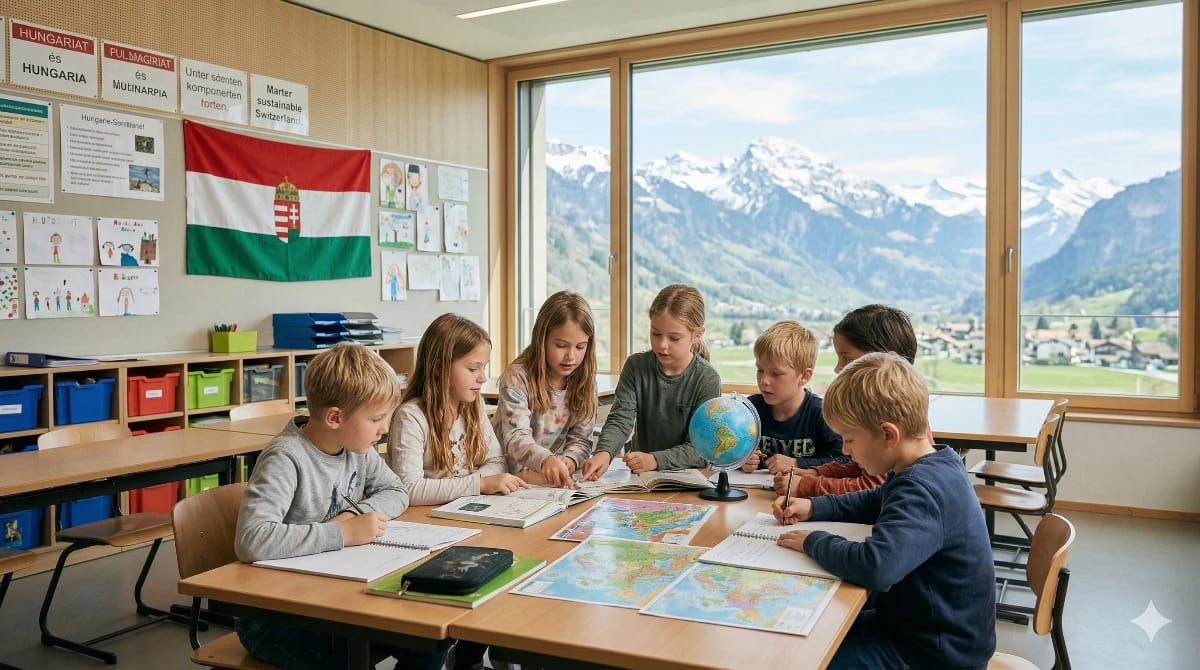
Living in Switzerland is a wonderful opportunity – but if you have children, sooner or later the question arises: how do we keep Hungarian alive? Swiss schools absorb children quickly: within a few years they speak German, French, or English fluently, while Hungarian gradually fades into the background. The good news is that you don't have to choose: Hungarian weekend schools operate throughout Switzerland, offering a solution to exactly this challenge. In this article, we've gathered the most important information – from cities to tuition fees, from enrollment to language exams.
Key Information
- Hungarian weekend schools operate in at least 5–6 Swiss cities: Zurich, Bern, Geneva, Basel, and Lausanne.
- Classes take place on Saturdays or Sundays, so they don't conflict with the Swiss school schedule.
- Most schools accept children aged 4–18, placed in groups based on their actual level of Hungarian.
- Monthly tuition ranges from CHF 50–150; many schools operate on a voluntary or church basis.
- The Kőrösi Csoma Sándor Program can support schools with teaching materials, teacher training, and direct financial assistance.
Where Do Hungarian Weekend Schools Operate in Switzerland?
The Hungarian community in several major Swiss cities is strong enough to maintain its own weekend school. Below we've compiled the most well-known locations – but it's worth checking local Facebook groups and the Hungarian Embassy's website, as smaller cities may also have groups starting up.
Zurich: The city with the largest Hungarian community, where several organizations offer Hungarian education. The Zurich Hungarian School is one of the best-organized institutions, with regular Saturday classes.
Bern: In the capital, the local Hungarian association coordinates the weekend sessions, which are generally held on Sunday mornings.
Geneva: Home to the largest Hungarian community in French-speaking Switzerland. The school here is especially useful for children who attend Swiss school in French but want to maintain their Hungarian at home.
Basel: The Hungarian community is also active in this three-border city; the weekend school operates in smaller groups in a friendly atmosphere.
Lausanne: For Hungarians living on the shores of Lake Geneva, weekend education is also available in Lausanne, organized by local volunteers.
If your city isn't on the list, don't give up. More informal groups are forming in Lucerne, Winterthur, and other mid-sized cities – often all it takes is a Facebook search or a local Hungarian community group.
What Ages Do They Accept, and How Are Classes Organized?
Most Hungarian weekend schools accept children from age 4 to 18, from preschool age all the way through to secondary school graduation. Classes are generally organized by age group – not necessarily according to Swiss school year levels, but based on the child's actual level of Hungarian.
For younger children (ages 4–7), the focus is on playful language learning, fairy tales, songs, and traditions. Older children learn reading, writing, and composition, while teenagers may also receive literature, spelling, and even exam preparation. Classes typically last 2–3 hours per week, which is just enough to maintain a connection with the language without overburdening the child.
How Much Does Hungarian School Cost in Switzerland, and Is There Financial Support?
Tuition fees vary by school and organization, but generally range between CHF 50–150 per month. Where there is a church background or a strong volunteer base, you may find lower fees. Some schools offer a sibling discount – if two of your children attend the same school, it's worth asking about it.
As for financial support: the Hungarian state regularly provides assistance to Hungarian education abroad through the Kőrösi Csoma Sándor Program, including Swiss schools. This takes the form of teaching materials, teacher training, and sometimes direct financial support. It's worth asking the school's coordinator about current opportunities – the situation can change from year to year.
How Do You Enroll, and What Should You Know About the First Day?
The enrollment process is generally simple and welcoming – these are not bureaucratic institutions, but community initiatives. Here are the typical steps:
Find the school operating in your city – the Hungarian Embassy in Bern maintains a list, but local Hungarian Facebook groups are also reliable sources.
Contact the school coordinator by email or phone – administration is usually handled by a team of parents.
Fill out the enrollment form – typically you'll need the child's name, age, Swiss school year level, and a parent's contact details.
Arrange the tuition payment method – most schools require payment monthly or per semester.
Attend a trial lesson – almost every school allows the child to come along first just to see how things work.
On the first day, it's a good idea to arrive early so the child can get to know the teacher and the other children before the lesson begins. The atmosphere is generally relaxed and welcoming – parents are happy to stay for a while, and in many places this doubles as a kind of community gathering.
Is There an Opportunity to Take a Hungarian Language Exam or School-Leaving Exam in Switzerland?
This is an important question, especially for families who may return to Hungary or would like their child to be able to officially certify their Hungarian language skills.
The Hungarian state school-leaving exam can be obtained through the Hungarian consular representation, or in some cases by sitting the exam in Hungary. Some weekend schools specifically prepare students for this, aligning their curriculum with the Hungarian national framework. Hungarian language exams (ECL, ORIGO) can also primarily be taken in Hungary, but Swiss schools provide preparation for them.
If this is an important consideration for you, ask about it at the time of enrollment: not every school offers exam preparation, but where they do, it carries real value.
How Can Hungarian School Be Balanced with the Swiss Schedule?
This is one of the most frequently raised concerns – and completely understandable. Swiss school on its own is already a significant workload, alongside extracurricular activities, sports, and other commitments. The good news is that Hungarian weekend schools are designed precisely with this problem in mind.
Classes take place on Saturdays or Sundays, typically in the morning or early afternoon, leaving the rest of the week completely free. During Swiss school holidays, the Hungarian school also takes a break – the calendars are generally aligned. Many parents find that children quickly get used to the rhythm, and the weekend Hungarian lesson becomes more of a social experience than an obligation.
What Do Parents Say? Real-Life Experiences
Parents who have been sending their children to Hungarian weekend school for years generally speak very positively about it – and not just because of the language skills. The Hungarian school serves another function: it builds community. Children find friends they can speak Hungarian with outside of school too, which creates a wealth of natural language practice opportunities.
Some tried-and-tested advice from experienced parents:
The earlier you start, the easier it is – children enrolled at preschool age maintain bilingualism far more naturally.
It's worth speaking Hungarian at home too – weekend school alone isn't enough if the language isn't heard during the week.
Take part in community events – many schools organize celebrations, excursions, and cultural programs that strengthen a sense of belonging.
Be patient at the beginning – some children are hesitant at first